
The De Neufville Family in Artois, France
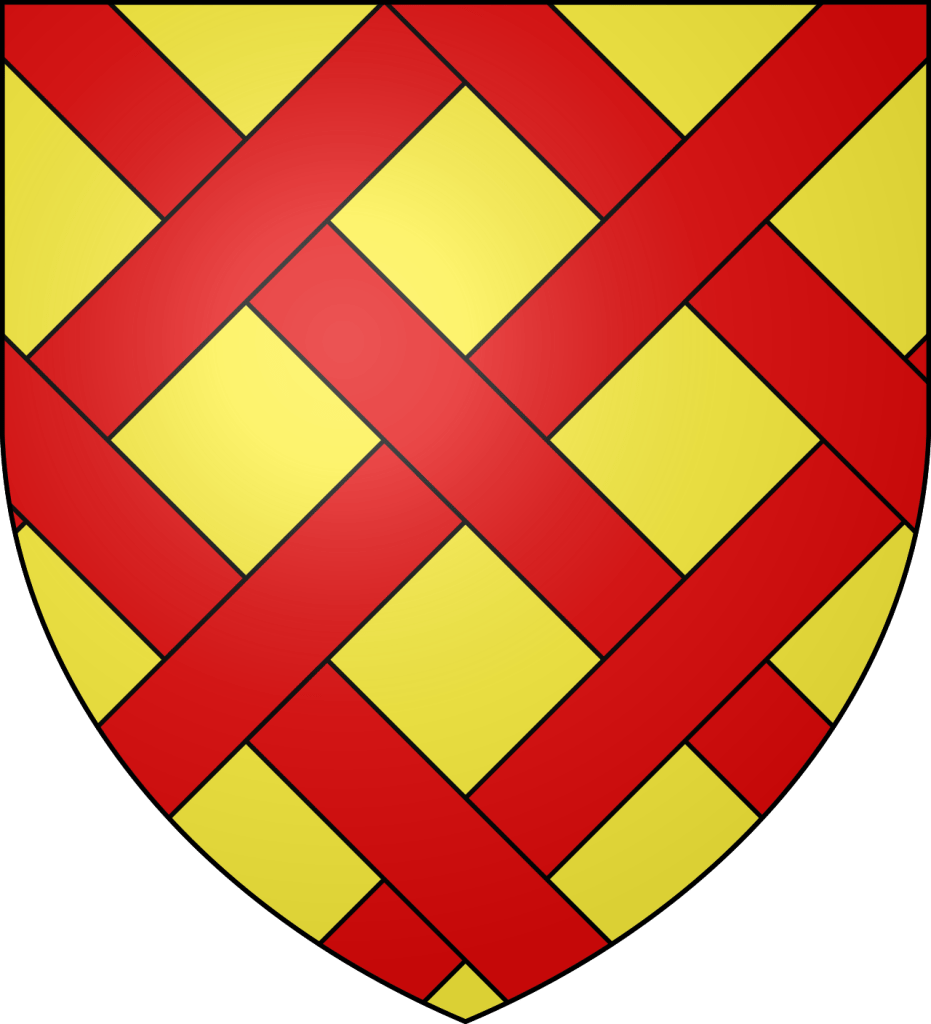
The de Neufville shield
“Blason, Neuville-Vitasse”
To give some family context to this section on the de Neufville’s, I’ll begin with Adam Eduard (known as Edward) Lejeune who came to Manchester from Frankfurt as a young man. His father was Johann (Gustav) Adam Lejeune (known as Gustav) and his mother was Franziska Eleonore de Neufville.
Many decades ago, my father David Lejeune, gave me some typed family notes, compiled by his Uncle, Rev Alec (Alexander) Lejeune that contained a reference to a de Neufville family tree going back to the middle-ages.
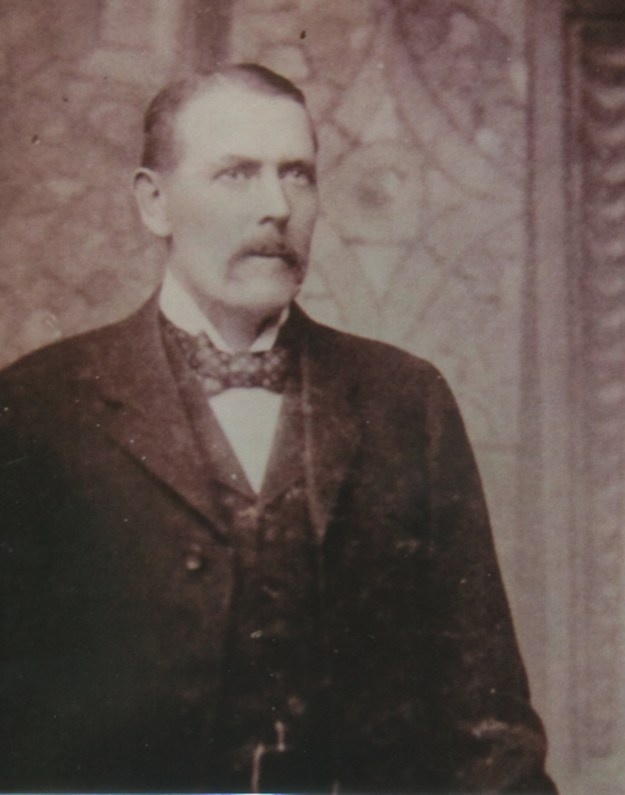
Adam Eduard Lejeune (known as Edward) who emigrated to Manchester from Frankfurt am Main
The House of de Neufville
Imagine my excitement when decades after first seeing Uncle Alec’s yellowing notes I discovered an online story about a man called Robert de Neufville. Could this man be related to us? In the references I found a link to a digitalised book, in German in 1897, called the Houses of de Neufville. In this book was a family tree from the 1550s.
The tree started with Robert de Neufville and Jeanne le Fer and their children and followed the male line of descendants until it eventually came to the 1800’s and our ancestor Franziska de Neufville and her husband Gustav Lejeune. Bingo! This was genealogical gold lotto and the very book that Uncle Alec had referred to! Since that first piece of evidence, I’ve found other de Neufville documents and the links to some of these will be available at the end of this page for further reading.
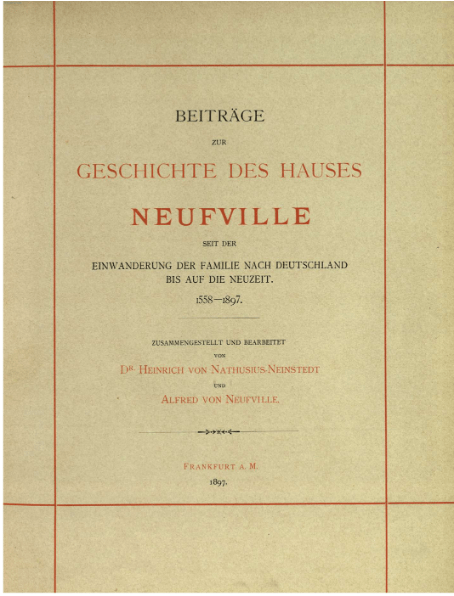
The Houses of de Neufville, the family in Germany between 1558-1897
Written by Dr Heinrich von Nathusius Neinstedt and Alfred von Neufville, published in 1897
The Early de Neufvilles
According to references, the House of de Neufville descends from the oldest French nobility. They are described either as an ancient knightly family or as lower nobility and were established in the Artois area of north-west France (now known as the Hauts-de-France region) near Arras, with possessions noted in Neufville, Cauroy, and Alennes.
The village of Neuville-Vitasse has been connected to the de Neufvilles since 1047. Neuville (novilla in latin or new town in English) and Vitasse or Sir Wistace comes from the names of the lords of Neuville from the 11th century onwards. First born males were named either Wistachius (or Eustache) and the earliest documented ancestor is Eustache de Neufville, recorded in 1047. Traditionally the given name Eustache was passed to the eldest son.
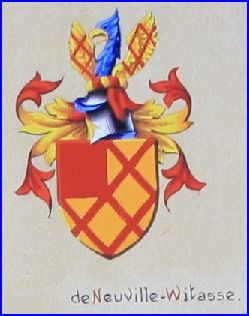
The de Neufville coat of arms is preserved in the arms of the village of Neuville-Witasse
Heraldry: The historical coat of arms features “d’or & de gueules,” accompanied by the cri de guerre “Neufville! Neufville!” and the motto Ne vile velis.
Male members of the family distinguished themselves in tournaments, wars, and Crusades and women marrying into the family came from the leading houses of the County of Artois, some of princely origin.
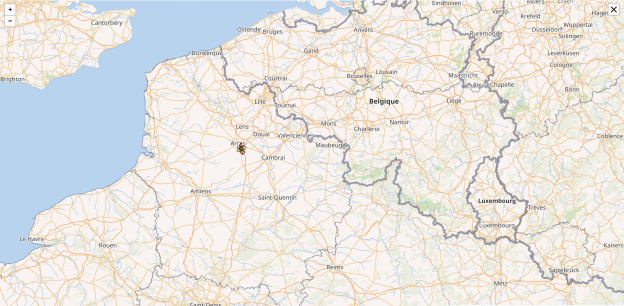
The above map shows where the village of Neuville-Vitasse is in the current Hauts-de-France region near Arras. Other branches of our family were also established in this north-west region of France e.g. the du Fay’s and D’Orville’s in Valenciennes and the de Bary’s in Tournai, now Belgium.
The Battle of Agincourt and Jeanne XII, Dame de Neufville (1368-1415).
A significant event in de Neufville history was the battle of Agincourt. This was an English victory in the Hundred Years War which took place on the 25th October 1415 near Azincourt, in northern France.
The French suffered a catastrophic defeat. In all, around 6,000 of their fighting men were killed. The list of casualties, one historian noted, “read like a roll call of the military and political leaders of the past generation”. Entire noble families were wiped out in the male line, and in some regions an entire generation of landed nobility was annihilated.
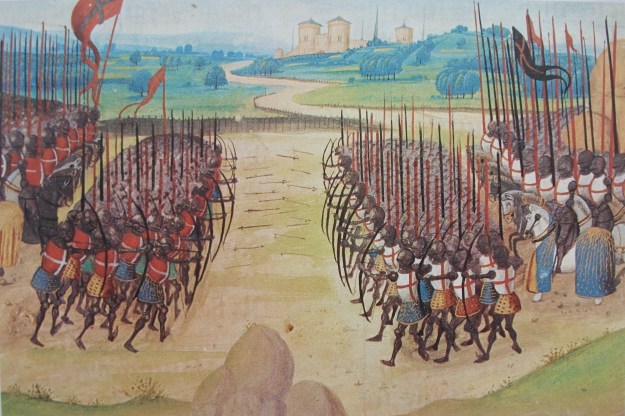
Left: From the The Battle of Agincourt, 15th-century miniature, by the French chronicler Enguerrand de Monstrelet
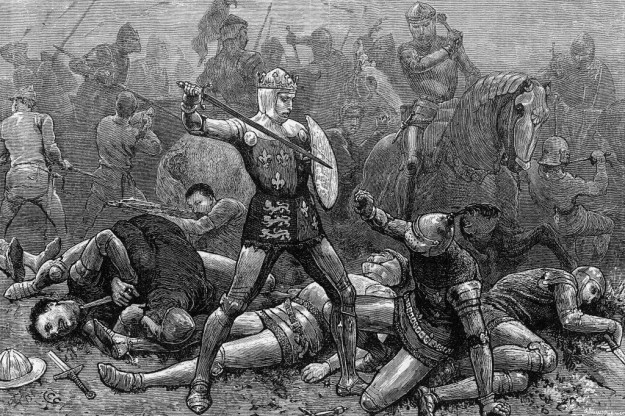
This annihilation at the Battle of Agincourt included the last male representatives of the House of de Neufville of whom Hugues, Lord of Neufville, was the then head of the family. With no males to inherit the title Hugue’s sister (and our ancestor) Jeanne, became Jeanne XII, Dame de Neufville (1368-1415).
Her husband, Robert d’Ocoche agreed to his children taking the name and coat of arms of de Neufville so the title could continue.
Robert de Neufville and the Reformed Protestant Religion
We now skip forward several generations to Robert de Neufville (who was mentioned earlier), son of Jean de Neufville known as Mensart. Robert was a possible Governor of Arras and our first known ancestor to convert to the Reformed Protestant Religion (RPR) and to flee France due to religious persecution. The first Edict of Fontainebleau was issued on June 1, 1540, by King Francis I. It declared Protestantism to be “high treason against God and mankind,” sparking severe persecution of Huguenots throughout France. It was the first of many edicts that sanctioned persecution of the Huguenots and it is likely that this turn of events resulted in a number of branches our family, including the de Neufville’s to leave France.
Records show Robert was in exile in Antwerp in 1554 with his wife Jeanne le Fer and family where he was probably operating as a silk merchant. That year, Robert and Jeanne’s 12th child (and our ancestor) Sebastian was born. Robert and Jeanne were to go on to have a total of 20 children.
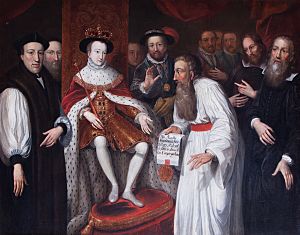
1550, Edward VII grants permission to John a Lasco to establish a refugee church in London which became known as the Strangers Church
John a Lasco and his Followers in England
Robert de Neufville was a follower of John a Lasco, a Polish Baron and preacher. In 1550, the English Monarch, King Edward VI, sensing the intensification of Catholic persecution on the continent and with the support of Jean Calvin, granted theologians, including a Lasco, and his follower’s freedom of worship in the City of London.
Robert de Neufville, his family and other foreign exiles flocked to England from France, Wallonia, the Netherlands as well as Italian and Spanish speaking communities. The accession of Edward VI brought a period of great hope for Protestants and the exiles were welcomed by the English as they arrived with little or nothing except their skills.
J. A. Froude wrote: “The honorable humanity with which they were received, sheltered and sustained must be counted among the not too many virtues of Edward’s ministers .”
The influx of foreigners had created a need for religious services in their own languages and led to the establishment of the Strangers Church in London. Robert de Neufville and his family found safety in the Refugee or Stranger’s Church at St Austin’s. The church was called the “Temple of the Lord Jesus.” The congregation quickly grew so large that individual congregations were split by languages-German, French and Italian. The French and Walloon members were assigned to use the “Chapel of St. Anthony in Threadneedle Street. “
However, this safety was short-lived.
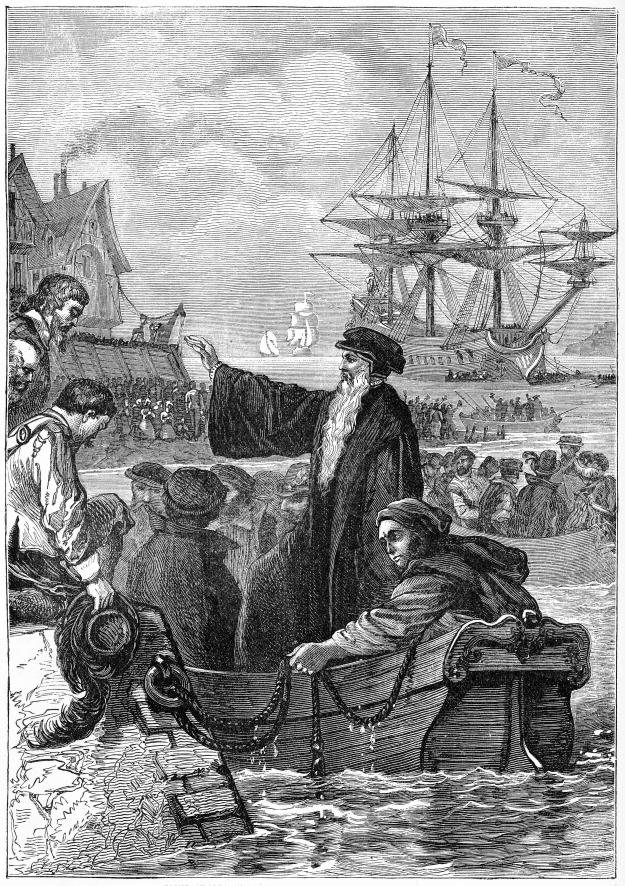
Left: Engraving of Jan Łaski or Johannes à Lasco leaving England (in several ships) with his congregation on September 17, 1553.
Lasco (1499 – 1560) was a Polish Reformed reformer. Owing to his work in England (c. 1543–1555) during the Reformation, he is known to the English-speaking world by the Anglicised form John à Lasco, John Laski, or John Alasko. This Illustration is from ‘The
history of Protestantism’ by James Aitken Wylie (1808-1890), pub. 1878.
John a Lasco and Followers Flee England
With Edward VI’s death at the age of 15 and the accession of the Catholic queen, Mary Tudor, in early 1553, it became apparent to the Protestant refugees in England that they could no longer stay and that they would be forced to flee Catholic persecution once again.
In early September a meeting of the officers of the Strangers Church was called by Lasco
at his residence in Bow Lane. They decided upon an immediate departure for Denmark because two Danish ships, the Mohr and the Kleine Islandische Krahe, were then in harbor at Gravesend and Mary Tudor’s government had encouraged the reformers to depart immediately.
A substantial number of Lasco’s congregation (175 in all) from the Strangers Church accompanied him aboard the Danish ships when they departed on September 15. During their voyage to Denmark, the two ships were separated by a storm and they were not reunited until
October 29 at Heiseborg.
In an account called “the London Dutch Refugees in Search of a Home 1553-1554”
Frederick A. Norwood details the community’s ordeal.
“A small company set sail from Gravesend, September 17, 1553. Welcomed by the English after the death of Henry VIII as refugees from religious persecution in the Netherlands, they now, after the death of the boy king Edward and the accession of the Catholic Mary, were once more embarking on a voyage in search of a new haven and a new freedom of worship. Before they found their promised land, they were to sail through a watery wilderness and endure the bitterness of winter and the hatred of men. Whether one draws from this saga of the sixteenth century a lesson in Christian constancy or of Protestant bigotry, it stands as one of the most dramatic and heroic episodes of a colourful era.”
Norwood’s account follows the group to Denmark where they spent a miserable winter. Harassed by Lutherans wanting to impose their doctrine and practice, the Reformed believers and their leader were eventually ordered to leave Denmark by King Christian III. They then travelled southwards, eventually reaching Emden in March 1554. By this stage they had sought refuge in at least six places.
(The complete account of “the London Dutch Refugees in Search of a Home 1553-1554” can be found in the references at the bottom of this page.)
John a Lasco served as a minister in Emden for a brief period, then moved to Frankfurt-am-Main in 1556 with many of the refugees, where he led a Reformed church. In the 16th century, Emden briefly became an important centre for the Protestant Reformation under the rule of Countess Anna von Oldenburg, who was determined to find a religious “third way” between Lutherism and Catholicism.
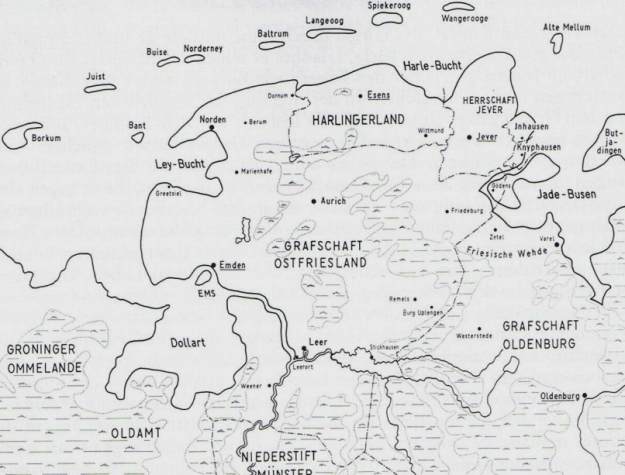
East Frisia 1550. Emden is a sea port town in north-west Germany very close to the Netherlands.
The de Neufville’s in Frankfurt am Main
We know Robert de Neufville was in Emden in 1554 and perhaps came to Frankfurt in 1555 with John a Lasco. However, his death is recorded in Antwerp in 1558.
It is Robert’s eldest child Robert and twelfth child Sebastian (the Elder, 1545-1609) who are attributed as the founders of the family in Frankfurt am Main, arriving there from the Spanish Netherlands in1573. Sebastian married his wife Anna Cock van Opynen in 1577. She was from Bergen in the Spanish Netherlands, so Sebastian may have been residing there prior to coming to Frankfurt.
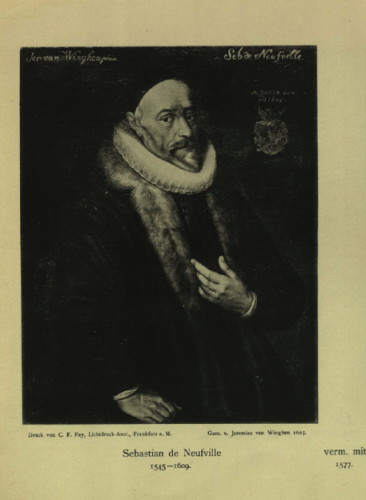
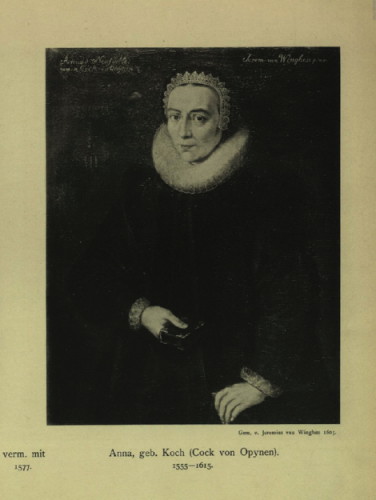
Sebastian (the Elder) de Neufville 1545-1609 & Anna Koch (Cock van Oypynen) 1555-1615. Married 1577.
No doubt a factor in the brothers’ 1573 migration to Frankfurt was the Eighty Years’ War (from 1568–1648). The war was a revolt of the Seventeen Provinces of the Netherlands against the Habsburg Spanish Empire and resulted in the formation of the independent Dutch Republic.
Robert and Sebastian became citizens of the city of Frankfurt in 1575 and 1580, respectively. They traded initially in Flemish cloth and quickly amassed a fortune.
Sebastian’s son, Sebastian de Neufville the Younger, (1581-1634) expanded the business to include precious objects, silks, jewels, and metals, multiplying the family fortune to the considerable sum of 270,000 guilders. They also began handling bills of exchange and shipping finance, the first step toward becoming bankers.
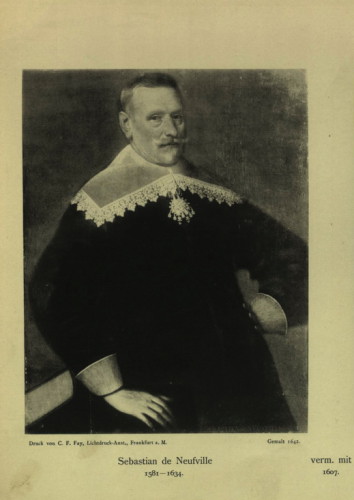
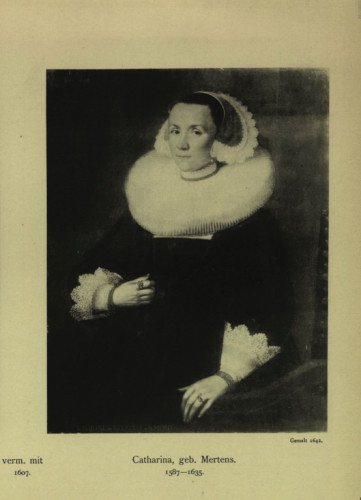
Sebastian (the Younger) de Neufville 1581-1634 and Catharina Mertens 1587-1635. Married 1607.
From then on, family members were at the forefront of the stock exchange, the Frauenstein merchants’ guild, various merchant associations, and the French Reformed and later the German Reformed congregations.
Interestingly, instead of marrying into old patrician families the de Neufvilles (along with other Huguenot families) chose to form marriage alliances with Reformed families of equal standing. Even so, the de Neufvilles belonged to Frankfurt patrician society known as “Zum Frauenstein“.
Their economic prominence persisted and this manifested itself in an almost princely lifestyle, including patronage of the arts, and art collections.
Around 1650, the family’s foundation increasingly lay in the private bank that had emerged from the trading house. This was run by the next generation of brothers Peter (1623-1691) and David de Neufville. (1623-1684).
From 1690, David and his son Jakob de Neufville (1668–1730) managed the bank, which now bore the name “D. & J. de Neufville”. They also held partnerships in other banks, particularly the Frankfurt banking house “Johann Mertens”, with which the de Neufvilles had been related since 1607 (when Sebastian the Younger married Catharina Mertens).
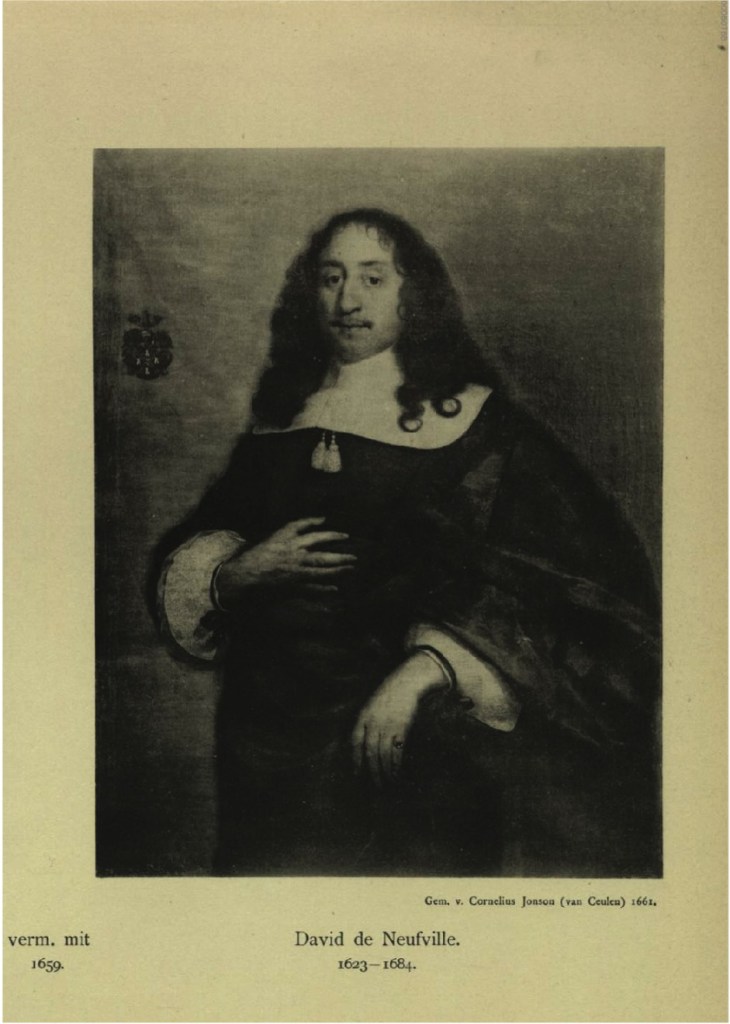
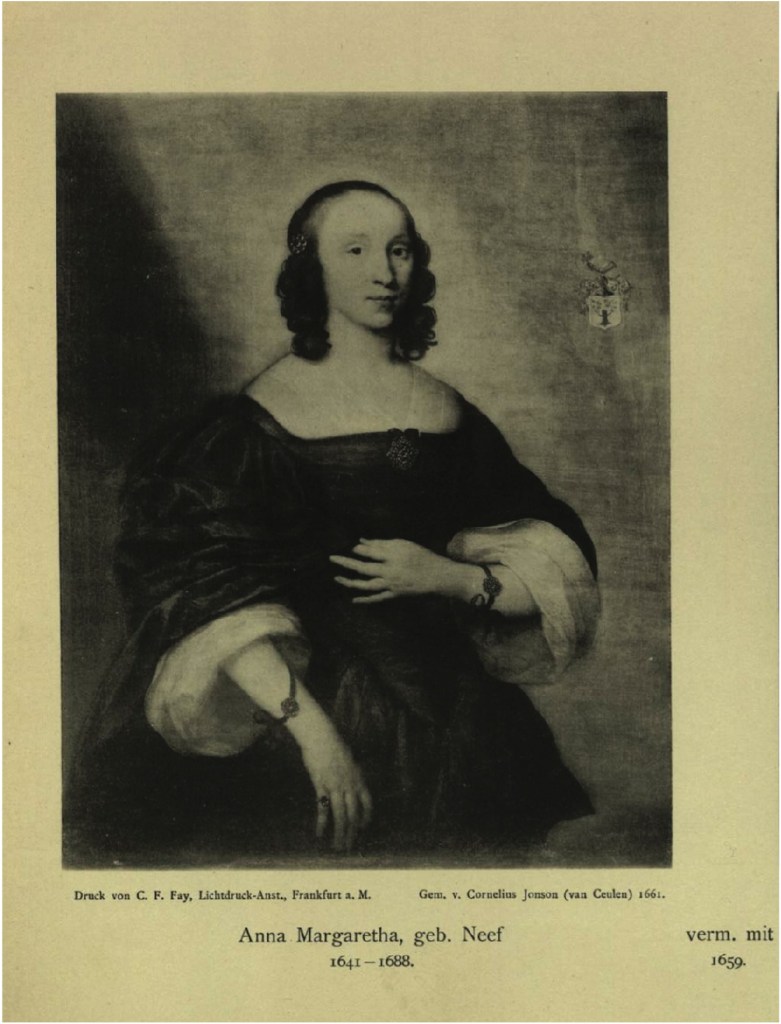
David de Neufville 1623-1684 and Anna Margaretha Neef 1641-1688. Married 1659
In addition, the de Neufvilles were among the founding members of the Frankfurt Stock Exchange in1685. The company D. & J. de Neuville developed an international reach as the family spread and was one of the leading names in Frankfurt‘s banking and stock exchange world for a very long time.
18th and 19th Century Influencers
The De Neufville family built their Frankfurt connections gradually over two centuries, but their 18th-century influence was the result of networks created earlier through trade, marriage, and banking partnerships.
During the 18th century, Frankfurt became a centre for private banking houses, and the De Neufvilles were among the leading firms. Their role covered currency exchange (Frankfurt’s trade fairs required complex currency conversions), credit for merchants (loans allowed merchants to finance goods months before payment), and Government lending (e.g. the family financed princely states such as those in Nassau).
By the 18th century, the De Neufville network extended far beyond Frankfurt. Family and business connections existed in Amsterdam, London, Paris, Nuremberg, and Breslau. This allowed the Frankfurt branch to function as a clearing hub for European trade finance. For example, they financed trade in Austrian steel, Hungarian copper, luxury goods and textiles, and long-distance commodity trade. Major clients included German princes and the dukes of Lorraine.
Late in the 18th century, the De Neufvilles were already part of the network that produced later famous banking houses. One striking example: the Frankfurt bank D. & J. de Neufville lent money to the young banker Mayer Amschel Rothschild, who later founded the Rothschild family. This illustrates how the De Neufvilles were part of the older generation of Frankfurt merchant bankers from which later financial empires emerged.
Outside of the banking house D. & J. de Neufville, members of the de Neufville family, especially since the 19th century, were active as merchants and lawyers, but also as soldiers. Many acted as charitable benefactors, participated in Frankfurt‘s municipal politics, were involved in the Frankfurt Chamber of Commerce, and assumed leadership positions in the French Reformed and later in the German Reformed congregations of Frankfurt.
Zum Hirschkopf at Kleiner Hirschgraben 4
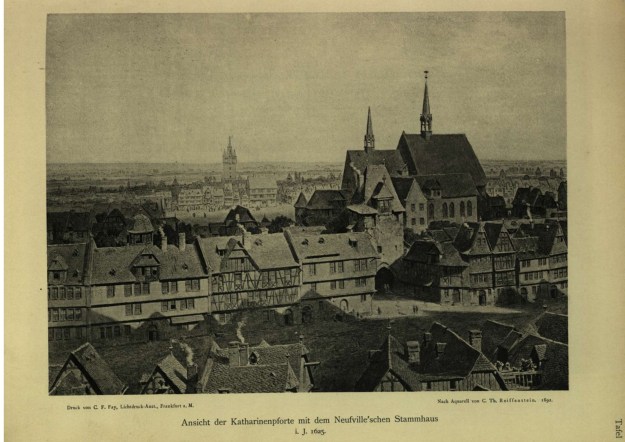
The D. & J. de Neufville banking house, remained one of Frankfurt’s leading private banks until 1924 when it was was quietly liquidated following the hyperinflation post WWI.
Until its dissolution, the family home and the original headquarters of the Bank de Neufville had been located for more than 300 years at “Zum Hirschkopf” at Kleiner Hirschgraben 4.
This house (acquired in 1590 and rebuilt in1863) was destroyed along with the family museum in the air raid of March 22,1944. The property still belongs to the “De Neufville Family Foundation, founded in 1837.
Eduard de Neufville (1857–1942)
Jacob Friedrich (Eduard) de Neufville (1857–1942), was the son of Franziska‘s younger brother Johann Robert and was a first cousin of Adam Eduard Lejeune.
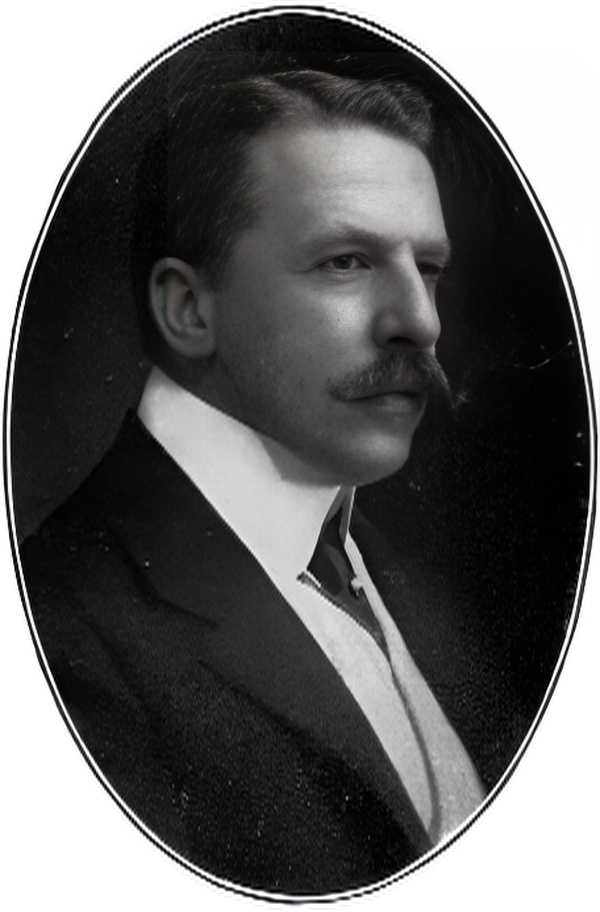
Jacob Friedrich (Eduard) de Neufville (1857–1942)
A prominent German peace activist before and during World War I (1914-1918) and was a first cousin of our ancestor Adam Eduard (Edward) Lejeune who migrated to Manchester. Eduard Lejeune was naturalised in Manchester in 1871.
One of my de Neufville online discoveries was a website sharing information about a lecture series, organised by the Society for Frankfurt History called “Frankfurt Family Histories in Street Names”.
The event promotion read “On Monday, November 18, 2019, Bendix Balke will speak about the Frankfurt merchant and banking family de Neufville, after whom a street in (Frankfurt am Main)-Oberrad is named.
“Eduard de Neufville, one of the most influential German peace activists before and during the First World War, was born into this esteemed banking family in 1857. From 1906 to 1909, he organized reciprocal peace tours for English and German mayors, journalists, and church leaders. In his lecture, Balke demonstrates how Eduard de Neufville’s extraordinary pacifist commitment fits into the family tradition of this old Frankfurt merchant family.“
References and Resources
Maison de Neufville-en-Artois – Racines & Histoire
Histoire généalogique de la Maison de Neufville (Amsterdam, 1869) House of Neufville-en-Artois, Étienne Pattou’s genealogical research on Racines & Histoire (updated in August 2025)
https://share.google/QBGY5FSnF9woUOKVm
The London Dutch Refugees in Search of a Home 1553-1554 Frederick A. Norwood
https://archive.org/details/historyofprotest01wyli/page/410/mode/1up
I have copied and reformatted from the online version. See below.
John à Lasco: A Polish Religious Reformer in England, 1550-1553. Richard Glen Eaves and William. A Carter. Vol. 14, No. 4 (November 1979), pp. 311-323 (13pages)
https://www.jstor.org/stable/42588808
Full text of “Proceedings of the Huguenot Society of London“
https://en.wikipedia.org/wiki/County_of_East_Frisia
https://frankfurter-personenlexikon.de/node/625

