
The Protestant Reformation was one of the most significant religious and political upheavals in Western history, fundamentally reshaping Christianity and European society in the 16th and 17th Century.
Background
By the late medieval period, the Catholic Church had accumulated enormous wealth, political power, and institutional corruption. Many Christians felt the Church had strayed from authentic Christian teaching and practice, and calls for reform had been growing for over a century before the Reformation exploded onto the scene.
Key Causes
Clerical Corruption and Abuse
The Church was rife with practices that struck many as scandalous — simony (selling church offices), nepotism, absentee bishops, and priests who were poorly educated or openly lived immoral lives. Popes like Alexander VI were notorious for their worldliness and political scheming.
The Sale of Indulgences
This was the immediate spark for Luther’s protest. Indulgences were certificates sold by the Church that promised to reduce time in purgatory. The aggressive sale of indulgences — often by traveling preachers — to fund the rebuilding of St. Peter’s Basilica in Rome struck many as a crass commercialization of salvation.
Martin Luther and the 95 Theses (1517)
Luther, an Augustinian friar and theology professor, nailed (or possibly mailed) his 95 Theses to the church door in Wittenberg, challenging the theological basis of indulgences. He argued that salvation comes through faith alone (sola fide), not works or Church-mediated sacraments, and that Scripture alone (sola scriptura) — not papal authority — was the ultimate guide for Christians.
The Printing Press
Gutenberg’s printing press (invented ~1440) was a revolutionary accelerant. Luther’s ideas spread across Europe with unprecedented speed, making it impossible for Church authorities to suppress the movement as they had earlier reformers.
Renaissance Humanism
Scholarly humanism, with its emphasis on returning to original sources (ad fontes), led figures like Erasmus to scrutinize the Latin Vulgate Bible and Church traditions critically. This created an intellectual culture receptive to Luther’s arguments, even among those who didn’t ultimately break with Rome.
Political Fragmentation in Germany
Unlike in France or Spain, where powerful monarchs kept church-state relations unified, the Holy Roman Empire was a patchwork of princes and city-states. Many German princes embraced Lutheranism partly out of genuine conviction, and partly because it allowed them to seize Church properties and assert independence from both the Pope and the Emperor.
Popular Discontent
Ordinary people resented Church taxes (tithes, Peter’s Pence) flowing to Rome, and many peasants and urban workers felt the Church served the powerful, not them. The Reformation tapped into widespread social frustrations.
Spread and Diversification
The Reformation quickly spawned multiple movements beyond Lutheranism — Calvinism in Switzerland and France, Zwinglianism, Anabaptism, and the English Reformation under Henry VIII (driven more by political than theological motives). Each had its own emphases and broke with Rome in different ways.
Consequences
- The permanent fracturing of Western Christianity into Catholic and Protestant branches
- The Catholic Counter-Reformation, which cleaned up many abuses and clarified doctrine
- Decades of devastating religious wars, culminating in the Thirty Years’ War (1618–1648)
- The gradual development of religious toleration and pluralism in Europe
- A profound reshaping of education, literacy, politics, and culture — many historians see it as a major root of modernity
The Reformation is a reminder of how deeply theology, politics, economics, and technology can intertwine to transform the world.
Events Directly Affecting Huguenots
As Protestantism grew and developed in France, it generally abandoned the Lutheran form and took the shape of Calvinism. Huguenots, 16th–18th century French Calvinist Protestants, faced intense persecution, leading to major conflicts and mass exodus.
During the mid-16th century, France was deeply divided between:
- Catholics, who supported the traditional Church and many powerful noble families.
- Huguenots, influenced by John Calvin and the wider Reformation.
January 1535: General Edict urging extermination of Heretics (Huguenots)
May 1559: First Synod: The first national synod of the French Reformed Church was held in Paris, establishing structure and formalizing governance, accepted sacraments and rejection of the Pope and all papal councils, synods, conclaves etc.
January 1562 – Edict of Saint Germain: Catherine de’ Medici, the regent, issued the edict which allowed Protestants to worship outside city walls. Many Catholics opposed this law and believed it threatened the Catholic kingdom.
March 1, 1562 – The Vassy Affair: Francis, Duke of Guise, a powerful Catholic noble, stopped in Wassy (Vassy) while traveling.

Nearby, about 300–500 Huguenots were holding a worship service inside a barn. Accounts differ on how violence began, but Guise’s soldiers confronted the worshippers. Stones were reportedly thrown. The soldiers then attacked the congregation. Some 50–60 Protestants were killed while over 100 wounded and the meeting place was destroyed.
The massacre had enormous political consequences. Its immediate effects were outrage among Huguenots, Protestant nobles took up arms, and Catholic forces rallied around the Guise family. Within weeks, open war erupted, marking the beginning of the French Wars of Religion. The key Protestant leader Louis, Prince of Condé mobilized forces against the Catholic crown.
The Vassy Affair mattered because it ended hopes of peaceful religious coexistence in France, turned political tensions into open civil war and deepened the divide between Catholic royalists and Protestant nobles.
1568-1648 – Spanish Invasion: The turmoil in France drew in the Spanish. The Eighty Years War began by the Spanish invasion of the Low Countries. The military campaigns, initiated by King Philip II of Spain, were aimed at suppressing the Protestant Reformation and maintaining control over the region. This conflict led to significant resistance from the Dutch provinces, ultimately resulting in their independence and the establishment of the Dutch Republic.
August 1572- St. Bartholomew’s Day Massacre: After a decade of intermittent civil war between Catholics and French Protestants (Huguenots), an attempt was made to restore peace through a royal marriage. In August 1572, the Protestant leader Henry of Navarre (future king Henry IV of France) married Margaret of Valois, the Catholic sister of King Charles IX of France. This wedding brought many Protestant nobles to Paris, a strongly Catholic city.
At court, the Huguenots were increasingly influenced by their leader Gaspard II de Coligny, Admiral of France, who had gained the king’s trust. This alarmed powerful Catholic figures, including Catherine de’ Medici, the king’s mother, and the powerful Guise family.
On 22 August 1572, an attempt was made to assassinate Admiral Coligny. He was seriously wounded but survived. Huguenot leaders demanded justice and suspected the Guise faction. The royal court feared that Protestant nobles might retaliate or rebel.
According to many historical accounts, Catherine de’ Medici and the royal council decided to eliminate the Protestant leadership before a rebellion could begin. During the night of 23 August 1572, royal guards and Catholic militias began assassinating leading Huguenots. The first major victim was Admiral Coligny, who was murdered and thrown from a window.
Once the killings began, they quickly spiralled out of control. Crowds in Paris attacked Protestants throughout the city. Victims were dragged from homes, killed in the streets, and thrown into the Seine River. The violence continued for several days. Estimated deaths in Paris were 2,000 to 3,000 people.
News of the killings spread and similar massacres occurred in other cities, such as Lyon, Rouen, Bordeaux and Toulouse. The total deaths across France are estimated to have been 10,000 to 30,000 French Protestants (Huguenots)
The Protestant groom Henry of Navarre survived only because he was forced to convert to Catholicism temporarily. Years later he returned to Protestantism and eventually became King Henry IV.
The massacre had enormous consequences:
- It destroyed trust between Catholics and Protestants.
- It restarted the French Wars of Religion with greater brutality.
- It shocked Protestant Europe and strengthened anti-Catholic sentiment in England, the Netherlands, and German states.
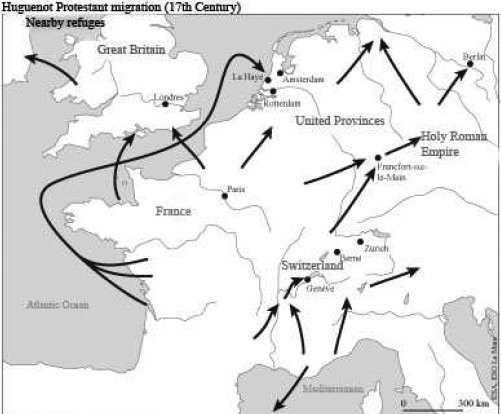
For French Huguenots it clearly demonstrated that the French crown could not be trusted to protect them from violent and dangerous discrimination. As a result, in the first of two major emigration waves, some 200,000 Huguenots, between 10% and 15%, left France for safer places including Switzerland (Geneva, Zürich, Basel), the closest and most popular, Rhineland, Dutch Republic, England, and others.
Edict of Nantes and Its Revocation
1598 –The Edict of Nantes: Signed in April 1598 by King Henry IV of France, it granted the Huguenots substantial rights in the predominantly Catholic nation. While upholding Catholicism as the established religion, and requiring the re-establishment of Catholic worship in places it had lapsed, the edict granted certain religious tolerance to the Protestant Huguenots.
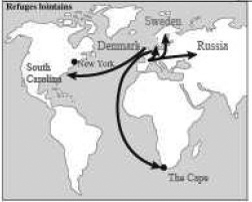
1685 – Revocation of the Edict of Nantes by Louis XIV: This was a cataclysmic act for Huguenots since it immediately led to Protestant churches being destroyed, forced conversions, protestant schools being closed and emigration being made illegal (but widely defied). For many Huguenot families, bitterly, the persecution was not new. Consequently a second major Huguenot diaspora began, in which 400,000 fled France. The accelerated emigration, to the Dutch Republic, Prussia, England and Wales, Sweden and Denmark, South Africa and North America, reshaped those countries and communities into which they went. The wave strengthened the emerging middle classes in Britain, the Dutch Republic and Prussia.
Skills brought by Huguenots
Calvinism appealed particularly to urban merchants, craft guild members, professionals (lawyers, printers, physicians) and educated elites because it emphasized literacy (everyone should read the Bible), personal discipline, commercial honesty and thrift, and education. As a result many early Huguenots were already part of the rising middle class rather than peasants or traditional nobility.
During the French Wars of Religion, and particularly after the St. Bartholomew’s Day Massacre, Huguenots were excluded from many positions in the Catholic state. Because of this they could not easily rise in royal administration, were barred from many traditional Catholic institutions and military and court careers were limited. Instead, they focused on independent economic activity, especially international trade, banking, manufacturing and skilled crafts, all of which reinforced their middle-class economic profile.
Huguenots formed tight transnational networks across Protestant Europe. When they fled France and settled mainly in the Dutch Republic, England, Brandenburg-Prussia and Switzerland, they already had family contacts, business partnerships and shared religious communities and so were well positioned to rebuild businesses quickly, specializing in banking and finance, international trade, luxury manufacturing and printing and publishing. They brought skilled crafts and industries. Common trades included silk weaving, watchmaking, goldsmithing, printing, glass making and textile dyeing. Because Calvinist culture strongly encouraged education, discipline, frugality and entrepreneurship, many Huguenots communities established schools, printing presses and academies. The resulting high literacy rate gave them advantages in bookkeeping, trade correspondence, financial contracts and international business.
Ironically, one result of the Huguenot diaspora was that France lost a productive segment of its commercial middle class. Despite the Edict of Toleration of 1787, which restored Huguenots’ civil rights (but not political rights), it was too late – the die had been cast. By 1789 France faced a financial crisis, leading to the French Revolution and, ultimately, religious equality becoming the law, and the very values the Huguenots represented – literacy, commerce, merit – became dominant revolutionary principles.
 The Marion Project - A Family History