
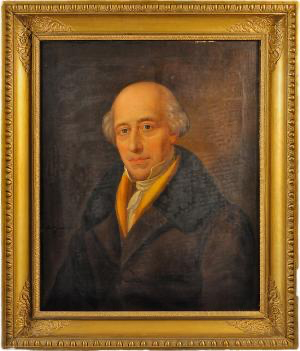
Dr. Lejeune was born into a French-speaking Protestant family in the textile town of Verviers, his father Adam Lejeune was from nearby Ensival. Veviers was an industrial wool-manufacturing centre, and many of its Protestant families were connected with trade, industry, or the professions. This environment produced a number of educated middle-class families, typical of the Huguenot diaspora.
As elsewhere mentioned, after completing his medical doctorate in Reims in 1788, Lejeune practiced in Verviers but was eventually forced to emigrate to Frankfurt.
However, an anecdote passed down in the family tells that Lejeune wanted to travel along the Rhine at that time and stopped off at a hotel in Frankfurt. That night, he was summoned to the Russian Grand Duchess D’Oemidoff, who lived in the same house with her husband, because her delivery seemed imminent. However, the Grand Duchess’s heir took his time, especially since the due date was only expected a few weeks later. The Grand Duchess, however, had now gained confidence in the Belgian (and therefore French-speaking) doctor. So, Lejeune stayed in Frankfurt to assist her during the delivery as an obstetrician, his skill and manner having impressed the household so much he was invited to remain as personal physician.
This event changed the course of his life. He settled permanently in Frankfurt am Main and became part of the city’s French-speaking Protestant community. Frankfurt at the time had a strong Huguenot and merchant population, making it a natural destination for someone of his background., During François Adam Lejeune’s lifetime Frankfurt was one of the most important commercial cities in central Europe. Amongst other things it hosted major international trade fairs, strong merchant banking houses, links to Amsterdam, London, and Swiss trading centres, and established French Reformed churches. The French-speaking Protestant community in Frankfurt was closely tied to the broader Huguenot diaspora economy that stretched across northern Europe. Families in this circle often worked in merchant houses, banking, international trade and professional services such as law or medicine.
In the circles of Frankfurt’s French Reformed congregation, he met Helene Marie, called Mimi, d’Orville (1768-1843), who became his wife in June 1796. Upon this marriage, he acquired citizenship and established himself as a general practitioner in Frankfurt. With his own practice on the Roßmarkt, he soon became a sought-after and popular general practitioner, among others for distinguished Frankfurt families and the Steffan von Cronstett and Hynsperg noble Protestant women’s foundation. Through his acquaintance with Soemmerring, he met Goethe during the latter’s stays in Frankfurt in 1814/15. At the beginning of the 1850s, when Bismarck became a federal envoy to Frankfurt, Lejeune is said to have been his personal physician.
François Adam Lejeune and Helene’ d’Orville had two children who survived beyond infant hood: Adam Eduard Auguste (1797-1882) and Johan Gustav A (1800-1888).
There is an interesting story about the childhood education of Adam Eduar and Johan Gustav which can read about at Dr François Adam Lejeune (1765-1854) by Marion Lejeune Enke
The eldest, Adam Eduard Auguste Lejeune, spent his life in Frankfurt. He became a friend of Heinrich Hoffmann and a supporter of Friedrich Stoltze, swore the Ffter Bürgeroath as a merchant on October 31, 1825. He began trading furs and founded a rabbit hair cutting business, which supplied the raw material for the production of felt hats. Initially to organize the disposal and production of shipping crates for animal fur and rabbit hair, Eduard soon added a timber business and a sawmill to the business.
In 1832, Adam Eduard Auguste married Appoline Eugenie Barre (1813-1863). They subsequently had two sons, Adam Gustave Julius Eduard (1836-1905) and Eduard Alfred (1838-1917).
After taking on his brother Gustav as a partner in 1832, Adam Eduard Auguste expanded the company to include a coal business with its own shipping company (which existed until around 1858). He was also involved in the development and distribution of special ovens and stoves for the Buderus company in Wetzlar. In doing so, he contributed to the introduction of Ruhr coal for combustion in businesses and households in Frankfurt, especially since he himself used the coal to heat the pickling furnace in his factory, newly built in 1836 at the company’s headquarters at Schäfergasse 15 (destroyed in the war in 1944).
Abandoning the rabbit hair cutting business around 1865, the company concentrated entirely on the wholesale distribution of fuels, timber, and, from the 1930s onward, building boards. As Ed. Lejeune KG, most recently (since 1967) at Hanauer Landstraße 220 in the Ostend district, the business remained in family ownership until the filing for insolvency proceedings in 1974.
François Adam’s brother Johan Gustav Lejeune married Franziska de Neufville (1806-1870), linking the Lejeune family with the prominent de Neufville family.
The De Neufvilles were part of the large Huguenot merchant network centred in the Dutch Republic. Through this connection the Lejeunes became tied to a financial network that linked Amsterdam banking house, Frankfurt merchant firms and London trade connections.
Johan and Franziska had nine children, six girls and three boys, one of whom was Adam Eduard Lejeune (1844-1899), future husband of Jane Louisa McLaren. He was sent to Manchester, where he entered the cotton trade and later became a British citizen.
 The Marion Project - A Family History