
Some of Ruth Enke Chambers’ Memories
“Our hopes and fears do change their name as life goes on.”
From the preamble to J. L. Lejeune’s Annual Christmas Wishes to Withington Girls School 1925
[Ed Note: Another founder, Louisa Lejuene, wrote to the School’s Headmistress at Christmas 1925: ‘Our hopes do change their name as life goes on, and mine, my hope and wish for myself and those dear to me, is that courage and love and the power to pluck little joys from the wayside may last – and even grow – to the end of the pilgrimage, which I hope is the beginning.’ See http://www.withington.manchester.sch.uk/about-school/page/founders-withington-girls-school]
____________________________________________________________________________________________________________
Foreword
by Derek Chambers
As I approach fifty I become increasingly conscious of the passage of time and its consequences: aches, pains, and deteriorating eyesight on the negative side, but, on the positive side, the ever-growing numbers of people who are connected to me by a family relationship. As children are born, grow up, marry, and have their own children, our family connections spread like the ripples in a pond that follows a pebble’s plop. But as those ripples undulate outwards, their origin often smooths and disappears; and so it is with human beings, families and their remembered records.
Human beings form a great multitude, a crowded caravan traveling together through trackless country on a journey whose origins and whose destination are equally unknown. We are born, live, and die accompanied by some who are there when we arrive but leave before we do, and joined in our journey by newcomers whom, when we depart, we leave to travel on. As life passes, the crowd around us shifts and mixes, bringing new faces into our ken while others are carried off by the topography of circumstances to fade into the distance.
At first we are not greatly concerned with our place in the caravan, although we may pass through a stage in early youth in which we toy philosophically with the Meaning of Existence, Why Are We Here, and other capitalized questions. But, as our attention is deflected to the more prosaic task of making our way in the world, we put such speculations aside, though only into abeyance it seems since they come surging back in mid-life as we come to realize that there really is only one life and that the paths we take at each crossroad of choice definitely do preclude ever taking the other route.
And so we are brought once more to speculate about our particular, personal place in the puzzle of existence, our appointed position in the caravan. Our biological roots, our genetic inheritance, and the fact that ancestors of ours lived and died in what are now dim historical times, all work to awaken an interest in our origins. So it was for me.
However, I also came to realize that, although my mother had told me many stories about our family, because I was not gripped with interest at the time I had forgotten many of the facts; the ripples of the pond were there to study but I had not the eyes to see. And now, conscious that my mother is mortal and aging, and that once she has gone so will go an important, encyclopedic source of first hand information and keen observation gathered over the decades, as will also go her skill of making the bare facts about people come alive, revealing the human qualities behind them, I have encouraged Mum to write about her life, the people that she knew, the places that she visited, and the details about her ancestors that she had come to know. She has responded with what follows, tracing her life from its earliest beginnings on Galiano Island in 1910, up to mid 1989. Woven into this narrative are bits and pieces about others, members of the family and not, who played a part in shaping her memories.
Interspersed in the text are photographs illustrative of its people, places or subjects. Choosing which photographs to use was extremely difficult as there is such a wealth. In the end, rather than including a family pantheon of important looking Enke men and women, brothers, sisters, aunts, uncles, cousins, I have restricted the choice to those who occupy a significant place in Mum’s narrative. Perhaps there will be a future opportunity to widely reproduce the remaining family pictures.
In addition to Mum’s story, I have taken an editor’s prerogative and incorporated, where relevant, other material which has come to hand. This includes some brief notes about Alexander MacLaren (my matrilineal Great-Great-Grandfather); the text of an article written for The Horn Book Magazine by Marion Enke (my maternal Grandmother); extensive notes prepared by my maternal Grandfather, Max Enke, describing his experiences during World War II; and some notes on my maternal great-great-great-grandfather, Adam François Lejeune. These latter three comprise respectively Appendices A, B and C.
The task of typing in the nearly 55,000 words that are contained here has been a long one, but one marked with fascinating periods of complete immersion in life decades in the past, as I was transported to another time and place. Not uncommonly, after some days of working at the material I have reluctantly surfaced, as if waking from a dream, to be surprised by the present and its often uncomfortable realities. However, again and again, I have then seen my grandchildren and been once more reminded of the quickness of life and the wonderfulness of all children. It is for them that I have done this.
Narnia, Knutsford
October 30, 1990
********************************
January 2011
It is more than 20 years since I wrote the words above and now I am approaching 70. Much has changed in the meanwhile. Mum died on January 11, 2002. Madrona Farm was sold in 2010 to TLC. And technology has advanced to the point where inserting images into documents is very simple. So, I am revisiting Mum’s autobiography to actually insert the images that I talked about above.
But I am also taking advantage of the digital advances of recent years. This document, when finished, will be available as a pdf download, but will also be published in a blog, thus making it considerably more accessible.
____________________________________________________________________________________________________
Table of Contents
Purpose
The Early Years (1910 – 1919)
Oaklands (1919 – 1921)
Manchester and Withington (1919 – 1921)
The Aunts and Uncles
Edward
Victoria (1921 – 1924)
Alexander Maclaren
England and the Continent (1924 – 1931)
Boarding School
Pinehurst and Oaklands
Austria
Oxford
Belgium, 1930
Trekweg
California, 1931 – 32
Easter, 1932 – December 31, 1937
1938 – 1939
1940 – 1942
1942 – 1949
1950 – 1951
1952 – 1982
Babies Bonfire
Nature Conservation
Stephen
1982 – 1988
Purpose
Dear Family – Present and Future Unknown
I want to describe some of the people and places that had a part in making me what I am.
Mine has not been a distinguished life by any means. Yet, for me, its been most interesting and mainly enjoyable. But a fascinating part of family life is that one never knows which child or grandchild will, as an adult, wonder about former relatives, how, when and where they lived. And when these individuals reach their 50s they may know 5 generations of one family. I did. At 53 I’d met grandparents, parents, my own generation, my children, and even my first grandchildren in the shape of twin boys born in July 1963.
Sometimes it’s intriguing to see some remembered feature or characteristic reappear. A way of walking, the shape of an ear, a tone of voice, a swiftly changing mood. Such small details, and yet, in an instant they evoke memories of another decade, a different place, a faraway but half-forgotten world.
Ruth Enke Chambers
Victoria, B.C.
July, 1988
The Early Years (1910 – 1919)
I was born in the upstairs bedroom of a farmhouse in the valley at the south end of Galiano Island. It was a wet December night, the 5th, in 1910, and the rain was coming down in long swishes. So wrote my darling Grannie Lejeune who had come from Manchester to Galiano for the birth of her very first Grandchild. Her letter, dated December 6, was to her son Russell who had emigrated to Western Australia (and who was later to die tragically, shot dead accidentally by a bullet from a kangaroo hunter’s rifle ricocheting off the rib of one of his prey), and was mainly to tell him that the baby had arrived the night before, and was a little girl to be called Ruth. It was sent to me by Josceline Lejeune who was Grannie’s first Australian grandchild. So now it’s in a farmhouse in a valley at the south end of Vancouver Island.

Mother was unwell for weeks after the difficult birth. Life on the island was different with a baby to consider. Picnics, outings, visitors were no longer a pleasure. Just extra work. She took the baby to Europe to show to both sides of the family. Max, realising she was an urban not a rural type, enquired about Victoria’s architects. Keith, who designed Christ Church Cathedral, got the contract. (Xeroxes of the plans for the Island Road house are in the Provincial Archives.)
By 1913 we were living in a large house, at 572 Island Road, on a hill in Oak Bay, an area that is now part of Greater Victoria. The house is still a familiar landmark with its black and white timbers, great size and its peculiar lookout room that rises like a bump from the main ridge of the roof. That room was reached by a ladder from the attic landing. Its strangeness and its many windows fueled and increased the German spy stories in World War I.
War hysteria is not new and has taken many forms over the centuries. It ran high in Oak Bay. Max Enke was certainly not an Anglo Saxon name, they said. A man with a German sounding name building a big expensive home that had a clear view southwards of all the ships on their way to Vancouver. If you watched carefully, the rumours ran, you could see figures in the windows silhouetted by the flashing beams of the Trial Island light. The figures moved and you could be sure they were speaking German. They were watching for a submarine to signal them from the strait. Why else would Max Enke keep a good clinker built rowboat on Shoal Bay beach? Rowing out under cover of darkness. Spies — dangerous German spies — no doubt about it at all. And children at kindergarten were told by their parents not to play with Ruth as her Daddy was a German spy.
Such tales seem unbelievable now. But so do accounts of the Lusitania riot in Victoria in 1915. On May 7, 1915, the Cunard liner Lusitania was torpedoed off the Irish coast on her way to Liverpool. She sank with great loss of life. The news of over 1000 passengers lost, reached Victoria the next day. The May 8 issue of the Victoria Daily Colonist had editorials on the sinking and on that weekend of May 8 and 9 a real riot began with the wrecking of the Blanshard Hotel which had been the Kaiserhof. An excited crowd was breaking glasses in the bar and throwing furniture into the street. Soldiers were summoned from their barracks at the Willows — off duty police were called in. The swelling crowd outnumbered soldiers and police. The mob set out for stores whose owners had German sounding names. There was looting of groceries, tobacco and drygoods, and Mayor Stewart read the Riot Act. The May 8 – 14 issues of the Daily Colonist make strange reading in 1988.
I enjoyed the years at 572 Island Road. Except for a 1919 – 1921 trip to England and Belgium, I was at 572 until I was taken to England in 1924 to go to a boarding school in Sussex.
In that early part of 572, I’d be the age when it was fun to build tree forts, run free on the hill, and shoot wildly with a bow and arrows I’d been given. The hill was truly a fine place for children to grow up in. Open grassy places to run through, paths between the broom bushes, hiding places among the windblown stunted Garry oaks that lay against the southern slopes of the hill. Each year in June there was a thrilling morning of the very lowest tide when one could reach certain rock pools and see places that were unattainable the rest of the year. In one deep crevice there was something living that looked like a butcher’s slab of liver in his store.
The flowers on the hill were mainly what I knew later as the Garry Oak Arbutus association. There were white erythroniums, too, usually growing under the oaks, Indian paintbrush, larkspur, camass. In the 1980’s “the hill” is an Oak Bay municipal park. It became a park just weeks after I’d scattered Stephen’s ashes in a grassy stretch within sight of the windows of the room where he was born in 1916.
It was on the hill, too, that I had my first glimpse of Geologic time. My father and I had walked to the rocky ridge at the eastern end of the grassy part of the hill. There we sat, looking at the view and a house below. My father said a great river of ice had passed over these rocks millions of years ago. The force of the moving ice had gouged out valleys and rounded hills that were not as high as the ice was thick – and in places a boulder imbedded in the ice scratched and grooved the rocks. He showed me a groove on the rock where I sat and gently guided my forefinger along that groove.
Now in 1988, about 15 paces from my back door, is a patch of bare, glaciated,, striated rock.
I like the look of it.
Oaklands (1919 – 1921)
In 1919 my father wanted to see how his father and sisters had survived the German Occupation of World War I. During the war we’d had no news – and, since the Armistice we’d had some but my father wanted to see family and battle fields for himself.
The family factory, that imported rabbit skins, processed them, and turned them into fur felt for the hat trade was at Eecloo, a small manufacturing town midway between Bruges and Ghent.
The liner we sailed on had the usual passenger list with names printed alphabetically. There we were “Mr and Mrs Max Enke, Miss Ruth Enke, Master Stephen Enke.” One morning, a woman walking on the deck, stopped me and asked “Are you the little Enke girl?” I nodded. “People with a name like that shouldn’t be allowed to travel,” she snapped.
At the time I was puzzled. However, before we returned two years later, I’d seen the World War I battlefields in Flanders, ruined Ypres and gained some knowledge of the carnage of the war. Slowly, slowly, from places visited, and from books read, I began to understand a little about the damage war could do to minds as well as bodies.
We found that my grandfather had survived the war intact but a bomb had landed on the big front lawn and shattered windows in the front of the house. The big bay window in the dining room was boarded up, and we had the electric light on for all meals.
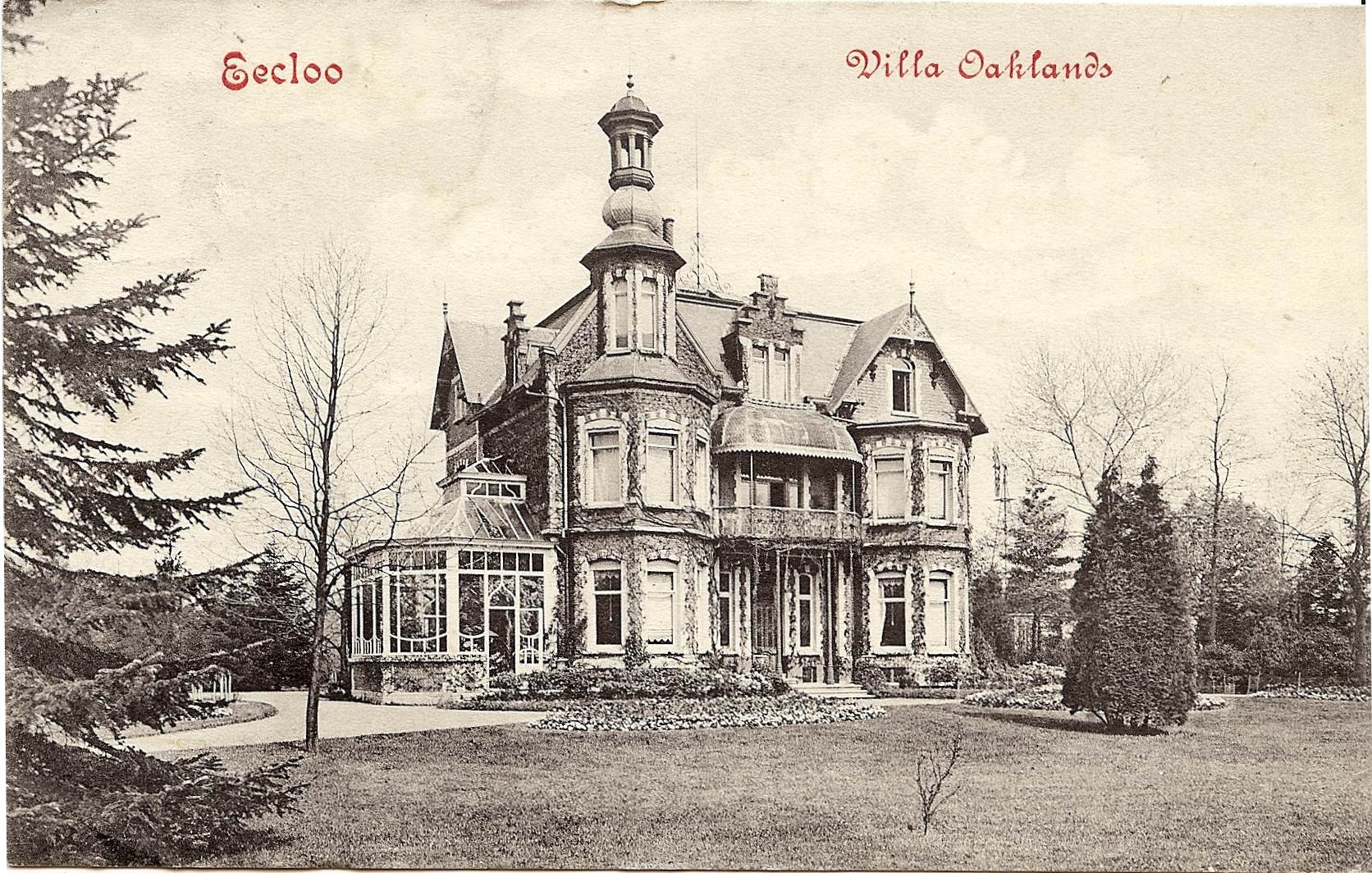
| Oaklands, the home of Hermann Enke, father of Max, and of Max’s twin sisters Adeline and Paula Enke |
On the morning after we arrived, my cousin Margaret, who was 3½ years older than I and lived next door at Pinehurst, came over to meet us all and show me around.
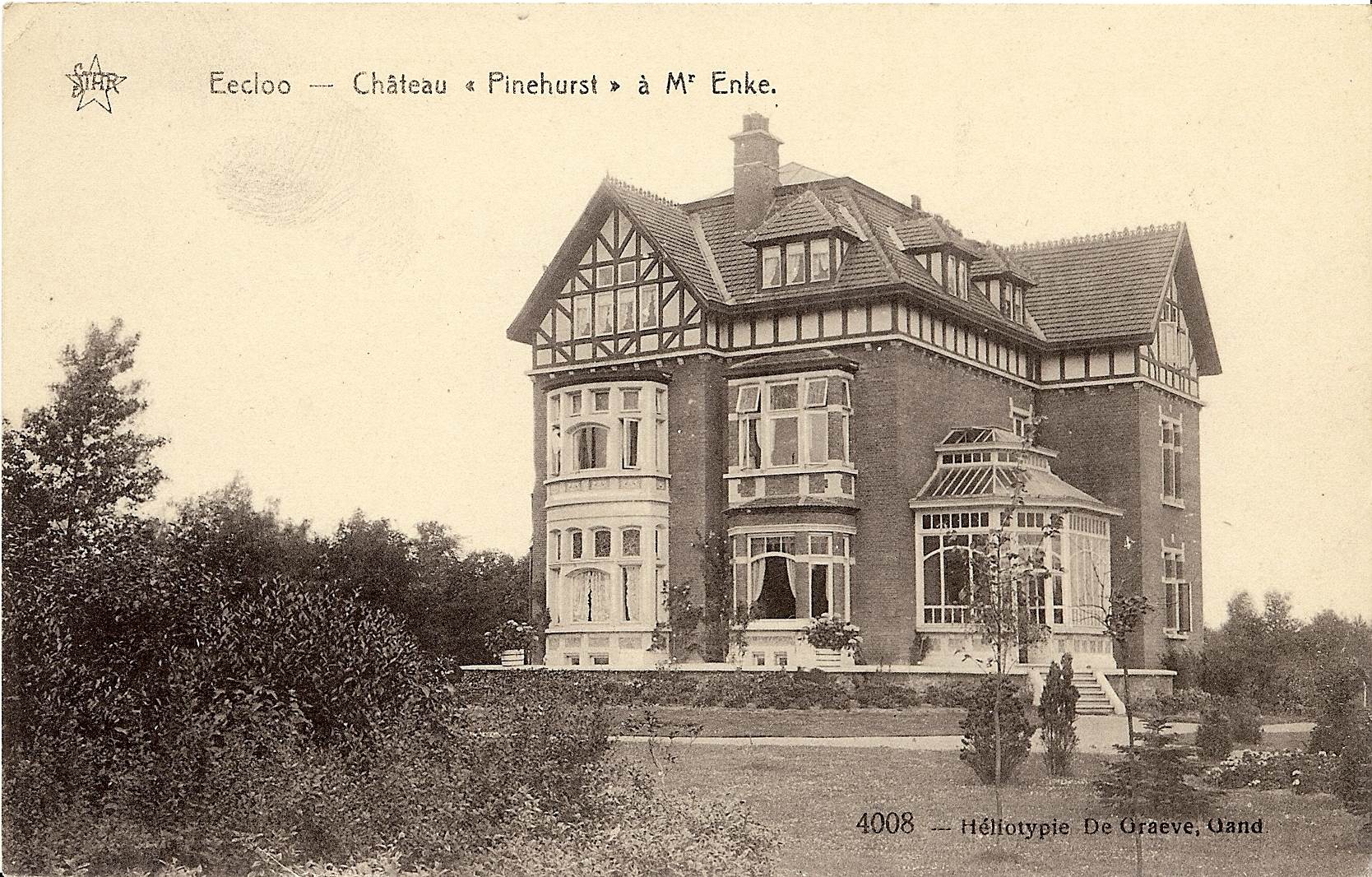
| Pinehurst, the home of Peter and Isabel Armstrong |
She suggested going to the Pill box. I was mystified as we went along the sandy path between espaliered pear trees. For Margaret said that the Oaklands pill box was in the back field and camouflaged so it couldn’t be seen from the air. When we reached the far end of the field, Margy (as her family called her) pointed to a low cement boxlike affair that was covered with sods of grass. In the winter it flooded down below, Margaret said. They had a pill box in their birch wood Margaret said. The trees hid it partly from the air, and birch branches had been spread over it like a concealing mat.
In the next few weeks Margy and I often cycled along the road that led to the village of Lembeke. We saw several other pill boxes in the wayside fields. Years later my father explained about this curving line of carefully concealed gun positions.
One morning Margy and I were told that we and my parents were going to Ypres next day. Just a day trip in the big Enke car, and the chauffeur Kamiel would drive. We’d be seeing world history with our own eyes, my father said, and we’d remember it all our lives. We didn’t want to go. But we went. Two cross kids. We stopped at one or two spots on that route through the flat treeless land. At one such spot we walked along a designated track that wound among the shell craters. At another we walked along a short stretch of muddy trench. For many years I had a snapshot of Margy and myself standing on top of a wrecked tank. Our hair was blowing in the wind and I was wearing an ugly but extra warm winter coat.
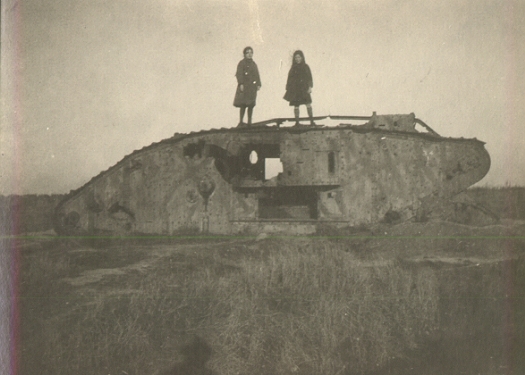
I went to Ypres several times after that first visit with my parents. For in the late 1920’s, when I was at boarding school in Sussex and my parents were in Canada, my official guardians were Margy’s parents, Peter and Isabel Armstrong, who lived at Pinehurst, the house next door to Oaklands. [Ed Note: Peter Armstrong, Max’s eldest brother, was christened Hermann Peter Enke when he was born in 1876. He later married Isabel Lunt whose mother’s maiden name was Armstrong. During World War I, because of the virulent anti-German feeling in England, Hermann changed his name to Henry Peter Armstrong.]
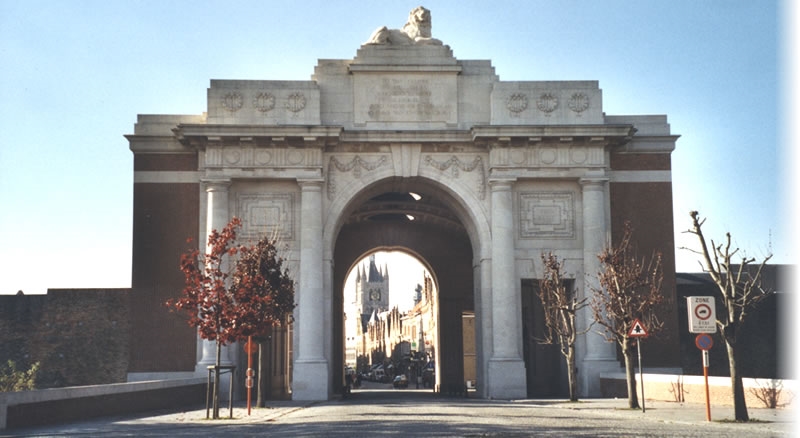
Ypres was not a long drive from Eecloo and it was interesting to see the gradual changes. The fields we drove past were no longer a dreary battlefield pocked with shell craters. They’d become farm fields, though all trees were comparatively young. Ypres was ready for tourists and shops sold books of sepia-coloured picture postcards — showing Ypres before the war and after — cafe’s, patisseries, restaurants, hotels. But the big reminder of the war was the white marble Menin Gate where the names of the missing men were printed in gold on the white panels of the gate. There were interior stairs you could mount and always, at each side, were the golden names on white. These were the missing men, not even found, just blown to bits, bodies squashed into the blood-soaked mud of what had been fertile farms. A foot left in an army boot, an arm here, a leg there. No wonder the later poets of World War I wrote so bitterly as the slaughter dragged on.
Some Eecloo stores had picture postcards of the town and nearby features. The card of “Oaklands” was labelled Château Enke. According to Larousse Château is simply “a fine big country house.” It was certainly large, and originally it was in the country for the Oostveldtstraet (Eastfieldstreet) ran between fields and farms and was the direct way from Eecloo to the village of Lembeke.
[As an aside — the parents of Remi de Roo, Bishop of Victoria, emigrated from Lembeke to Canada where Remi was born. His father died in Manitoba.]
* * *
The Oaklands drawing room and dining room had the highest ceilings of any house I’d ever seen.
The drawing room was divided by an archway with, on either side, a swoop of brown velvet curtain fringed with bobbles. Normally the curtains were looped back by golden cords with fancy tassels.
In the front drawing room was the oil portrait of Hermann Enke that, left to my brother Stephen, was lost in the fire that destroyed the house in Santa Barbara.
The back drawing room became magical at Christmas. The gardeners used to bring in a tree so tall that it almost reached the high ceiling. The butt of the tree was set in a strong metal holder that was part of an unforgettable music box. The Christmas tree ornaments were brought down from the attic. The sturdy tins holding the ornaments were those 9x9x9 tins in which Peak Frean, and other such firms shipped their biscuits to wholesalers. The tree was lit by candles and revolved slowly as the music played. By tradition the tree stood in the bay window of the back drawing room, the candlelight was soft, the familiar ornaments appeared year after year. At the time I never wondered why there were only two of the slotted metal disks (rather like the perforations on rolls for a player piano. Just the same method, I guess.) Two disks, so we had just two tunes. I did not care for the Last Rose of Summer but Marching Through Georgia was fun.
Decorating the tree was a task for Margy and myself. It took us three days. Always when the candles were lighted an adult stood casually by the bay window. A hollow metal curtain rod was ready to use as a blow pipe if a candle should gutter or burn too low.
There were two special evenings in the Christmas season. On one all the children of the garden staff came. The other evening was for the children from the row of houses just across the Oostveldtstraet. On the tree was a special present for each child who came forward to get it as the name was called. After that there was a short interval when some of the mothers urged a child to recite a verse or sing a song. We listened attentively, clapped loyally. The finale was my grandfather standing in the doorway, and slipping a silver coin into the each child’s hand as part of the handshake. I think there may have been cookies or coffee in the kitchen with Lena and Marie. (In 1921 most of those Christmas guests wore sabots. These were left in the back kitchen as they had sort of carpet slippers worn inside sabots.)
At the time these occasions seemed lovely to me. Since then I’ve often wondered how those parents felt in their hearts. It seems too feudal to me now.
Manchester and Withington (1919 – 1921)
The 1919 – 1921 trip to Europe was part Belgium and part the Manchester suburb of Withington where my maternal grandmother lived at 8 Burlington Road.
It was raining the afternoon we arrived in a horse-drawn omnibus as we had too much luggage for a taxi. My grandmother ran out to greet us and she and mother began to exchange news. I ran into the garden where a leafless tree looked easy to climb. In minutes my hands were black with soot, and my neat beige travelling coat was ruined, or so my mother said. Thus I learned that trees were not for climbing in Manchester.
The garden beside the house was a stretch of long roughish grass that had been a tennis lawn. At the back of the house was a neater lawn outside the windows of the South Room, a room I’ll remember as long as mind and memory last. Less grand than a formal drawing room, more than a sitting room, it had a glass-fronted bookcase in the corner. The top shelf of this was “the Museum” holding unfamiliar shells we mistakenly called Maori shells instead of cowries that are found in the warm seas in Asia and the extreme south of India. These glossy shells were used as money in parts of Africa we were told. So we used them as money when we played gambling games.
The great pleasure for me was the shelf of books in the bedroom. They belonged to my youngest Aunt, Caroline, who was born after her father’s death in 1899 [Ed. Note: this is not correct. Caroline was born in 1897]. I’d had a few books in Victoria, but nothing like this. Several of the Colour Books by Andrew Lang were there. His Blue Fairy Book (1899) and the first of his collection to appear; there was the Green , the Olive and I think two others. I read them avidly, not so much for the fairy content, I think, as for the smooth and flowing style. Howard Pyle was there too. I turned again and again to his Merry Adventures of Robin Hood. That shelf of books was a special part of the European visit.
The South Room was special too. Grannie’s little slipper chair was a novelty to me. In its South Room days it was covered with red velvet. In the 1980’s that same chair was in a Pasadena living room where chair cover and curtains were of the same light coloured patterned material.
When the Manchester Guardian’s great editor C. P. Scott bicycled over from his home in Fallowfield, he and Grannie would sit talking in the South Room, and I wish now that I had been older because often they were discussing the newspaper ideas and policy. But I was too young to realize what a noble and important man he was. I just thought of him as “Scottie” who put his bicycle on the front porch if he rode over on a rainy day. His daughter married C. E. Montague who wrote the novel Rough Justice.
While we stayed at 8 Burlington Road on that 1919 – 1921 trip, I went to Withington Girls School of which Grannie had been one of the founders.

I’m still grateful for my spell at that school, the best school I would attend. Many of the students were the daughters of Manchester’s intelligentsia, and thus many were Jewish. They did not come down to the daily assembly, and they were absent from school on certain Jewish festivals. Such differences were unimportant, and were taken for granted. There was no trace of anti-semitism, and mercifully none of us could foresee the coming of Hitler. Even now, the sort of laughing comment about Jews fills me with cold contempt for a mind that lacks charity.
The two individuals I remember best from Withington Girls School are Doris and Miss Casswell.
Doris, small, palefaced, red-haired, was on a scholarship. Good at most subjects, she excelled at Math. A broad, broad Lancashire accent. But her mind snapped tight on a Math problem.
Miss Casswell admired the natural world in the true sense of admire. For the Latin verb mirare means to admire or marvel at. She could make us marvel, too. The morning I remember best was about Paws and Claws. Miss Casswell drew two simple diagrams on the board. One was of a dog’s foreleg and paw. The second was of a cat’s leg. We saw the muscle in the cat’s leg and how the claws retracted. Then we contrasted and compared the two diagrams. Somehow, to this day, a purring cat, kneading its paws, a dog’s claws clattering a little on the linoleum, can remind me of Miss Casswell and that long ago lesson in Withington.
The Aunts and Uncles
The 1919-1921 trip was the first real encounter with our relatives for Stephen and me. I’d been exhibited as a baby to the Enkes and Lejeunes. But Stephen, born in 1916, was only known to them through Mother’s letters and his father’s snapshots. There seemed to be swarms of Lejeunes and only three Enke’s of my parents’ generation and “Papa” who was Hermann Enke who lived until 1926.
Grannie Lejeune, who married Edward before she was 20, had Franziska in 1878, followed by 3 girls, 3 boys, 4 miscarriages according to accurate Max, and, finally Caroline born posthumously [Ed. Note. This is incorrect. Caroline was born in 1897] as her father had died in Zurich in 1899 while he was travelling in Switzerland with his second daughter, my mother, Marion.
I’ve never seen a formal group photograph of all 8 children. The Isle of Man photograph, of which Max made a copy, included Arnold but not Caroline. The formal photograph, nicknamed The Oliver Cromwell Hats belonged to Juliet for years. There should be a copy of it in the family photograph box currently at Narnia. Four solemn little girls, Franziska (1878), Marion (1879), Juliet (1880), and Helena (1881 or 1882). All wore tall black velour hats like those worn by the Roundheads in the seventeenth century Civil War between Roundheads and Royalists. There were two distinct physical types among the 8 children. Marion, Juliet, Arnold and Caroline resembled their father and had his blue eyes and light brown hair. Franziska, Helena, Alick and Russell had their mother’s brown eyes and slightly darker brown hair.
The girls were more academic than the boys. Franziska went up to Oxford, read English, got a first class. Marion, considered good at Math in her school days went to Cambridge (Newnham College) as Cambridge was then considered better than Oxford for Math. Released from the responsibility of being a prefect, and the oldest but one of a large family, Marion decided to enjoy her first year at university. She played a lot of grass hockey, went to endless cocoa parties and ended her year with a 40% examination mark. This was not good enough for the authorities. She must either switch to another subject or leave and make way for a more dedicated student. She switched to English, completed her course and gained a first class.
Juliet, the third Lejeune girl did not go to university, I think. She had some teacher training and got a certificate or diploma that would have enabled her to teach small children. Helena, who like Juliet never married, went to Oxford, read English and got second class marks.
Franziska and Marion both married and neither made professional use of their education, although Marion did teach for a year at a new school for girls at Southwold on England’s East Coast. There she met a teacher, Lucretia Cameron who later had a school for girls at Seaford in Sussex [The Downs School, Sutton Road, Seaford]. Although Helena only got a second class and was considered academically a mite inferior to Franziska and Marion, she had a teaching job at Huyton near Liverpool. This Huyton school for girls had, I understood, a good scholastic reputation. When I was Oxford in the late 1920’s, I met a girl from Huyton. She was a tall, blond, almost classic beauty with a broad Lancashire accent and a scholar’s gown. Her name was Josephine, but I’ve forgotten her surname. She was at Oxford reading English, she said, because of a wonderful teacher she’d had – a Miss Helena Lejeune. She described the inspired teaching, the extra coaching time given so generously and enthusiastically. She couldn’t have afforded university without a scholarship, she said, and winning it was entirely due to Miss Lejeune’s teaching.
Caroline went to Manchester University, read English and emerged with distinction. She never taught. Instead she worked for the Manchester Guardian (later called the Guardian), becoming their film critic. She was convinced that the cinema was a new twentieth century art form, and pointed out to the paper that as films were released in London before Manchester, the paper would be better served by having her as film critic in London.
After Tony’s birth in 1930 and Caroline’s switch to the Observer, her column of film criticism was called At the Films. She was still writing in the 1950’s. I’m unsure of when she retired. That column was very well known, and she was at her best in the 1940’s I’d think.
Caroline’s books were Cinema, Chestnuts in Her Lap, and her autobiography Thanks for Having Me.
Arnold wrote textbooks about the English language. He had no university education but he had a lively and enquiring mind. And he was of that rare breed – a born teacher. Emigrating to California in 1924, he spent several years at the Thatcher School in Ojai. There he met Archibald Hart and much admired his book Twelve Ways to Build a Vocabulary. Together, and at Dr Hart’s request, they wrote The Growing Vocabulary. After the Thatcher School, Arnold joined the Crane Country Day School in Santa Barbara and, later, became its headmaster. He wrote The Latin Key to Better English. He died before PBS gave TV audiences The Story of English. It would, I’m sure, have been much appreciated by Arnold.
Edward
So many Lejeune men have had Edward as one of their given names.
A list of Enke/Lejeune names was among Max Enke’s papers. Max, a stickler for accuracy, had listed
1) Edward Adolf Lejeune. Born Frankfurt(?), died Zurich, Switzerland. 1899.
There is no doubt that he was “in cotton.” Manchester’s damp climate suited the manufacturing of cotton. In fact, Manchester was the centre of the cotton trade.
It’s probable that he was born in Frankfurt, for, at the end of the 18th Century a popular physician Dr Francois Adam Lejeune lived in Frankfurt. This Dr Lejeune was determined that his two sons Edward and Gustav should have the best education Europe could offer. So, he searched in France, Germany and Switzerland. On his travels he learned that a man called Pestalozzi had a school at Zurich. He heard that some fashionable folk felt that the school was too rough and simple, put too little emphasis on social manners. Dr Lejeune visited Zurich so he could discover more about the school. From a distance he watched boys and some of the masters playing a kind of football in a field. He felt they were healthy, were energetic, happy looking boys and there seemed to be an easy informality about the way they welcomed any teachers who appeared. In fact, after having gone to the school itself, met Pestalozzi, and joined in a school meal where he found simple but healthy food, and the easy atmosphere so much to his liking, he sent his sons, Gustav and Edward, not yet in their teens, from Frankfurt to Zurich at a time when groups of soldiers from the Napoleonic wars were roaming across Europe.
My mother told me the story of Gustav and Edward. She was reading and translating from a thin green-covered book written in German by a Lina Lejeune. Mother mentioned too that Dr Francois Adam Lejeune and Pestalozzi had corresponded with one another, and that part of that correspondence was in a Pestalozzi museum in Zurich (see Appendix D).
It’s interesting to me that E. A. Lejeune, having fathered the four girls Franziska, Marion, Juliet and Helena, called his first son Gustav Alick, the second Edward Russell, and the third Frances Arnold whose initials F.A.L. were also those of Dr Francois Adam Lejeune.
There is no Edward among the Canadian descendants of E.A. Lejeune. Edward Russell, who emigrated to Australia, married Rachel Percy. They had four children – Josceline, Aynis, Patty and David. Josceline, writing for Christmas 1988 put her new address as 7 Wilson Street, Claremont, W.A. 6010. Widowed, she is Josceline Thom.
At Thousand Oaks, in California, there is an Edward Lejeune, son of Gordon Lejeune. This slim boy in T-shirt and jeans lives in a world that would startle Edward Adolf Lejeune. And yet, to me, there is a slight facial resemblance between this 1988 Edward and a portrait of his great-great-grandfather as a small fair-haired, blue-eyed boy wearing a green velveteen or corduroy jacket with a big, floppy light-coloured collar. The picture’s frame was narrow and golden, the surround was cream-coloured, and the portrait round not oval. A photograph of that photo should be in the Family Photograph box that Derek took back to Kamloops to file and “sort.” Max took the photograph of the picture, so it will be clearly marked and identified on the back.
Victoria (1921 – 1924)
The return to Victoria in 1921 was a let down and I think I must have been in a pre-adolescent haze. But I remember my bicycle, my beautiful dove-grey bicycle with a back-pedalling brake. It was only an ordinary push bike – no extra speeds. Few people had even a three speed. The idea of a ten speed was quite unknown to me.
The beauty of my bicycle was destroyed by my father who said that, if the chain snapped or came loose, I’d be without a brake and might have a fatal accident.
His solution was a rod going up the stem of the handle bars. It connected to a cable extending to the right handgrip. If I pressed a shiny lever that stuck up like a sore thumb from the bike’s original handgrip, the rod would activate the brake now attached to the front wheel’s rim.
My father was pleased. I was not. The new brake system was hideous. My beautiful bicycle was ruined. I was heart broken. It was quite simply the end of my world.
From 1921 – 24 I remember how we had a relief collection for the Japanese children whose homes had been destroyed in the Tokyo earthquake of September 1923. It was sad, of course, about all those homeless children, but they were so far away that they ranked about equal with “Eat your crusts and think of the starving children in India.”
After the Withington School, Victoria’s Norfolk House seemed small. As I remember it in 1922 it had two classrooms. One upstairs and one downstairs in a solid well built home on a quiet street. I remember it chiefly as where I first glimpsed etymology, as part of Miss Atkins teaching us Latin. I hated Latin grammar and the memorizing of conjugations and declensions. But when Miss Atkins talked of Rome, of the Holy Roman Empire’s spread, of monks copying medieval manuscripts written in Latin, the drudgery of grammar seemed less hateful. It was exciting to learn that language is forever changing, that words travel from one language to another, and that many words come down to us through the centuries.
I’ve forgotten most of the Latin I learned at school and university. But I do remember clearly that my first excited look at language was at Norfolk House School and was thanks to Miss Atkins’ teaching.
Perhaps my excitement was partly inherited from my maternal grandmother’s background, of a long line of preachers and teachers. Perhaps it partly stemmed from the “hunger of youth,” an expression that my mother used in her article Manchester Memories that appeared in the July – August, 1945, issue of The Horn Book Magazine.
It happened that Mother had heard her grandfather Dr Alexander MacLaren (a Baptist minister so famous that people travelled to Manchester to hear his sermons) mention in his sermon The Story of an African Farm and its “dreary creed.”
In The Horn Book mother wrote, ” The moment we arrived home I went to the dining-room bookcase in which were kept the grown-up books that we were not allowed to read, and, curled up on the floor between the bookcase and a large armchair, all ready to slip the book back if anyone should come, I started posthaste on Olive Schreiner’s story. The philosophy was beyond my comprehension, of course, but I was gripped by the power of the book, and there was a completely new atmosphere in it that I absorbed with the hunger of youth.”
Manchester Memories was the only article that Mother ever wrote and it was done entirely for the sake of her children and grandchildren [Editor’s Note: see Appendix A for a complete text].
Alexander Maclaren
Grannie Lejeune’s father was Alexander Maclaren (1826-1910), born in Glasgow on February 11, 1826, the youngest child of David and Mary (née Wingate) Maclaren and one of six children. His father, David Maclaren, was a businessman.
Educated in Glasgow and London, Alexander Maclaren became one of the most famous preachers of the nineteenth century. He began his career in Portland Chapel, Southampton in 1846, and, in 1858, moved to Union Chapel, Manchester where he stayed until 1903. On March 27, 1856 he married his cousin, Marion (who died on December 21, 1884). He died on May 5, 1910.
Alexander Maclaren’s preaching was so vital, so powerful, and so fresh that Union Chapel, which seated fifteen hundred, would often be packed with over two thousand who had come to hear him.
Many details of his life and sermons can be found in Albert H. Currier’s Nine Great Preachers, published by The Pilgrim Press in 1912. Included in the book are such other famous preachers as Bernard of Clairvaux, John Bunyan, and Henry Ward Beecher. In its bibliography are to be found the following citations:
Miss E.T. Maclaren The Life of Alexander Maclaren Hodder & Stoughton London, 1911
Sermons Preached in Manchester 3 vols MacMillan & Co.
The first book is out of print, but a copy is available from the University of Toronto.
After Stephen died, in 1974, I corresponded for a brief spell with Tony Thompson who wrote under the name of Anthony Lejeune. One night, to my surprise, switching TV channels I caught William J. Buckley Jr interviewing Bernard Levine and Anthony Lejeune. I watched with great interest. Tony was balding in exactly the same pattern as his father Roffe Thompson. But suddenly there was a fleeting facial expression that reminded me of the picture of Alexander Maclaren holding a very long thin-stemmed clay pipe.
England and the Continent (1924 – 1931)
In early 1924 we were once more packing for a trip to Europe as I was to be sent to boarding school in Sussex [The Downs School, Sutton Road, Seaford, Sussex]. My mother chose the school as she and the school’s head-mistress [Miss Lucretia Cameron] had met when both were teaching at a school in Southwold in 1901. Also my cousin Margaret attended this school at Seaford in Sussex, and was happy there.
So Mother, Stephen and I went to England. My father did not come with us. I rather think that, unlike Mother, he didn’t consider an English education was so much better than a Canadian. I can recall him seeing us off in Vancouver and looking sad as we went towards the train.
When Caroline moved to London, Grannie Lejeune moved there too. 8 Burlington Road, Manchester became 19 St Loo Mansions, Chelsea, where Mother, Stephen and I stayed, and where Russell and Rachel and Josceline were in 1924 – the first year of the Wembley exhibition.
The Wembley Exhibition was in 1924. I went to it fairly often as Roffe, the man my Aunt Caroline would marry, lived at Ealing and was delighted to have a young relative he could treat to a day at the exhibition. We went often, eating strange foods, wondering at the exhibits and taking in the amusement side of the exhibition. The Giant Racer scared me but it was so thrilling that we always had a turn on that. Caroline refused to go on a thing called Over the Waves. I went. The trip started with a walk down a dark passage. Suddenly, without warning, the floor gave way and I was dropped on to a heaving, rolling sort of canvas. It carried me along, helpless, and the sound of laughter grew louder all the while. Then, again without warning, the galloping canvas slid me safely to a stationary floor. The space there was full of people who’d gone “over the waves” on the trips before ours. They’d stayed to watch. We watched the next trip, too. The women tossing helplessly – their skirts tossing with them, and thus displaying all kinds of underwear, while some watchers hoped for a case of no underwear at all. I understood the laughter now and Caroline’s reluctance.
The exhibition in 1924 was so popular that it was repeated in 1925 although I didn’t go. The second year had fewer exhibits from the dominions and colonies and the entertainment side was enlarged and emphasized.
Somehow we fitted in some weeks at a village called Steyning [ed. note: Steyning is in West Sussex, 5 miles northwest of Shoreham-by-Sea which is between Worthing and Brighton. Steyning is described in the AA Book of British Villages, Drive Publications, 1980 and in the AA Illustrated Guide to Britain, Drive Publications, 1971.] Grannie, realizing that Marion and two children were in England, that Russell, Rachel and their eldest child Josceline (born September 1916) were also in London, and that Arnold and Gladys with their two children were leaving shortly for California, rented a house in Steyning. It was really a small boarding school so it was vacant during the summer and there were plenty of beds and bedrooms. “So the little cousins can get to know one another.” The little cousins didn’t care for each other as I remember. Especially after the incident of Joscie and the grapes. Grannie as a great treat had bought a large bunch of grapes. When a child was offered the bunch of grapes, he or she was meant to break off a stem with about 5 grapes on it. Joscie took the whole bunch, the way she was used to in Australia. (In the 1970’s when Josceline visited Victoria we laughed about this.)
I was the eldest of the cousins as Stephen, Diana and Josceline were all born in the summer of 1916, and Michael was younger.
We went for enormous walks on the Downs – to Cissbury Ring, to Chanctonbury Ring with the lovely rustle of leaves to be heard from its beech trees. I remember Russell scooping up a handful of water from a dew pond.
Later that summer, I was at Grannie’s Chelsea apartment when Russell and Rachel were there too. It was near the end of their stay I think. They’d been shopping madly one morning as they were going that afternoon to a garden party at Buckingham Palace. They were both very good looking and wore their clothes with style. They went in a taxi, Russell with a top hat, I think, and Rachel with a lovely garden-party dress and becoming hat. After the rush and excitement of their dressing and departure Grannie and I stood at their bedroom door and looked at box after box and the masses of tissue paper scattered around, wondering how such finery could emerge from such a muddle.
Boarding School
The summer of 1924 was not all Wembley, as we had to get my clothes for boarding school which started its autumn term about September 21 and not just after Labour Day (the Summer term lasted until the end of July so the academic year was about the same length as in Canada).
The school list of required clothes seemed very firm and official.
I’d been excited when I first read it – 2 coats and skirts – a navy one for winter and a white for summer and all those tussore shirts for summer. The white shirts were to go with the suits and tussore were summer wear under tunics, the red pullovers were winter wear under a tunic, 6 pairs of long black woollen stockings, black woollen tights and white cotton linings to wear under the tights, black felt hat for winter and white straw for summer, 2 pairs of black brogues, tidy slippers, bedroom slippers – top coat – mackintosh.
I was bored before we’d bought them all. Mother was worried about money and it was costing far more than she’d realized. She couldn’t see the point of all those vests. Roffe noted that much of the clothing was to be obtained from a firm Samuel Bros (or Samuel & Son). Old Samuel must be making a pretty penny, he said.
By September, I was thoroughly sick of counting the garments for school and seeing that each was properly marked. Cash name tapes – boxes of them it seemed. Years later in Victoria I met Gwen who’d married into the Cash family.
Then the final day came. In navy coat and skirt with black velour hat and trunk and first-night-case I was taken to Victoria Station to catch the 5.20 p.m. Victoria Station, serving mainly the southern counties, was an experience at the start of term. Many schools, many different uniforms. Not all on the 5.20 p.m. Not all the same sex. But all the same kind.
I spent five years at boarding school. They certainly left their mark on me. Ten years after I left school, I still had the occasional nightmare about the beginning of term and catching the 5.20 p.m. It was a good school of its kind – not as big as Roedean, less classy than Battle Abbey. But it was so ruthlessly athletic, so plastered with slogans about team spirit, hard work, self control. Recalling it now, I’m certain that there were only Anglicans there. I was the only girl in the school who’d never been christened. The snag was: no christening, so I couldn’t be confirmed; not confirmed, I could not go to Early Service at the Parish Church. Even when I was in the 6th form and a prefect, I still was obliged to go to Matins with the Juniors. A crocodile of all those chattering little creatures from the fourth form, in our school uniforms and wearing black suede gloves in winter. And standing, tall and gawky, while we all sang about “the rich man in his castle, the poor man at his gate, and something, something, God ordered their estate” [ed. note from the unabridged version of ‘All Things Bright and Beautiful.’] No wonder I’ve never been a church-goer since!
The school slogans and mottoes were all in Latin. The school motto was Potens Mei quid non Possum i.e. Master of Myself what may I not achieve? Among the form mottoes were Per Aspera ad Astra, and Nihil sine Labore. The three “houses” were School, Tower and Bydown. I was in School House so my house motto was Play up and play the game. But in spite of these brave mottoes our winter greeting to one another was “Have your chilblains broken yet?”
Strengthening my character with mottoes like these for five solid years! When the time came to leave school for good, many of the girls cried. I do know that this school made me hate regimentation, compulsory religion and Birds Custard, especially when it was used to top off what we called Resurrection Pudding. Even a pudding had a religious name!
Life’s so full of surprises. Early in 1972 when I was dismantling my father’s apartment and checking the vast quantity of papers he’d amassed, I found a packet of letters I’d written home during my first year at Seaford. In them, there was no whining, no hint of unhappiness, and no mention of the horror of never being alone. For I found this herd living the greatest trial of all. Every minute of the day was organized. Even at night the dormitory was full of sounds of others. The only escape was in the winter evenings during the half hour between the end of prep and bedtime. Then I sometimes sneaked down to the cloakroom, took the rubbers I now called galoshes out of my numbered pigeon hole, and, stealthily crossing the road between School House and the huge playing field, began to run, run, run around the field in the darkness. Often it was cold and windy, but just running, wild and alone, was a help.
Judging by my letters home I was already brainwashed and an accomplished hypocrite. I destroyed all those letters after I’d read them in 1972 — the pages of thick white paper, and each stamped with the school shield and its familiar motto — so I have no actual letter to quote. But the fabricated one that follows is typical of most of them:
“Darling Mummy & Daddy,
We had a ripping game of lacrosse today. You should have seen Smithy run. She’s the fastest in the school, and this year she’s head of our house. Today, after games, she let me carry all her books up to the prefect’s rooms. Wasn’t it topping of her? She wants me to play my best for the honour of the house. And I shall jolly well try.”
[1988 comment: Where did I put my ulp-bucket?]
* * *
Possibly the pleasantest part of my time at Seaford was the long walks we went on Sunday afternoons. I grew to enjoy the Sussex Downs that had seemed so bleak and bare when I saw them first.
The arrangement for walks was safe and simple.
On the school notice board the listed walks showed which prefect or senior girl was taking the walk, and the destination. We signed under the walk we wanted to go on. Some leaders and some destinations were more popular than others. There were usually 6 – 8 in each walk, and walks would be about 8 – 10 miles. Our black brogues would get covered with white chalk. But Rupert, the boot boy, cleaned them and cleaned them well. I’m sure none of us ever thanked him. To me, now, such lack of thanks seems intolerable.
One of the favourite walks was to walk to the top of Seaford Head, along the top for a mile or so to a rise from which we could see the Seven Sisters marching firmly towards Beachy Head, then down to the Cuckmere, along the Cuckmere Valley to Alfriston. From Alfriston we went up steeply past the White Horse of Hindover where the short cropped turf had been removed to show the outline of the horse. (The Long Man of Wilmington was too far for us to walk. But relatives visiting by car on a designated date might take us there so we could see the Long Man looking towards the shires.) From the top of Hindover it was an easy downgrade to school and Sunday tea with the special treat of butter and jam, instead of the plain weekday either/or.
* * *
Our morals were well protected at school. The newspaper we were allowed to see in the last half hour of the day was the Times. One copy was put on a table in the “drawing room” which, instead of desks and wooden chairs, had two sofas and several arm-chairs all with cretonne loose covers. However, if the Times happened to contain an item that might tarnish our purity, we had to re-read the previous day’s issue.
Any mention of a divorce case was considered poor taste. Alan Patrick Herbert had joined the staff of Punch in 1924. He wrote as A.P.H. But it was not until 1937 that he and other M.Ps managed to modify England’s outdated divorce laws by securing passage of the Matrimonial Causes Bill (Holy Deadlock is the book by which he is best remembered.)
At the start of each term our private books which we had brought to school were scrutinized by the head mistress, Miss Lucretia M. Cameron. Approved authors were Anthony Hope, Baroness Orczy, Rudolf Sabatini. Conan Doyle’s Sherlock Holmes was acceptable — Edgar Wallace and Sax Rohmer were rather borderline. I never took any books to school as I had none of my own in Europe. At school the Library had enough for the hour of Reference Reading as they called it on Sunday evenings. My mother’s generation had had Sunday reading. Reference Reading simply meant reading nonfiction. If I stayed with Roffe and Caroline during a vacation, their house at Pinner Hall was full of books.
* * *
At the start of most terms, on the night before the dreadful day of catching the 5.20 p.m. from Victoria Station, I was taken to the theatre. So, in the Seaford years, I saw Rose Marie at Drury Lane, and The Desert Song. No No Nanette and The Constant Nymph. were at lesser theatres. Aunt Isabel much preferred musical plays, but she unselfishly treated me to The Barretts of Wimpole St. We watched the authoritarian Mr Barrett riding herd over his daughters, including Elizabeth who, a life-long invalid, lay on a sofa with her lower limbs discreetly covered by a shawl. Papa B. discouraged or forbade all potential suitors. Yet, after great tension and suspense, the handsome Robert Browning stood by the doorway and just inside Elizabeth’s room. He stood there, handsome, talented, the answer to a maiden’s prayer. Elizabeth didn’t wait to pray. He held out his arms and, joyfully, she ran into them on legs that had lain limp on the sofa for years. He clasped her in his arms. It was so beautiful and romantic that I was utterly thrilled. But a little whiffling sound beside me made me look down. Aunt Isabel was breathing rhythmically as she sat there, sound asleep.
The most carefree 5.20 p.m. departure I ever had was when Roffe took me to lunch in Soho. He was editor of John Bull at the time as the former editor Horatio Bottomley had ended up in gaol after a financial scandal. Roffe gave me a very good lunch at one of his favourite restaurants. Plenty of good food, plenty of wine, perhaps a bit too much as I was feeling fairly irresponsible as I hurried through the station to the platform for the 5.20 p.m. to Seaford.
There they all were — navy blue suits — school hatband with its crest — the school tie. Each girl had her “first night” case. Tuck boxes, neatly labelled, went into the luggage van with the trunks. We wouldn’t see them till next day in the “dorm.” And I was nearly late. I, the head of the House and the head of the School.
Potens mei quid non possum?
Thanks to Roffe, I didn’t give a damn!
* * *
I became Head of the House and Head of the School because I was competent, reliable, and able to address the entire shcool with ease. Also I reminded Miss Cameron of her youth, I think, when she and Mother taught at Southwold and they used secretly to smoke cigarettes behind one of the outbuildings. Also she was fond of me – I’d argued that she was wrong in not letting me go out with Maud Gordon on a visiting weekend. All because Maud’s father had with him the woman who was the cause of the recent Gordon divorce. Also when Roffe, to be annoying I think, had given me a new portable gramophone and a selection of current dance hits, Miss Cameron sent for me, furious at the noise. What had I got, and why? I simply, on impulse, gave her a hug and kiss and said I was just trying to give them a good time on my birthday, because the school had a good time on her birthday. She melted at once.
* * *
On Grannie’s bureau desk was a bowl of reddish wood that the Australian relatives had given her. Beside the bowl was a tall copper vase of which I have a tiny replica.
When Grannie died all but one of the bureau drawers were empty. In the top left hand drawer she had put her will, the necessary information for quick settlement of her affairs. She died of pneumonia in April 1936. My mother was staying at Grannie’s house Fallowfield. Her letter to Max is short:
“Mother died this morning after a very hard fight. She was pretty bad all yesterday, but was able to recognize all of us. At about 10 p.m. she began to get very bad, and at 4 a.m. the nurse told me to send across for Cis, Juliet, Alick and Caroline who were at Lane End. She sent for the doctor, too. At the end he gave her a little bit of morphia to help the pain and she died very quietly. It seems impossible that it’s only been two days and a bit since I came.”
They did as Grannie had wanted – Cremation at Golders Green, ashes scattered not kept. And the family gave Christmas Roses to the Garden of Remembrance. Dear Grannie, who was on Galiano Island when I was born in 1910. Dear Grannie, who when her own father died earlier in 1910, wrote that she was proud he’d given “the honour of his name to that great new social reform – cremation.”
In 1924 Grannie had been in Chelsea at 19 St Loo Mansions and Roffe and Caroline had been at Ealing. The move to Pinner Hall in Middlesex must have been in 1925. Grannie called her house Fallowfield and Roffe and Caroline’s was Lane End. Roffe’s surname was Thompson but professionally Caroline always used Lejeune. Mrs Thompson would come to see them on a short visit. Like Gracie Fields she’d been a Lancashire Mill girl. She couldn’t sing like Gracie but when she wanted to help the family finances she taught herself to write. I never read any of her books but I think they were romances that used her knowledge of mills and mill girls — their home lives, their dreams. I’d be interested to read some of them now but it’s doubtful they still exist. Good Lancashire grit.
Roffe and Caroline had only one child, Edward Anthony. He grew up to write too, as Anthony Lejeune. Patrick Lejeune who lives in Pasadena knew Tony and has had him staying there. After Tony’s birth in 1930 Caroline began writing in the Observer. Whenever I was staying at Pinner, I naturally heard a great deal about films and went to see as many as I could as Caroline passed on her spare press tickets to me.
These Sunday advance film showings attracted a number of fragile affected young men whom I’d only met in Patience or Buncombe’s Bride that I had in my collection of Gilbert and Sullivan gramophone records.
In Act 1, Reginald Buncombe (a fleshy poet) had seen the splendidly uniformed officers of the dragoon guards rejected by the twenty love-sick maidens who had preferred melancholic aesthetic men. In Buncombe’s opinion “Though the Philistines may jostle, you’ll rank as an apostle in the high aesthetic band, if you walk down Piccadilly with a poppy or a lily in your medieval hand…”
The free run of all the books at Lane End was a glorious time for me. No restraint at all. Roffe, who became editor of John Bull after the embezzlement scandal that put Horatio Bottomley in prison, had political books, books about journalism, celebrated trials, and plenty of good detective stories. Caroline was apolitical and her books were more literary. Her background, upbringing, University years had made English literature a part of her. In fact, the title off her second book Chestnuts in Her Lap comes from Macbeth, Act 1, Scene 3, where the First Witch, chatting to her pals on the blasted heath, says
“A sailor’s wife had chestnuts in her lap,
And munched, and munched, and munched.”
In the 8 Burlington Road days of our Manchester visit I’d been exposed to Caroline’s collection of Andrew Lang’s Colour Books. Among her books I’d also found those by George Macdonald, whom Grannie said was some kind of cousin on the Maclaren side. Caroline had At the Back of the North Wind (1871), The Princess and the Goblin(1872), The Princess and Curdie(1882).
In the Blenkinsop Valley days, I treated myself to A Critical History of Children’s Books, published by MacMillan Company, New York in 1953. It is one of my treasures. I’m really proud that I know so many of the books listed in the 15 page index at the end. The Introduction is by Dr Henry Sleele Commager, the Foreword by Cornelia Meigs who wrote the first of the four parts of this book which I consider should be in every college library even if it does not yet offer a course on children’s books. For this book, as it states clearly, is a survey of children’s books in English from the earliest time to the present. Part 3 is written by Anne T. Eaton, so well known in the world of children’s books in America. In her chapter on the gift of pure nonsense and imagination she rates George Macdonald as the greatest of Lewis Carroll’s contemporaries. Indeed she writes that Carroll and Macdonald were friends. Carroll told stories to the Macdonald children, and Macdonald urged the publication of Alice in Wonderland. Macdonald was a novelist, poet and clergyman. He studied for the Ministry, but resigned after holding a pastorate for three years. He was too visionary and not dogmatic enough for his congregation according to Anne T. Eaton.
Pinehurst and Oaklands
Pinehurst, home of my paternal Uncle Peter, was an important and happy part of my Seaford years. For, when I was left at boarding school and both my parents were in Canada, my official guardians were Uncle Peter and his wife Isabel.
Pinehurst was next door to my paternal grandfather’s house Oaklands. No fence divided the two properties — but we all knew the invisible line was the long straight sandy path past the mulberry tree.
In World War I Peter’s family had fled over the frontier to neutral Holland. From there they went to England. Because Enke was a German name and anti-German feeling was very high in England, Peter Hermann Enke changed his name to Henry Peter Armstrong. This was largely for the sake of his children, Godfrey (born 1905) and Margaret (1907) and usually called Margy.
Before they fled to Holland, they hid the silverware in the hollow terrace that was part of the house front. Otherwise, from what my parents told me, everything was simply left — clothes on their hangers, family photographs on the mantelpiece, and so on.
My grandfather stayed at Oaklands and so did his twin daughters Paula and Ady. The twins had been born in Manchester, England in August 1877.
In my teens I was not interested in all the details but I remember remarks about Ady going over to Pinehurst on routine inspection visits. German officers were quartered there and things should be run properly. I doubt she actually kept the linen cupboard key and issued linen as needed. But Ady slipped up on the brass stair rods. Towards the end of the war the Germans were getting short of brass and the stair rods, I think, were the only objects which disappeared. Ironically, the British, knowing that the German officers were quartered in a big house in that area, mistook their houses (and missed them!) When we were at Oaklands in 1919 the windows, shattered by the bomb that landed on the front lawn, were still without glass.
During the years I “belonged” to Pinehurst I had lovely clothes. Our shopping was mostly done in Ghent. Approaching Ghent we took the route that would let us see the three towers St Bavon, St Nicholas and the Belfry with the golden dragon atop its spire. Monsieur Verstraete was the tailor who made my brown coat, beautifully cut and finished, that had a becoming fox fur collar. I was proud of that coat but when I showed it off to Roffe in England he muttered that “it smelled of money.” Money-smelly or not, it was a stylish, flattering coat. Aunt Isabel went to Odette’s for lingerie. I had some beautiful camiknickers, with my initials expertly embroidered by hand. The silk was so slinky. About this time I had a black evening dress, of taffeta, I think. It was stiff and the hem dipped in a graceful curve at the back. It was simple, youthful and worn with a single strand of small pearls round my neck. Waists were low, skirts were short, and my two favourite summer dresses were of striped silk. Another favourite garment was an accordion pleated skirt with a pretty, silky jersey top. That skirt spun out beautifully when one twirled. Tidy stockings were silk, ladders were repaired with a ratchet crochet hook. No Nylons existed.
Pinehurst, too, was the place of good cars. Both Peter and Godfrey were very interested in them. Godfrey started with motor bikes, and later there were his cars. I remember the grey Rolls being shipped over from England. This car was later nicknamed the Super Standard. He was a good driver – and there was one lovely day when there were four of us out in the car, the hood was down and we drove very fast along part of the coast highway called the Route Royale.
Clothes were to the fore in February, 1928, as Godfrey married Denise Piron, the youngest and prettiest of the four sisters who lived with their widowed mother at Ostend. The wedding was in London. Margy and I were among the six bridesmaids. Our dresses were blue georgette over a pink satin slip. In 1988, I sent a night letter of Congratulation on their Diamond Wedding Anniversary. I timed it so that it would be delivered by the first post on Feb 2, the CNCP telegram service said. About the 5th of February the phone rang. A man’s voice, saying Ruth. It was a familiar voice. Godfrey saying the message had arrived safely — we talked briefly and the he said he’d put Denise on. From her I learned that he’d had a stroke in January so the Feb 2nd celebration was to be held later that month. Godfrey’s improvement continued as in June I had a letter from Denise (but signed by Godfrey). He wondered how long it would be before he could drive and wanted to know how soon after a cerebral aneurysm I was able to drive. He also wanted to know whether the Timmis Motor Co was still making model cars. I haven’t answered yet (July 15) as our cases were different. My epileptic fits, caused by brain damage meant that I must have two fit-free years before driving. I was born in 1910, Godfrey was born in 1906, so I would doubt that he could drive again.
I’m truly sorry about his illness. For he and Margy were like older brother and sister to me in the Pinehurst years.
The comfortable lifestyle at Pinehurst was largely because the H. Enke factory did well, very well, in the years right after World War I. Millions of European men, demobilized, needed civilian clothes. That included hats. The H. Enke factory bought rabbit skins, treated them, and turned them into fur felt for the hat trade. I’m glad that I had those years of good clothes, fine cars and solid comfort. I enjoyed them, but I’ve never hankered for them since as the experience is tucked away in my mind as useful knowledge that’s akin to inoculation.
Austria
I had a summer vacation in Austria during the time that Peter and Isabel were my guardians. The parents of “Tommy,” a girl who’d been sent to the school at Seaford to improve her English, were going to Austria that summer and wanted Tommy to bring a school friend with her. Tommy’s father, German and Jewish, had a chemical factory at Frankfurt am Main. Her mother was French, graceful, beautiful and charming. Tommy’s parents had rented Prince Hohenlohe’s villa in the village of Alt-Aussee as well as his chamois shooting in the nearby mountains.
Peter and Isabel prepared me for the trip. Nailed boots for the walk up to the shooting boxes in the mountains. Sturdy boots with rubber soles for walking in areas where the sound of nails striking rock might warn the chamois — a sort of green Harris tweed suit with plus fours instead of a skirt. I went by the Brussels — Frankfurt train. It was after midnight by the time we reached Tommy’s home which looked enormous in the headlights. Tommy had a whole wing of the house as a sort of apartment of her own. Bedroom, bathroom, guest room, sitting room and porch. In the morning we looked at the swimming pool and some polo ponies.
On the following day, Tommy, her mother and I set out for Austria in a sleek black immense car driven by the chauffeur Schneider. Our route was via Nuremberg, Munich, and over the frontier into Austria, where we were to stay for several days at Salzburg, so we could enjoy the Salzburg Festival which was one of Europe’s more important social events. I was too much the unsophisticated schoolgirl to enjoy the wealthy elegance of the people at the festival. Tommy blossomed and seemed a natural part of that expensive social scene. My highlight was Max Reinhardt’s production of A Midsummer Night’s Dream. I knew no German, but I’d recently had to study this play in detail as part of an important exam. To me, the exciting, surprising aspect of this production was that, in spite of not knowing German, I could somehow understand and appreciate each sentence. Now I could believe people who’d been to the Passion Play at Ober-Ammergau and noticed no language barrier at all.
After Salzburg we went to the village of Alt-Aussee. The villa was simple and charming. The cook who “went” with the villa made us unforgettable desserts involving small alpine strawberries.
The Prince and Princess Hohenlohe visited the villa one afternoon. Tommy and I, carefully coached by her mother, curtsied and kissed the hand of this gentle-faced woman in a simple summer dress. The Prince wore the shabbiest, oldest lederhosen in the village. In later years I’ve often wondered about that summer visit. Rich, industrial Jew renting shooting and villa from impoverished nobility? What were the true feelings on either side?
It was about a four hour walk up to the shooting box. Our party was Tommy’s parents (Tommy’s father had joined us for part of the summer), Tommy and I, a sturdy village girl who’d cook for us and for the game keepers, guides and gun carriers who walked up with us. We carried no packs. The time in the mountains was marvellous — the keen fresh air, the feeling that one could walk forever. Tommy’s parents each had a party. Her father liked to shoot. Her mother preferred photography. We both preferred going with her mother.
It was quite the grandest, most memorable holiday I was ever to have.
Not until later years, did I really understand Tommy’s whispered remark that her father was a Jew, but they never talked about it. I didn’t hear much about Hitler until 1933 when he rose to power. By then Mein Kampf was a best-seller. But much of the material that ultimately became Mein Kampf was written by Hitler in 1924, and some of it was published in 1925. It’s probable that Tommy’s parents, both well read and well informed, were aware of the political ferment and currents that preceded Hitler’s rise to power.
I lost track of Tommy and her family when I left the Seaford school, but I heard from somewhere that she’d married and was living in Sweden.
Oxford
I’ve mentioned the Seaford School several times: the school motto, song, and spirit, the walks, the compulsory religion. I’ve not written of the academic, scholastic side.
Perhaps this is because I didn’t learn for pleasure at Seaford. I was cramming for exams. Because I’d got very good marks in the Oxford and Cambridge School Certificate, my mother and Miss Cameron decided that I should try for University. By that they meant Oxford or Cambridge. Mother had gone to Cambridge, Miss Cameron to Oxford.
This meant serious study of required subjects and strict adherence to the official syllabus. In the 1920’s there were four colleges for women at Oxford — Somerville, Lady Margaret Hall, St Hilda’s and St Hughes. Their popularity and academic standards ranked in the same order. In the 1920’s the competitor was 10 girls for every vacancy. I tried all four and failed all four. So then I tried Newnham and Girton, Cambridge University’s two colleges for women. I earned an interview at Newnham where Mother had been a student. I failed Girton outright and Newnham after the interview. So a lesson I learned in that decade was how to fail and bounce up again.
“If at first you don’t succeed,
Try, try, and try again.”
So my next try was for the exams set by Oxford Home Students. O.H.S. had head-quarters and common room at No 1 Jowett Walk. Their students were full members of the University but, as no residence yet existed for them, they boarded at certain approved Oxford homes. I was at 26 Leckford Road with 3 other women students. Three of us were ordinary first year undergraduates; the fourth, Eileen Lloyd, was reading French and up at Oxford because she had won a scholarship. At some date after I left Oxford, O.H.S. acquired or built a residence, and are now a fifth college for women, St Anne’s.
Any student, man or woman, with less than an M.A. was considered a junior member of the University and was obliged to observe rules of conduct and discipline ordered by the Vice Chancellor. The rules and regulations were enforced by the Proctors (or, as the students called them “progs”) who were, in reality, university police. Because the university rules of that time were so different from those at a Canadian university of the 1980’s, it’s almost a shocker to read “MEMORANDUM ON THE CONDUCT AND DISCIPLINE OF JUNIOR MEMBERS OF THE UNIVERSITY” as published by the university in autumn 1929:
1) No loitering in the streets, coffee-stalls or at the stage door of a theatre
2) No taking the chair at any open-air meeting of political character, without special leave from the Proctors
3) May only be present at those entertainments licensed by the Vice Chancellor
4) Undergraduates strictly forbidden to visit the bar of any hotel, restaurant or public-house
5) An undergraduate in residence is not permitted to drive a motor vehicle without a Proctorial licence, which will not be issued during the first three terms of residence.
Briefly, no car for first year students, academic dress i.e. cap and gown for women and gown for men had to be worn if out of college after 9 p.m. (this was to help the progs nab their victim). Scholars (those who’d won scholarships) wore long gowns and for a woman scholar that meant hem length. The gowns of ordinary students like myself were short and only reached the waist. Often these gowns were little more than a scrumpled rag or a scarf. Flying was not allowed without Proctorial permission and the written consent of parent or guardian. Hotels, restaurants, garages and teachers of dancing all needed university approval. No mixed parties — a laughable notion by the standards of the 1980’s. But a brother and sister could go to the cinema together!
We all bicycled to lectures and every hour, on the hour, the streets were filled by cyclists riding madly to the next lecture which might be at almost any college. First arrivals grabbed the seats nearest the fire.
I had gone up to Oxford to read English. The English school had two sides — literature and language (i.e. Anglo-Saxon, then Middle English) My knowledge of literature was considered disgracefully low. My skill at Anglo-Saxon (i.e. Old English) was considered good. I did not explain that because of holidays in Belgium, I’d picked up some words of Flemish. And as Flemish and Anglo-Saxon are vaguely connected since both come from the same Germanic branch, I’d simply managed some lucky guesses when I had to translate from the Anglo-Saxon Reader. Thus the academic advice was that I should emphasize and concentrate on the language side of English and do what I could with my skimpy literature. It seemed to me that such specialized knowledge would mean being shut up in an ivory tower for the rest of my days. I rebelled and said I wanted to see what life and normal emotions (and enthusiasms) were like. My tutor told me that every existing human emotion was described in English literature. I was rude and said vicarious wasn’t good enough. The O.H.S. principal said coldly that I was throwing away the best education in the world.
So in spite of the criticism, the years of cramming at Seaford, the floods of tears when I heard I’d failed yet another exam for Oxford, I left Oxford cheerfully. I’d met some unfamiliar types, acquired some useful knowledge of social attitudes. I am still convinced I only got up to Oxford on my General Knowledge paper (The Salzburg Festival production of a Midsummer Night’s Dream and natural history in the Gulf Islands — botany and birds chiefly — my enjoyment and varied interests, I think.) But I’m grateful to my tutor who helped me often to find exactly the right word for the shade of meaning I wanted my essay to express. I still remember with delight a series of lectures on how the newly translated Bible influenced the seventeenth century writers. It appears in the work of men as unlike as Milton and Bunyan.
Two small Oxford purchases are with me still. The bookends depicting the “dreaming spires of Oxford” are on my desk, and, on the mantelpiece, is a miniature chest of drawers in which I keep my supply of postage stamps [both now at Eagleridge].
Belgium, 1930
I crossed the Atlantic twice in 1930. Mother, Max and I were going to Victoria, B.C. for 6 weeks during which we’d dismantle 572 Island Road and ship most of its contents to Belgium via the Panama Canal.
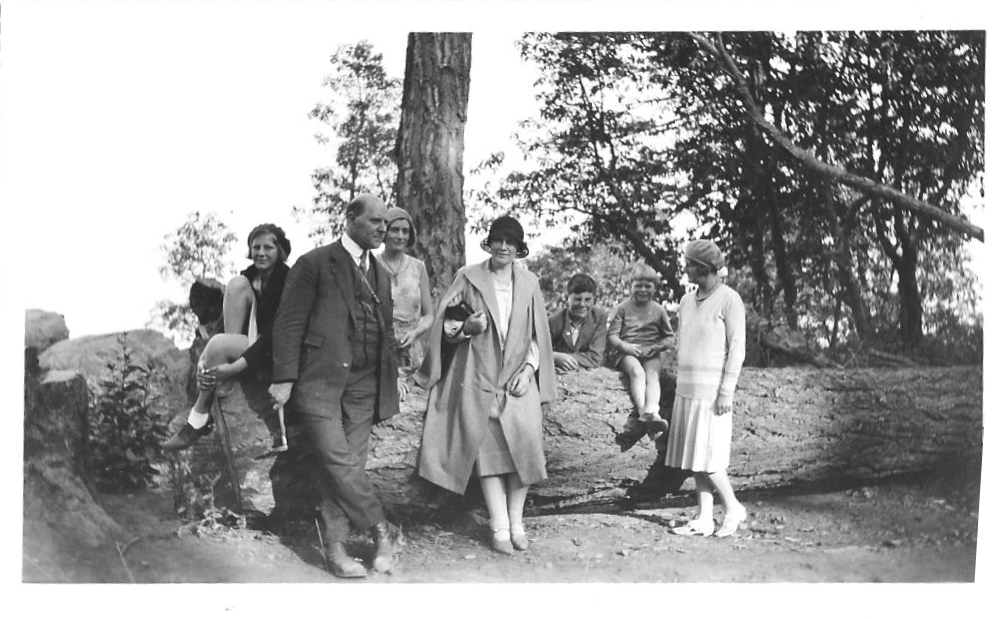
In 1926, Hermann Enke had died in his Oaklands bedroom. Born in Barmen on February 5, 1847 and dying in February 1926, he was 79. Of his four children, Peter was 50 and living in Eecloo, Paula and Ady, born August 3, 1877, were 48½ and continued living at Oaklands until Hitler’s Blitzkrieg in May 1940.
Max may have come to Europe briefly in 1926 as he certainly came down to Seaford to see me in some year before 1929 [Ed. Note: Max crossed by steamship from Canada to England in June 1925 and returned to Canada in October 1925], and he definitely was in Victoria in 1925 and 1927 as he won the B.C. Chess championship in both those years (if any of his descendants plays chess, I gave the precise record of one of those games to the Provincial Archives in 1971. I thought that some future chess player might be interested to see what standard of play was championship class in the 1920’s. Ask at the Information desk in the reference rooms. Most of the Enke papers and photographs are in the manuscript file but the chess game may be in a different category.)
I don’t know when Max decided that if he was to run the factory, we must have a family home. For that we needed furniture; hence the 1930 trip to Victoria.
That trip re-directed my life. I’d been a child when I left in 1924. I was now at Oxford and beginning to realize that a scholarly life was not what suited me. Canada seemed so lovely and so free of the class distinctions I’d met in Seaford, Oxford, and Belgium. I’d rather live in Canada than Europe.
During the dismantling of 572, we sorted and counted for hours on end. A carbon of those lists is by me now — 28 pages of items that were taken for packing by the Victoria firm of Weiler Bros. Some of these items interest me. The Chinese bowl that belonged to my great grandfather Dr Alexander Maclaren is now in Russell’s house. The Nursery Cupboard is in the “empty room” at Blenkinsop. The hideous green stone apple is on my mantelpiece now. One pair of bellows — these are on my hearth. One oak writing desk. I think Derek has this at Narnia [ed. note: confirmed] — (it’s a black bureau desk.)
The Singer Sewing Machine on the list deserves a note to itself. It is one of the two Singer Sewing Machines in my living room. The one with a cover but no cover handle is secondhand and was bought in the 1940’s. The 572 machine has a cover with a handle and is in good condition. In its compartment with a sliding lid, is the instruction book for Machines 127-3 and 128-3 and copyright is listed as 1915. It may have been bought in early 1916 for the baby expected in July (Flannelette diapers need hemming.)
Many of the books from Island Road were sold. The only sale I recall was that of Broken Pitchers. This was a series of sketches of girls who went to the bad. “The Girl who wore Silk Stockings” was one. Another was “The Girl who went out at Night” An elderly man from Weiler Bros. bought Broken Pitchers for 25¢ as he’d always liked baseball.
The house seemed very bright, light and empty without its curtains, carpets and furniture.
I’d see most of the furnishings in use again in Belgium.
But I’ve never been to 572 since Dr Elkington bought it. His married daughter lives there now. I’d rather not see Elkington furniture standing where Enke furniture used to be. Cowardice, Stephen said. As the steamer to Vancouver rounded Trial Island and 572 was visible no more, I wanted to cry and cry and cry.
Trekweg
We called the lions Samson and Agonistes. It was a silly pseudo-literary label for the pale coloured beasts who lay on either side of our new home’s front door. But Milton’s Samson Agonistes had been part of the compulsory syllabus. I had disliked the poem and did not care much for the lions, so the choice of name seemed logical to me at the time.
The house itself we called Trekweg because just across the road from the big iron gate was the Trekweg, or Towpath. It ran beside the canal where the long, dark barges passed so often. Sometimes a plodding woman pulled the barge by leaning heavily on a broad band that stretched across her upper chest and shoulders. A plodding horse sometimes did the pulling. Some barges had an engine. Washing blew from a line rigged on the deck, and most barges had a small dog that kept running the length of the barge and yapping constantly. The canal’s grassy banks sloped steeply and were so high that those on the barge could not glimpse the countryside. Barges riding high in the water, Dutch barges, Belgium barges and nearly always the small dog yapping at the pedestrians and cyclists far above its head. In Canada rivers were the roads for trade and explorers. But Belgium’s network of canals provided cheap transportation for moving heavy goods.
Trekweg was a square two-storied house with windows neatly balancing one another. Entering through the front door, the hall floor was white with a black band set in about 6″ from the outer edge. Mother’s study was on the right. It had the black bureau desk now at Narnia, and one window faced the front, and one window was at the side. Max’s study was on the left, had the rolltop desk and the same window pattern of front and side. Dining room and drawing room were at the end of the hall, about 20 feet from the front door. By custom the dining room’s mantelpiece was black marble, the drawing room’s was white. When washed, waxed, and polished the marble, like much Belgian marble was striking. The doors opened in two halves with the division vertically down the centre. Each of these two rooms had one of the big Persian carpets. The better one was in the drawing room and is now in Narnia.
Marie was the cook, her husband, Robert, waited at table, washed, waxed, polished, and did the windows. The gardener was Albert, crabby and not as knowledgeable as Oaklands’ Henri. Unlike the English, Belgians are not mad about lawns. Mother wanted Albert to cut and roll the rough grass that should have been a lawn. Reluctantly he pushed the lawnmower and muttered about “Madame’s verdamt pelouse.”
A firm in Eecloo made handcarved oak furniture. They had around 30 photographs of furniture they had made, as well as pictures of favourite carvings and the century they belonged in. As an advance 21st birthday present I was given the desk that is now in my living room, and what we call the Belgian sideboard was my dressing table. We had a settle, the woodbox, a large beautifully carved chest, 2 chairs. A cupboard with good proportions is at Russell’s. The tall thin cupboard with the wrong proportions was at 215 W. Seymour and is now at Narnia.
Originally, No 1 Trekweg had probably housed the owner of the next door business. Across the yard from the house was a long pale yellow building with the usual red tiled roof. In the centre of the space between house and creamy building was what had been a fountain but an encircling shallow rimmed upper basin now held not water but soil and festooning flowers. Behind it was one of the several huge copper beeches. The iron gate, the cobbled yard, the lions, flowers and copper beeches are an enduring summer memory.
Another vivid memory of the Trekweg era is November 1st which is All Saints Day and a religious festival.
From my bedroom window on November 1, I could see across the canal towards the big Ghent cemetery — the pewter coloured water of the canal under a grey winter sky and, walking towards the cemetery from the city itself, black clad figures, each carrying a bunch or pot of tousled white chrysanthemums. Grey, black, white. Sombre but striking.
California, 1931-32
It was in November 1931 that Max drove me to Rotterdam for, given the choice of staying in Europe or returning to North America, I chose Canada. It was arranged that I should go by a Holland-America freighter, the Dinteldijk. Uncle Arnold would meet me in California and I’d stay for two or three months with their family in Santa Barbara. I did just that.
My 21st birthday was somewhere in the Caribbean. It was hellishly hot in the Panama Canal, as the freighter had to go so slowly through the Culebra Cut, and we really sweltered as we lay in the locks. On the Pacific side, as we reached the tip of Lower California, there was a complete climate change overnight. In the morning the officers were no longer in tropical white. It was back to navy blue. Always a climate change at the tip of Lower California, they said. It was freezing the morning I landed in California. Smudges in the orange orchards. Quite unusual, said Uncle Arnold, who’d driven down to meet me as promised.
The few California months, that began that frosty morning at the Dinteldijk docks, were a completely new experience. I’d never seen oranges growing, or oil derricks actually standing in the sea, although close to shore. On one part of the highway, near Ventura, there was a strong smell of oil. Eucalyptus trees, pepper trees, evergreen oaks — all were new to me. The Spanish influence in California came as a real surprise. My English school had ignored all things American except for a passing mention of the ungrateful colonies who broke away.
The Arnold Lejeune family had picnics every weekend. Picnics in the winter!
It can’t have been easy for Gladys to have me there for so long. My only personal contribution, I guess, was that I helped with the housework. Maybe she did forget that I was so much older than Diana and Michael, both born in England, and Patrick born in Santa Barbara in 1926. Her kindness outweighed what I felt was too bossy, too opinionated, too inaccurate. Moreover she laughed at people, not with them.
But the incident of the earrings was perhaps the truest side of her character.
When I unpacked she admired my floor length evening dress and asked about my earrings. I explained that my father, approving of bracelets, rings, necklaces and brooches, considered earrings barbaric. Hence I had none. She said that the dress needed them and I needed them, and, within 48 hours I had a pair of pretty earrings that were exactly right for that dress. I have them yet, lying on a bed of cotton wool in their original box.
By mid-April I was in Victoria having been driven to Seattle by a Lejeune family friend, Bill Body, and I stayed in Victoria until 1937 and my marriage to Lawrence.
Easter, 1932 — December 31, 1937
For me, the two main personal events between Easter 1932 and December 31, 1937 were starting the Library for Boys and Girls in 1934 and my $20 marriage to Lawrence Chambers on June 12, 1937.
My interest in children’s books had grown gradually. I had few books as a child at 572 Island Road. Mother didn’t want to start making special trips down town to the Public Library in the old Carnegie Building at the corner of Yates and Blanshard Streets. So, apart from Christmas and birthday presents I’d few books of my own. Mind you, I read some books I didn’t fully understand. One such was Married Love by Dr Marie Stopes who, like the American Dr Margaret Sanger (1883-1966) was a pioneer advocate of birth control.
Through a mutual friend I met Hazel King, a librarian who would soon become the head of the Public Library’s Children’s Department. I began to subscribe to The Horn BookMagazine that concerned itself entirely with Books and Reading for Children and Young People. From it, I learned that the Newberry Medal was instituted in the 1920’s as an annual award for the finest book for children by an American author. The medal was named for John Newberry of London. Newberry, publisher, bookseller and stationer, sold books for children in his store in St. Paul’s Churchyard. Thanks largely to John Newberry books began to be written for children.
Also Hazel King had introduced me to Realms of Gold by Bertha Mahoney and Elinor Whitney. Its first essay (an Introduction really) is a condensed overview of the type of reading available to children since the Middle Ages.
So I found a street level apartment on Newport Avenue near a grocery store and opposite what later became Windsor Park. The front room was the library. I had a desk and shelves, four chairs bought for 50¢ apiece from a bakery that had folded. (The last is here beside me in my kitchen. The 1934 orange paint is worn but the chair is sound.) My twin aunts in Belgium sent me £5 as a starting gift. That, at $5 to £1, was almost a fortune in 1934.
At the start I had too few books to put side by side on the shelves, so I stood them up facing into the room and showing their bright, attractive jackets. I only opened in the afternoon as children were in school in the morning. I went to one of the papers and offered to write a short weekly piece about children’s books in return for a weekly advertisement of a stipulated size and style. I was subscribing to the The Horn Book so I put an issue or two on my desk and showed them to parents who happened to come in. I had catalogues too, from the publishers, and found that their travellers came to Victoria in the spring and fall and had their books on display in the sample rooms at the Empress. Some of the children collected stamps — so gradually stamps became a sideline. From Belgium, I got some oak hand-carved figures that 8″ – 12″ high looked effective on top of the bookshelves. I sold them and some foreign posters as well. In the mornings I worked at the Oak Bay Library and Bookshop run by Mrs Meugens in the Windsor Block.
In 1935 I moved my library into the same block. I shared this apartment unit with Bill and Gladys Speed who had the Windsor Wool Shop in the corner store of the block. Hilda’s Beauty Shop was between the Library and the corner.
At weekends I nearly always went up to Cherry Point near Cowichan Bay. Usually I stayed with the Henry Bayley family whose house looked across to Separation Point at the entrance to Sansum Narrows. Henry Bayley had retired from Malaya, his wife “Winks” was from Australia. Their only child was Edward.
In summer I drove up in my beloved 1927 Chev that I’d bought for $100. Flapping side curtains that buckled down, a top that needed two people to put it up or down — gorgeous. At the Bayley place I met Lawrence Chambers. He was tall, fair-haired, blue-eyed, handsome and a lot of fun. By 1937 I realized that he was truly energetic, cheerful and fun as well as kind and helpful, so I said yes when he asked me to marry him.
On a fine June Saturday we had our $20 wedding. I worked until 10 a.m, changed into a Liberty dress, put on my wide-brimmed white straw hat, my brown and white saddle shoes I’d cleaned the night before and went into town to meet Lawrence who was coming down from Cowichan Bay by bus. We walked along to the Law Courts that later became the Maritime Museum of B.C. in Bastion Square. We paid the $10 licence fee, the sheriff married us, the $10 gold wedding ring was on my finger, we walked two blocks to the Poodle Dog which, in 1937, was about the finest restaurant in town. After a good big midday meal we got into the 1927 Chev and off and away to Cowichan Bay to deal with a weekend of boat rentals, discussing fishing in the Bay, selling chocolate bars, candies and pop to our weekend guests. For Lawrence was managing a boat rental place that Henry Bayley had built and owned, and was committed to manage it until the end of 1937.
I had told the Speeds I’d be there for a year, so I felt committed, too. So Lawrence and I only saw each other at weekends for the first six months of our marriage.
At the start of January 1938 we both went up to Ladysmith to live with Lawrence’s parents who were in a large empty house at the south end of what was Victoria Crescent in the 1930’s. In a few months we bought a nearby house owned by Mrs Clifford who’d been widowed. We stayed there till 1952 when we moved down to Blenkinsop Road where I still live in 1988. You see, Lawrence died in 1982. We’d had 45 years for our twenty bucks. I think we got a good return on that investment!
1938-1939
When I’d finished with the library and Lawrence with the boat rental job, we moved up to Ladysmith where his father and “Auntie Joan” were living. They’d sold the farm north of Edmonton and moved to Vancouver Island with the minimum of furniture. They were welcoming and kind to us, but I was a real shock to them. Joan, who was practically a professional cook and who had cooked for threshing gangs, had planned that she and I would cook on alternate weeks. Thus we’d avoid the hazard of two women working on the same stove. But I didn’t know how to cook. Just meat loaf and baked custard. That was it and Lawrence couldn’t or wouldn’t eat anything made mainly of milk. As to washing sheets at home, I was ready to try as, after all, we’d had laundry tubs in the basement of 572. But this was a big galvanized tub set on the ground. Strong planks set on a sawhorse would have been a solution. But Eldon hadn’t even done that for Joan. True, it was the Depression and money was scarce, but there was always money for his pipe tobacco. The series of bridge evenings they’d arranged as a way of introducing me to Ladysmith people were another shock for them. Lawrence had inexplicably married a girl who couldn’t cook and had no card sense at all!
Lawrence, being jobless, wanted work. A friend from his Alberta days, Percy Belson, suggested that Lawrence and I might go up on the Belson boat to the place where Percy had a job connected with logging. He and his wife Alice had a float house at the head of Frederick Arm, he said. It was the first such house I’d seen, It was too early yet for the flower boxes to be out, said Alice, but she knew what she’d choose for the coming year. Inside, the house was charming and the furnishing was a surprise in that place where there were no neighbours, no roads, no real communication it seemed to me. A comfortable chesterfield and chairs, all with flowered loose covers, attractive pictures, books. On a table a clutch of English magazines coming then: Punch,The Queen, Country Life and The Illustrated London News. After half a century some of the details are forgotten, but the magazines and atmosphere are vivid memories. The china, the family silverware made me feel this house and its furnishings might be one of those houses one finds in the countryside of southern England.
Percy and Lawrence went to look at the terrain, the logging methods and equipment. For Lawrence had worked at Port Neville which was some 20 miles north of Frederick Arm. He had also worked at Hillcrest on the Island.
Alice and I stayed home. It was warm and comfortable with an oil stove and heater. I was starting a baby and the faint smell of oil made me feel sick — but I was too mortified to mention it. The idea of a baby, with the nearest medical facilities at Rock Bay on Vancouver Island, was one of the reasons why we decided against Frederick Arm. Now I think I was too nervous, too inexperienced and too spoiled. Plenty of other young women could have and would have stayed. But I knew the story of my own birth — a breeches presentation — on Galiano and Mother’s hours of needless suffering because the nearest doctor was at Ganges on Saltspring Island. So, we returned to Ladysmith.
Mother had also come to Victoria and was staying with Stephen in a rented house on Sunset Avenue. The Trekweg house had seemed too large and forlorn once Stephen and I had left for America. She wanted to see Stephen and to meet Lawrence. She stayed with Stephen as we had no house at Ladysmith. However, as I was having a baby in November, and Mrs Clifford wanted to sell her house and cherry orchard that was across the field from Eldon and Joan, plans were rearranged. Mrs Clifford’s place was more than Lawrence and I could afford, although that 1938 price seems unbelievably low by 1988 standards. Mother offered to pay half the purchase price and, if we didn’t mind she’d give us a house warming present of a chesterfield as at 59 she preferred that to one of the orange kitchen chairs I’d brought from the Library. We agreed happily — that chesterfield is in the living room at Blenkinsop Road, strong and solid but needing yet another new cover.
In the summer of 1938 the crop of Bing cherries was large and good. Lawrence spent a day picking cherries from dawn till dark. We’d got crates and basket containers. Setting out early next morning we drove down to Victoria and sold cherries from door to door in Oak Bay and James Bay. We showed them in the case, fresh and shining, no tell-tale withered stalk, and they were properly picked with their stems on and not sloppily broken off. We charged 10¢ a lb. but a bulk shipment of Okanagan cherries had reached Victoria that morning. We could not compete and ended by giving cherries to friends. It was my first glimpse of a food producer’s problems.
We acquired an old commercial fishboat. It wasn’t grand but it was seaworthy. Lawrence paid for it with cement work and carpentry. The Alberta farm had taught him to be handy in many practical ways. We used the boat a lot that summer. We’d take the boat halfway to Tent Island, stop the engine and let it drift. I’d jump off the boat into deep warm water. It was better than anywhere south of Sansum Narrows. I found it hard to climb on to the boat because of the baby but Lawrence made an arrangement of ropes that helped a lot. There was no heavy pregnancy weight when I was in the water. I swam and swam. More than I had ever done in my life before. I’m sure my summer of swimming helped me produce my first baby, Russell, in record time. A little back ache and one savage pain that made me ring for the nurse. She got me to the delivery room in time, but only just. The baby was certainly there before the gynecologist arrived. I glimpsed him coming out of the elevator as I was rushed by. I stayed in hospital for ten days and then went home with Russell Eldon, born on November 13, a healthy hungry baby with astonishing lungs.
In 1938, a maternity stay in hospital was at least a week. One wasn’t allowed to get out of bed at all. Walking to a toilet was forbidden. So long in bed tended to make the patient weak. Thus the first day at home was appalling. In my case I stayed in bed for ten days, then got up for the first time, dressed myself, walked to the nursery, saw, also for the first time, how a baby was bathed, oiled, powdered, dressed. In the early afternoon, after mother and child had eaten, Lawrence drove us up to Ladysmith [ ed. note: Russell was born in Victoria, at the Royal Jubilee Hospital.] I, who had breast fed the baby so well in hospital, had been given no formula for emergencies. I had no breast milk at all by supper time. The baby wasn’t fooled by boiled water in a bottle. He screamed with rage. All night he screamed, with rage and hunger mixed. In a day or so life became more liveable. In later years, though, I realized that baby Russell, wildly energetic, always kicking and struggling, was the type that burns up its food energy quickly. In 1938, however, doctors decreed that young babies should be fed every 4 hours and cut out the 2 a.m. feeding as soon as possible. No mention that not all babies followed the same food pattern. Russell’s pattern was food, peace for two hours, then scream steadily for two hours. Once he’d reached the age of Pablum our troubles were over. The truth was that at last he was being adequately fed.
Mother, though meaning to be helpful, was a difficult and destructive person to have living with us. Why didn’t Lawrence do this? Why did Lawrence do that? What a pity that he’d had so little education. On and on like this, whenever she and I were on our own. Later, I realized that it was jealousy and possessive love. It was the same, too, when she stayed with Stephen and Jean. The visits were short when she stayed with Stephen and his wife Fay.
Even now, I feel disloyal for admitting this side of my Mother’s nature. My father, Max, never admitted it to anyone so far as I know.
Luckily, Lawrence was firm and steady and very fond of me. I truly believed in “for better or worse, till death do us part.” Besides, I’d promised him and that was it.
The Beginning of the War (1939)
The original plan was that Mother would be with us for two months, and then, in early 1939, she’d return to Belgium. However, Hitler’s power was steadily increasing. Max wrote that, in spite of Neville Chamberlain with his umbrella and his “Peace in Our Time,” war seemed inevitable. When it came, a fast get away under difficult conditions might be too much for Mother. It would be better, he wrote, if she postponed her Spring return until the late summer when the crops had been harvested.
In Ladysmith, the weather was fine and lovely on the day Germany invaded Poland. We’d previously arranged that Mr and Mrs Osborne whom Mother knew and liked, and whom we knew well, would join us in the boat and we’d picnic on some island’s beach. When we heard about Poland I phoned to ask if they still wanted to picnic. “Yes — anything to get George away from the radio,” she said. So we went. A fine September day, a calm sea, baby Russell in his pram in the boat’s tank, which, on an active commercial fish boat, would have held water and probably fish. It was a fine place for a pram and on a blowy, choppy day, it could be firmly lashed, and Russell would sit there laughing as an occasional small shower of spray splattered him. The picnic should have been lovely, and in some ways it was. But Poland was hard to forget. How would the world, especially Canada, react? The Osbornes had a son and son-in-law who might be affected.
After the invasion of Poland, the winter that followed was dubbed “The Phony War” as nothing happened. Then, in April 1940, the Nazis invaded Norway. The sudden attack was unexpected by most of the Western world, but eagerly awaited by a few in Norway who betrayed the country to the Nazis in the hope that a Nazi victory would bring them political reward and power. One such man was the Norwegian Nazi Party leader Vidkun Quisling (1887 – 1945). And thus the noun quisling crept into the English language.
But May 10, 1940 was the date that hit our household. In Ladysmith, the weather was fine, the scent of blossoming lilac came through the open windows and ever since that scent reminds me of Hitler, refugees, fear and suffering. Mother and I stayed close to the radio. We could see it all. The shower of parachutists, the armoured divisions, the straight, cobbled highways. We didn’t need an atlas to show us what was happening. Where was Max? Where were the Aunts? The Canadian radio announcers were having trouble with some of the names. Lice must mean Lys. All Eecloo, including Oaklands and Pinehurst would be in occupied territory. And probably the Ghent apartment that Mother and Max had taken after Stephen and I had left for North America.
It was weeks before we heard how our relations had fared (see Appendix B). The Nazi progress was clear enough — northern France, Hitler’s triumphant presence in Paris. The Nazis pushing south of Paris. What next? Where next? Blitzkrieg was a word we learned. Just as, later in World War II, kamikaze was another word spelling death.
1940 – 1942
On January 1 1940, at Helena, Montana, Stephen married Jean Sherriff, only child of Frank and Bernice Sherriff. Bernice’s father, Max Sieben, had been an early Montana rancher with a large ranch. In the summer of 1941, Stephen and Jean came to Ladysmith briefly as they were cruising among the Gulf Islands on a boat Stephen had chartered. I met Jean for the first time. We were both pregnant. Her baby, Max, would be born on December 11, 1941. My pregnancy would end on January 3, 1942.
So far I’ve barely mentioned Lawrence in Ladysmith. Jobs were scarce until the war started. He worked in the woods for a few weeks as chokerman. (Ladysmith was really a Company town run by the Comox Logging Company of which Jimmy Sheasgreen was the local Big Push.) After the woods, Lawrence switched to cement work and carpentry, and to laying Duroid shingles for the Sidney Roofing Company which did work up and down the Island. He was trained in bricklaying by an old bricklayer from England. Peg Leg, so called for his wooden leg, had built chimneys and fireplaces in England and then, in Africa, he’d built mainly railway arches. He taught Lawrence about chimneys and fireplaces and the trick of building an arch, any arch if needed. Lawrence liked bricklaying and was good at it. The fireplace at Blenkinsop Road was built by him, but he said it was a rotten job. (The cows broke out and there’s a mistake in symmetry somewhere.) I’ve never bothered to check. It looks okay to me and it always drew well in the days when we had an open fire. Nowadays I’ve grown lazy and rely on electric heat. I’m not sure which year Lawrence and Dave Stringer began to work together as partners. They had a concrete mixer, a spray painting machine, and they always seemed to have work.
When Pearl Harbour happened on December 7, 1941, Lawrence was up Island on a roofing job. Blackout was compulsory, the radio said. So, enormously pregnant, I stood on top of the step ladder fixing grey blankets over the living room windows.
Another December date that was important to us as a family turned out to be December 11. Jean had a baby boy in Helena, Montana. Stephen sent an excited telegram — a son and heir, Max Sieben Enke. Another Max Enke!
A more important date for me was January 3rd 1942. On January 2nd I felt very energetic so I threw a load of furnace wood into the basement. That evening I was in the maternity ward upstairs in the grey frame building that was the Ladysmith Hospital. The little sister for Russell was on her way. Little Judith Marion she was to be. Nothing happened until the next afternoon when labour actually began. The next three hours were wretched. Having Russell had been nothing like this. Right then I decided that two children were plenty. No third baby for me, thank you. When the baby boy was finally born the doctor went away for a short time. On his return, presumably to attend to the afterbirth, he looked at my figure thoughtfully and announced that he did believe there was another baby there. So for the next hour or so I lay there while the nurses brought a second set of everything. Lawrence was allowed in to see me. I told him the news, and it seems that when he went downstairs, he fainted dead away into the arms of a nurse standing at the bottom of the stairs. He never denied the fainting, but said it was NOT shock. The labour room had been hot and had a smell of anaesthetic.
The doctor, the two nurses and I had to wait a while. This might be Judith Marion, I thought. Just 2½ hours after the first baby had been born, I felt a gigantic heave and tearing pain. “Look at that,” said someone. After a few moments of excited flurry, I heard a baby cry. “A fine baby boy,” said a voice. “Born in a caul,” said the nurse, “I’ve never seen that before.” I wasn’t interested. I’d done enough for one day.
Apart from the shock and discomfort of the twins’ arrival, I remember the Ladysmith Hospital almost as a fun place. A small hospital in a small town may lack sophisticated equipment and medical specialists. But in Ladysmith the nurses on that maternity floor truly made me feel a “somebody” (to quote a 1988 automotive TV commercial.)
Mind you, I was the only patient on that ward, there’d been no twins born in that hospital for perhaps ten years, and moreover they were the first babies of the year, so druggist Tom Bertram who usually gave this special baby a present gallantly produced two. Two little blue hot water bottles shaped like rabbits with floppy ears.
Now that I was eating for three the meals were not exactly tripled in size, but they were more than doubled. And when the nurses made themselves a cup of tea in the room along the passage they often made an extra cup and brought it along to me. We discussed the matter of names for the boys as my original choice of Judith Marion didn’t seem to fit now that my little girl had become two boys. The nurses had a book “A Name for Baby.” I started it hopefully, but was stopped cold by Aaron, Abner, Achilles, and Adam. Steadily, the names marched through the alphabet and most of them were from Greek or Roman mythology or taken from biblical stories. Finally Lawrence and I decided on Derek and Bruce as these were new names for both sides of the family. One name apiece was plenty, we decided. A middle initial in your signature wasn’t all that important.
I stayed 17 days in the hospital. After all, it was my chance to have a holiday and there would be plenty of work ahead. The last three days, warmly dressed for winter, I went for walks in that part of town near the hospital.
The day I left for good, I got into the cab of the truck, a nurse put a baby into each arm, and I was given a bottle of formula in case I needed it that evening. I didn’t. Feeding twins was easier than feeding a single baby, I found. I ate a great deal and drank so many quarts of milk that Lawrence bought a quiet Jersey cow. There was already a barn on the place, so that was no problem. The problem came when Lawrence suggested that I should make butter with the surplus milk. I tried three times with a glass Daisy Churn. I got it to the solid point all right and was thrilled to hear the change in sound as little blobs of butter began to cling to what I already thought of as “those goddam paddles.” And washing the buttermilk out was slavery, slavery and bondage. Wash, wash, wash the Daisy Churn, slap, slap, slap the mess of butter that would surely be inferior to bought butter. I struck.
1942 – 1949
Lawrence bought a very pregnant sow to feed on the extra milk. Later on when she and all her progeny broke out of the pig enclosure, and she led them all down the middle of the long flower bed of best daffodils, I made careful notes and such a sow was part of one of my short stories for a small publication produced in Nashville, Tennessee. “For girls 8 – 12,” the editor wrote to me to explain their needs. “Boy meets girl but no sex.” (Miss Beulah Folmsbee of The Horn Book Magazine had given them my name as a possible contributor.)
I’d never written a short story, but this was a chance to earn money at home, so I gave it a try. I ended by writing them 10 or 12 stories. All but the last came back with a most helpful letter. Introduce your main characters early, cause and effect are better than too much coincidence. Without exception, I altered every rejected story as suggested and resubmitted. Finally, a story was accepted at once with no mention of alteration or rejection.
I had in fact been given a free course in short story writing by someone who knew the mechanics of the job.
Nowadays, training on the job and being paid for it is taken for granted. In the 1940’s as I fought my way through the diapers, such training, free, seemed to me like all this and Heaven too!
The Ladysmith years were busy years and there was little time for social life. But we managed to go to a lovely Yellow Point beach nearly every Sunday in summer. Our friends there were Barney and Catherine Wilson, and their permanent boarder George Howland. From the Indian band George had rented a headland and a beach that were a rarely used part of the reserve. The water was warm, the beach sloped gently, was safe and free of barnacles. A wooden table and bench were by the big fir tree on the bank. There was no broken glass anywhere, no scrumpled paper.
Our house was on Fourth Avenue, and our nearest, older friends were Tom and Mollie Collinge whose front entrance was on Victoria Crescent (now Dogwood Drive!) Tom was editor of the weekly Ladysmith Chronicle. Like my parents he came from Manchester, Lancashire. He also admired the Manchester Guardian. It was Tom who told me about “Penny Readings” when he was young. At a certain hall on specified dates, a penny paid for admission to listen to a fine voice reading from the classics. Tom and Mollie loved their garden. I remember them with respect and love. When Tom died in 1953, we went up to Ladysmith for the funeral. The minister omitted the usual speech. He simply read aloud the Fifteenth Psalm. Tom had earned it.
Another long-time faithful friend made in our last Ladysmith years was the Vancouver Sun columnist, Mamie Maloney. She lived nearby and with her two boys and my three we often walked down our grassy track to Holland Creek where salmon came to spawn each Fall. From my place we could hear the creek roaring after heavy winter rains. While the children played in a grassy open place where the creek was placid and shallow, Mamie and I talked and often the talk turned to columns and writing. After we left Ladysmith, Mamie and I used to meet for a day every year. For a year or two we met halfway to lessen the length of the drive. This year, because in Spring Mamie was ill enough for a week of intensive care, and I’m restricted to only driving within 30 km of my residence, a good friend Joan Baker drove me up. The two old Grandmothers sitting in the shade on a hot July day and talking comfortably. It’s her heart and my eyes that are being tiresome. For me it was a happy day.
* * *
In the 1940’s Mamie and I tried never to miss a P.T.A. meeting — we had five boys there between us and education was, for us, an important issue. At one of those school functions, each child on the platform was meant to step forward and read a line alone from Dick and Jane. Russell read correctly and looked neat and composed but all his fly buttons were undone and his pants were gaping.
For a time Derek went to the convent school’s kindergarten class. It would be a helping step towards Grade 1 in Public School. The convent school impressed. The colour blue was no longer plain blue. It became Virgin’s blue. I still clearly recall the school’s Christmas gathering for parents, pupils and friends. It included the kindergarten children’s nativity scene tableau. Derek, in blue dressing gown, was gazing with maternal fondness at the Babe in the manger — it was indeed a charming scene.
But when the term ended he began a period of Protestant thought — fundamentalist Protestant.
I heard him phoning a friend’s house. The mother answered. Derek sweetly asked if Tommy could come up to the Sunday school next weekend. She was not enthused by the idea. I listened to the sweet pleading of my son. No, he’d call for Tommy himself, go with him, and see him safely home at noon.
Still the mother refused. Quietly, politely Derek hung up the phone, then, turning, he snarled, “Dammit, there goes my chocolate bar.”
“What chocolate bar?” I asked innocently.
“We’re given a chocolate bar for every new kid we bring to Sunday school.”
I was appalled. Bribery and corruption of the young? Ignore it as open objection might create a spell of small town religious bigotry? Let it pass now and let him think that bribery was permissible? As a parent I was perplexed.
Casablanca was another perplexity.
The poem Casablanca by Mrs Felicia Hemans was taught to me when I was about 10. I hero worshipped this boy who stood so bravely on the burning deck. This brave, obedient, noble and faithful boy. His father, an admiral, had told him to stay at his post. It was the Battle of the Nile, the ship caught fire, but this 13 year-old stayed at his post.
One day in Ladysmith I thought it might be good for Russell to hear of this courageous boy.
Russell listened with attention as I read: –
The boy stood on the burning deck
Whence all but he had fled;
We continued to the end when the flaming ship explodes.
“Huh” said Russ. “Retarded, eh? And those buggers ran off and left the poor guy.”
Dominion Day was Ladysmith’s Big Day. The Loggers Sports were held in the field by the Agricultural Hall. The Parade assembled on Victoria Crescent about 5 minutes walk from us. It passed the house with the Monkey Puzzle tree and then on through town and ended at the Agricultural Hall. If we borrowed a boy we qualified for Group of Four in the Children’s Section. Group of Four was right behind the Parade Marching Band. The Marching Band was mainly why Bruce rebelled. He wanted to march with the Band and not with his group. It was either the year of “Old King Cole and his Fiddlers Three” or more likely “The Farmer’s Wife and The Three Blind Mice.” Each mouse wore a sack as a costume. Each had a long pointed-tip tail made of a stuffed nylon stocking. The parade was slow assembling. Bruce began running up and down and over and over he shouted “I hate the Parade. It stinks.” Finally the parade got going — through town, down the slope, along the flat to the finish at the Agricultural Hall.
* * *
On Sunday mornings outside the Agricultural Hall was a fine place for beer bottles. Russell would bike down early and get ahead of the other kids.
Each year Lawrence and I tried to have a short September holiday.
One year, to broaden the minds of our young, we took them along. Taking turns, one sat in the cab of the truck, the others were in the open back with sleeping bags, tarpaulin, tent and food.
Just after the Alexandria Bridge there was a wild scream from the back. Lawrence braked instantly. Nobody was hurt, but a boy had seen two beer bottles by the road. We pulled out a spare gunny sack, put in the beer bottles and the boys were in business.
We’d left home right after the Labour Day weekend so there were plenty of bottles beside the highway. Like the biblical seeds, bottles don’t do too well on stoney ground. But in the dry belt, a bottle, unbroken and shining in a clump of yellow flowered rabbit bush is a thrilling sight to a true collector.
We formed a bottle policy. Each day we’d stop for bottles until noon. After noon there’d be no more bottle stops or we’d never get to Coulee Dam, the Columbia River and up the coast to home. Money from bottles that we turned in frequently was for the boys’ chocolate bar, gum and pop fund.
When we finally reached home, filthy, exhausted, I wrote an article “Bottling Our Way Round B.C.” It was accepted and paid for by a B.C. Digest. I forget its exact name but I know it turned into B.C. Outdoors in later years.
When we asked the children what impressed them most on the mainland, the verdict was unanimous. “They only give you 20¢ a dozen for bottles. Here we get 25¢.”
So much for broadening their dear little minds.
On this trip we had taken the three boys to the Y.D. Ranch in the hills above Ashcroft.
There were horses, and the dry-belt hills with their scattered Ponderosa pines were a wonderful place to ride.
Following this visit the twins went several times on their own.
On one such visit they’d been to a movie in Ashcroft and were waiting for Colin and Mrs Matier to pick them up. An elderly man emerged from a nearby beer parlour, and, seeing the boys, asked them,
“Know why I like canned milk?” They shook their heads.
“No tits to pull
No hay to pitch
Just punch a hole
In the son of a bitch.”
The boys were delighted. Now aged 47, they remember that verse as clearly as any learned in school.
* * *
Summers were hard work in Ladysmith. The kitchen faced southwest and had a lean-to roof. The sawdust range was large and hot. I always baked bread. One hundred quarts of jam and 150 quarts of bottle fruit was what I aimed for and achieved each summer. We swam a lot, off the Transfer Beach until the boys could swim, and then off the slackpile as there were no barnacles there and you could dive off into deepest water. I loved swimming, not fancy, but steady and strong. I could and did manage to swim to Shell Beach from the slackpile, so long as, for safety’s sake, I had someone rowing in a dinghy beside me.
By 1945 I was writing a series of scripts for CBR, the CBC’s radio station in Vancouver. My writing attempts and successes are described in the section 1982 – 1988.
* * *
I prefer to skim over the tiresome year of 1950. I think I was plain run down. I had an operation for a problem that was originally caused by the pregnancy months of lugging around two normal sized babies. Varicose veins that had to be attended to. It was a year to forget.
Mother, living at No 1 Cook Street, must have suggested to Max that Ruth and Lawrence should be given a trip to Europe. We went in early 1951, by train to New York with a change in Toronto and then the Queen Mary one way and the Queen Elizabeth the other. We’d booked a car from a firm in Southampton and when we landed it was waiting for us. We had 1½ months of driving about England, and finally back in Ladysmith on April 10 1951. Puck and Lou Richard and their daughter Tisha had been in our house all that time looking after the boys for us. Tomorrow August 4th I’ll be ringing Puck to wish her luck and congratulate her on being so close to 87. Tomorrow, Thursday, is her day at home — for she goes daily to see Lou who has been in hospital for 3 years, but seems to know her when she visits.
The year 1950 had been tiresome. The year 1951 started well with that lovely trip to Europe. We were back on April 10, but the strangeness of that summer started, I guess, on May 26. The diary entry for that date notes that I woke that morning with face paralyzed, talking like a gangster from the corner of my mouth, and feeling like Dr Jekyll and Mr Hyde. Two days later Dr Cantor came as I was sleeping most of the day and all night — “like a coma” notes my diary. Then, on August 27, I read “Feeling cheerful and energetic, thoroughly normal for the first time since end of May. I hope to God it lasts but even if it does (not) I know now that it is possible. Three months of acute depression, really irrational and an overwhelming sense of personal failure as wife, mother, friend, daughter and individual plus a resurgence of all the old terrors that I’m overgrown, ugly, clumsy, dull and lacking in all the social graces.”
Yes, that summer was strange indeed. I’d forgotten it until I re-read my 1951 diary in the last week of July 1988.
I’ve sometimes wondered whether it could have been an omen or a forerunner of what happened in January 1961.
1952 – 1982
In 1952, after several trips to Victoria, Lawrence and I bought 27.34 acres in the Blenkinsop Valley. It was more land and more money than we’d reckoned on but we liked the place better than 25 others that had been suggested or shown to us. The previous owners were the Smiths. Mr Smith had died in late December 1951, and Mrs Smith had reluctantly decided that she would have to sell. Originally, she asked $16,000 with $8,000 down and $8,000 as a mortgage to be paid to the Executor of Samuel Charles Smith, deceased. Then, abruptly, Mrs Smith wanted to change the agreement to $15,000 in cash. We managed to raise the extra cash by having several large trees logged off the very top part of the property which is invisible from the house — $2,000 for the timber and Mother loaned us $5,000.
So that was it: $15,000 in 1952. We had Peter Porter living here for about six weeks between the departure of Mrs Smith and our arrival towards the end of August.
I’ll always be glad that I told Mrs Smith she could leave her cat if she thought he’d like to stay. It seems that the fate of her cat had truly been troubling her. She’d thought she would have to get him destroyed as she couldn’t have him at the apartment block. He was a really good barn cat, she said, but he liked to live off the land in Mt Douglas Park in the summer. So if we couldn’t find him that’s where he’d be, and he’d turn up again when the nights got cold and the rains began. And sure enough he did.
This property of 27.34 acres is made up of Lot A and Lot 3. Both were once part of the 258 acre Parcel 51 that is shown on an 1858 map issued by the Victoria District office. The figure 51 is very familiar to us for it appears on tax notices and is the legal description of this property where I’ve lived for 36 years. The front field is Lot 3, Section 51, Victoria District, Plan 5420. The other, larger lot is Lot A, Section 51, Victoria District, Plan 7421. Lot A is 23.50 acres. The house and various outbuildings are on it. This means that Lot A is eligible for the homeowner’s grant, the front field is not. As a point of interest the taxes paid to Saanich in June 1988 were $169.00 i.e. $69.02 for front field and $100 for Lot A. Mind you, these are farm taxes, and to qualify for farm taxes the land must produce $1600 gross income on the first 10 acres and a little less on the second ten acres. At least that is what I’ve always understood from an official green form that was in Lawrence’s cupboard. On the basis of 20 arable acres producing hay, I’ve aimed for and managed to get the land to produce $2,850 gross annually from 1982 – 1987. The arrangements for paying taxes in June 1989 will be different on this place.
One of the better descriptions of the southern portion of this valley is an article Notes on the Flora and Fauna of Blenkinsop Lake, Southern Vancouver Island, British Columbia. Written by the late George A. Hardy it’s the main article in the Provincial Museum’s Report for the Year 1956. Hardy’s flora and fauna observations were made on weekly visits to the lake from 1945 – 1950.
Since our 1952 arrival here, this valley has been planned for, restricted and quarrelled over. A May 1988 offering by the Saanich Planning Department states “The Blenkinsop Valley is a rural enclave within urban Saanich.”
When we moved down to the Blenkinsop Valley property in 1952 I didn’t think of the valley as a rural enclave, or of our 27.34 acres as a valuable piece of real estate that was bound to appreciate. To me the place would be a home near enough to Victoria for us to enjoy some of the amenities of a city — libraries, theatres, movies, bigger newspapers. To Lawrence, the house was unimportant. He saw the place in terms of arable land that with care would be pleasantly productive. A fair sized barn, a chicken house, a woodshed. The sumps or holding ponds fed by natural springs would be useful too. He was used to the sort of carpentry, and mechanical jobs one always expected around a farm and with three boys to do the milking.
Between 1952 and 1982 this place had three farming phases: cows, vegetable stall and hay. While the boys were still living at home and going to school we had cows. They were chestnut brown dual purpose shorthorns and their double purpose was meant to be beef and milk producers. They did both jobs tolerably: not as much meat as a Hereford or Black Angus, not as much milk as a Holstein, not as rich as a Jersey. With three teenaged boys and a foster daughter for nearly two years we went through over 1000 pounds of beef a year, with turkey at Christmas for a change and treat. For breeding the cows we mostly got semen from the east that came by air packaged in ice. We were notified of its probable arrival time and picked the package up instantly and put it in our 21 cubic foot deep freeze with our frozen food supplies! Thus we were raising all our meat and all our milk.
We also produced all our own hay and had adequate pasture. It was loose not baled hay for us in the 1950’s. One wettish summer we had a dreadful haying season. We turned the hay in the front field three times that year. Turned it by hand. A 3.84 acre field. Lawrence turned hay and stacked the hay on the truck, a skill he’d learned with a wagon and horses in his youth. An arrangement of ropes and the whole lot could be taken off with a single pull by a tractor. Separating the milk, we took thick cream up to the Andrews family next door on a regular basis. The well-trodden path across their field was nicknamed The Grease Trail after the well known Indian routes from the Coast.
* * *
The boys grumbled steadily about having to milk cows night and morning. They were the only boys in town who had to do this, getting up so early and having to milk again at night. They had a tougher time than any other kids they knew, they said.
By 1971, the boys had left home or were at university so we had lost our “milking machines” and needed less milk and meat. Gradually, we changed the land use of this property. We sold the cows and a 1971 photograph shows that fields were already growing vegetables. Being within the 4½ mile circle centered on Victoria’s City Hall, most of the customers for the roadside stand that Lawrence built came from Greater Victoria. The stand was open daily from 1 p.m. to 9 p.m. in summer, with the hours decreasing as the days shortened. We closed for a time in the winter.
Our vegetables were fresh. We knew our customers individually. Our paper bags had Madrona Farm and our phone number stamped on each with a rubber stamp. Customers who rang by 10 a.m. would know that their order would be ready for them when the stall opened at 2 p.m. The phone rang in the stall and house and I was within earshot of the phone till noon. We discovered that customers wanted several types of vegetables when they made a trip to the stall. In their season, we had peas, carrots, sugar peas, green beans, yellow beans, broad beans, beets, lettuces of various kinds, 4 kinds of squash — Hubbard, banana, Danish and acorn — pumpkins, Brussels sprouts, Swiss Chard, red cabbage, Savoy cabbage and several varieties of green cabbages. Pickling cukes were big sellers. Tomatoes and ordinary cucumbers were always there in season. But the BIG SELLER was Corn on the Cob. Our record sales of these would come one Labour Day weekend. 100 dozen cobs. From Plot to Pot in Half an Hour was a sort of popular line of sales chatter. Those years were hard work for Lawrence. He’d be up soon after dawn so he could irrigate from the sumps while the morning was quiet and windless.
We had the vegetable stall for about 8 years. Lawrence enjoyed these years. He had a green thumb. His customers were pleased and complimentary. Most importantly he was satisfying a compulsive urge to grow food. This was partly the result, I think, of having been hungry as a child in England during World War I. The farm north of Edmonton also contributed to his great urge to grow food. For there, if summer work was not done, there’d be no food for the animals in Winter, no milk or meat for humans. The Depression Years also left their mark on Lawrence as they did on hundreds in his generation. And, again naturally this same urge and feeling for the land became an obsession by his sixties.
But after much discussion in the slower-paced winter months we both admitted that truck gardening was very labour intensive, that we’d need more not less help as we grew older and wages were increasing steadily. We needed enough staff on the stall to cope with customers coming in bunches as they invariably did, and it was important that their arrivals and departures should not create a traffic hazard. So, once more, we decided to change our line of farming. This phase 3 would be raising hay. We decided reluctantly as risking all in a single crop was a gamble. Sure enough, Lawrence had “haysterics” every summer. One year in the mid-1970’s Lawrence sowed alfalfa in the Maple Tree Field which faces southwest and is some of the earliest land on Southern Vancouver Island. The rest of the fields were orchard grass, a species of rye grass and some clover.
That first sowing of alfalfa did not catch. It was a disappointment. But in 1978 friends brought us some alfalfa seed from the Okanagan. Perhaps the sowing of fresh seed might catch and do well. It did and now in 1988 it’s growing well and has done ever since the start.
Alfalfa is a very ancient forage crop. According to a most useful Agriculture Canada publication Growing and managing alfalfa in Canada, publication 1705, alfalfa is thought to have originated in Iran and the oldest historical record supposes that it was cultivated in Turkey and Persia more than 3300 years ago.
Again, according to the same booklet, publication 1705, alfalfa was first introduced to Canada in 1871 when a shepherd bringing some sheep from Lorraine, France, also brought 1 kilogram of seed to a farm in Welland, Ontario. Later this strain became known as Ontario Variegated and is still occasionally grown in Eastern Canada.
But the successful start of real alfalfa growing in the United States and Canada was from 8 kg of seed that a German immigrant Wendelin Grimm brought out in 1857 when he settled in Minnesota. A hardy strain appeared after several severe Minnesota winters. Canada has grown it in every province.
Our alfalfa is certainly the only alfalfa in the Blenkinsop Valley. Apart from the demonstration plots at the Agricultural offices on the East Saanich Road, ours is probably the only alfalfa grown on the Peninsula in 1988.
The best crop of alfalfa and hay we ever had was in the summer of 1982.
Hay cut and baled that summer was as sweet and good in February as it had been on baling day.
I’m especially glad that the 1982 crop was good and that Lawrence knew it. For on a sunny, blowy afternoon in December, 1982 I walked up to the Maple Tree field and there, where the alfalfa grew so well, I scattered my husband’s ashes.
* * *
Except for the land-use changes from cows to market gardening to raising hay, our portion of George Blenkinsop’s original Parcel 51 stayed unchanged for the period 1952 – 1982.
But marriages, divorces, deaths and births changed the family pattern considerably. Yet, as I remember them all, I feel we are still a family. We hold together when things go wrong. I hope it will continue that way, and I believe it will as we are learning all the time. I’ve learned to be thankful for the moral and mental support of my sons. I’m even willing to admit that some of my grandchildren are light years ahead of me in some areas of knowledge. But not in all areas. Not by a long shot!
When we left Ladysmith for the Blenkinsop Valley, Lawrence was 46, I was 42, Russell 13½, the twins 10½. My father, Max, now retired had come out to Victoria. Mother was in an apartment at No 1 Cook St. She and Max bought a house Olinda at 528 St Charles St. Lawrence’s father and “Auntie Joan” had left Chemainus, and were in a small pleasant cottage on Penrhyn in Cadboro Bay. The three boys started at the University School in September 1952. I felt so proud of my sons as, wearing grey suits that were a part of their uniform, they set off on their bikes for their first morning of school.
There Russell and Bruce learned to play rugby and loved it.
Derek didn’t care for ‘rugger,’ but to this day he maintains that his first serious ideas about justice derived from this school [ed. note: more like injustice!]
Russell was there for two years, Derek for three, and Bruce for four; he was “such a splendid little chap” said his headmaster. For all three boys, their time at the University School was an unforgettable experience.
* * *
In Ladysmith, I’d added to the family finances by freelance writing. The short stories for the Nashville, Tennessee publication had taught me a bit about the mechanics of writing short stories. Except for Linda Takes Charge, I prefer to forget those stories.
My radio series The Frasers was a 15 minute sustaining program on CBR in 1946. In my bedroom cupboard, in a cardboard box with a cover picture of two youths playfully sparring in their Stanfield’s Unshrinkable Underwear, I have 22 scripts as played on CBR January 3 – June 5 1946.
There were three characters, Dick and Dorothy Fraser and their young son, Doug. They were “British Columbia’s Own Family” and lived in Littleton. The scripts were simple, unsophisticated and I had living copy underfoot as usually several of the 8 small boys who lived nearby had decided to play at our place. Those scripts were not great literature but they had the ring of truth and the human touch. Miss Lee, my Oxford tutor, would have disowned me. My teacher for such scripts was James Whipple, Instructor, Radio Classes of University of Chicago. His book How to Write for Radio was, I found, clear, concise, practical. His book alone would have taught me the technique of radio writing. But having learned how from the book, I spent one week listening critically to every soap opera on the air. Setting the scene through dialogue, changing the scene through fading in and out. Lawrence was starving and quite demented by the end of the week. But CBR accepted the scripts immediately. When the first script was aired the part of Doug was taken by an adolescent with a breaking voice. I was so appalled that I went over to Vancouver and from then on a girl of about 10 played the part. She did well. Ken Caple was in charge of programs. One radio script I did like was a half-hour drama called A Settler’s Wife. It played on the national network. It was sad, but it, too, had the human touch and the ring of truth.
In the 1950’s, down in Victoria, I decided to try column writing. Mamie and I had discussed columns, and I’d made a point of reading a variety of syndicated columnists as well as those in British Columbia. I sent sample columns to the Times; also down at the office, I saw Stu Keate who was publisher in the 1950’s before moving to the Vancouver Sun. We discussed columns in general as I asked him how he would define a woman’s column and that meant I answered a lot of questions and was able to show that I knew a bit about North American columnists. On March 19, I was told that I could start with one column a week. On April 3, according to my diary, the column frequency was increased. I could write as I wanted, so long as I wasn’t libelous or obscene. To be given such latitude and to earn a monthly cheque for what I loved doing truly delighted me. The column material in the 6 years I wrote for the paper was as varied as I could make it. I deliberately changed pace, writing style and topic so the reader would wonder what next.
To save my family embarrassment, I wrote under my maiden name. Enke was a familiar name to many Victorians. I had a wonderful time for 6 whole years. I loved that job, really loved it. I was writing with head and heart and having the time of my life. I knew that if I cried when I was writing a column some of my readers would cry, too. If I laughed aloud, they’d likely laugh, too. Occasionally I wanted to write seriously, but my job was to be light and amusing so readers would open the paper at page 5, read me and then look across to the editorials and important stuff. I didn’t mind. I knew my columns had style, and were good for the paper. I wrote about conservation, about rural affairs (a description of a calf being born), human interest columns, character sketches in which the people were never named, but were almost always recognizable types or composites. Of the 600 columns I wrote for the Victoria Daily Times, there was only one I really liked. The End of the Trail. It was about an old man leaving his cabin in the small gold mining town and being driven up to the hospital in town 100 miles away. Into extended care, I guess. Gerry Andrews asked me who it was. I didn’t know.
* * *
In the Spring of 1960, I stopped writing columns. My headaches were becoming more frequent and more ferocious. I thought the pressure of column writing might be a partial cause.
So I just stopped. But the headaches continued and worsened. On December 9, my diary notes “terrible headache. Just endured all day.”
On January 13, 1961, I was taken by ambulance to the Jubilee. The diagnosis was a cerebral aneurysm. I was in a coma for 2 weeks and my left side was paralyzed. Because the clot of blood in my brain would not dissolve, I had an operation to remove it. The neurosurgeons were Dr J. Harvey and Dr Hiro Nishioka. The clot removed, the appearance of my paralyzed hand changed almost immediately. Later, in February, Dr Nishioka operated twice. He had brought a technique learned in London whereby, if a cerebral aneurysm developed in an inoperable position, the flow of arterial blood could be diverted to a set of secondary veins and thus avoid using the weak artery (the smaller veins gradually enlarged themselves to take the extra flow.)
The operation had never been performed at the Jubilee before. It was medical history in Victoria. We knew this as a young nurse, Wendy Diment told Derek. They married later. Their twins Mark and Bruce were born on July 26, 1963. The first family marriage, the first grandchildren for Lawrence and me, the first twins in their generation.
My mother never saw them. She had died in the Jubilee Isolation Ward at 6.30 a.m. Tuesday, November 21, 1961. She’d been there 5 days. Not staphylococcus aureus, said Dr Riley, but a staph. The funeral service was at the Memorial Services chapel on November 22. Max picked bronze chrysanthemums from the St Charles St garden and put them on the simple grey coffin. In his short family farewell he said “Let us especially remember the times when she was kind to us.” September 2, 1879 — November 21, 1961.
Mother’s physical death was more a solace than a matter of deep grief. For, since the winter of 1960 – 1961, mother’s mind and memory had been disintegrating and disappearing. The realization that we’d never again be able to have a normal conversation with her was a greater grief than the fact of her physical death. Max had been under considerable strain for almost a year. I had only a week of being responsible for her while he had a September holiday. Her pattering footsteps followed me constantly about the house. She couldn’t grasp or remember the answer to the questions she kept asking. Max, too deaf to hear telephone or doorbell, would never have heard her cry for help if she’d fallen or hurt herself in some way.
After the funeral he wanted to continue living in that house. It seemed simple and sensible, and we knew that he was not likely to be bored or lonely.
But, because of his deafness, I asked him to phone me each morning at a set time of his own choosing. We did this at 7.45 a.m. for the rest of his life. He could distinguish between “Yes” and “No.” Often he had a question which needed more than a Yes or No reply. It was awkward, but we managed.
One morning when he didn’t phone, we went over and found him writing letters. He’d simply forgotten. I was so relieved and angry, I threatened to get a taxi next time, there and back and Max to pay the bill. That fixed him. He never forgot again. I knew how his mind worked. Extravagance of a taxi. Can’t let my daughter pay for my error or forget-fulness.
Unlike Mother, Max saw Derek’s children, went to Bruce’s wedding in May 1966 and met Wendy Rona and her family. When Russell announced that he was marrying a teacher. Mary Luchin, his misgivings about a Roman Catholic marriage disappeared when he realized that Mary’s formal name was Maria Augusta. It was good, he wrote his brother Peter, to have an Augusta as a family name again, though Mamma had spelled it the German way with an “e.” Caroline Auguste Pöting and Maria Augusta Luchin. Both had twins, but Auguste had twin daughters in 1877 and Augusta’s twins were Michael and Lea born May 12, 1970.
* * *
After the upheaval of the 1952 move from Ladysmith to Victoria, I hoped that there would not be another move for years to come. Life did not turn out that way. In between 1962 and 1982 I had to help Max move three times. The first move was the largest, saddest and most difficult.
After Mother’s death in 1961, Max stayed on at 528 St Charles St. Then suddenly without any kind of warning he said that house and garden had become a nightmare to him. He must move into something smaller and near a bus line. From 528 St Charles St, Max moved to an upstairs apartment at 1545 Richmond Ave. That house belonged to Diana Knowles, daughter of Dorothy Stanier née Broadbent. Dorothy had been at Newnham College, Cambridge with Mother. Dorothy’s husband Tom had the first X-ray place in Victoria. Their son Roger became Dr R.Y. Stanier, a professor at the Pasteur Institute in Paris.
Moving to a smaller place meant selling or storing many of the furnishings of 528. Luckily, Max loved making lists — so room by room he listed the contents, noting if to keep, store, or sell. I said I’d do any phoning he wanted so long as I knew whom to phone and exactly what information was needed.
This system worked quite well. But the decisions about pictures, posters, vases, crockery and chairs, furnishings I’d known for years, took time and patience and were a section of life that I’d practically forgotten. For each item had a story — the green vase from Sluis, that pleasant small town just over the Dutch frontier, the bright pottery from a shop in Bruges. A quick decision was impossible as story followed story.
But that process of dismantling a home made me think about possessions as a whole. Most of the objects Max wanted to keep or store had only a moderate monetary value. The objects he wanted to stay with him were the sentimental treasures — the treasures of the heart. I know now that “treasures of the heart” matter to most people. But the treasures vary so greatly and so unpredictably. There was that awful little replica of Stonehenge, for instance. Cheap, ugly and why Stonehenge? I heard that he’d bought it for “Mamma” with the first shilling that he’d ever owned. So it must have been bought between his birth (1884) and her death (1899). A photograph of it existed in the 1980’s and was in a box marked family photographs, but the replica itself is gone.
Moving Day went smoothly. Everything had been labelled the evening before so that the men on the various vans could see at a glance what was for their load. I stood by the front door with a clipboard and lists so that I could check the items as they were taken out.
Once, when there was a pause, I went over to where Max was sitting and watching the whole procedure.
It was strange, he said. All those years ago getting a home and gradually the furnishings, you began to feel you were somebody, and now you just sit and watch them carry it all away. Poor Max, he was feeling what thousands have felt before him and thousands will feel after him. Some of these will likely be his descendants and mine.
By the time I’d moved Max three times I knew the routine well. The stay at 1545 Richmond Ave ended when developers bought the house as they were putting up two apartment buildings in that block. The next address was a house, 1116 Leonard St. near Beacon Hill Park. This house, too, was sold and the newcomers wanted Max’s apartment for themselves. He found the third place, Captain Cook Apartments at 1025 Sutlej and explored the building while it was still under construction. His apartment, facing south and east, was near the stores in Cook St Village. The movers loaded the chesterfield last, so it was the first item in the new apartment. It was for Max to sit on they explained. He sat gratefully as he was quite tired. “No need to worry. These good fellows know their job,” he said. I could hear the “good fellows” out in the passage asking one another why the old guy wanted to lug all this crap about!
* * *
The morning phone call came daily until January 1971.
On January 27, 1971, the phone did not ring at 7.45 a.m. on the dot. I waited for half an hour, hoping that he’d simply forgotten. By 8.30 a.m. I was at Sutlej St. The moment I opened the apartment door I knew something was wrong. The bathroom light was on and I could see one bare foot. He’d shaved and then had a stroke getting out of the bath. Conscious, his speech a little slurred, he said “There you are. I knew you’d come.” To me that was a great compliment and admission of faith and trust.
I phoned Dr Houston (386-1712 is fixed forever in my mind) and described the situation. Rather than waste time he ordered an ambulance to come direct to Sutlej St and he’d be waiting at Emergency.
As we waited for the ambulance, Max told me two stories about his father’s and his mother’s death. I’d heard these stories several times before. So I listened critically. Every word was correct and present. His mind was ticking over well. Next day, January 28, in hospital he was confused and barely knew me. On January 29, as I was preparing to go to the airport to meet Stephen, Dr Houston phoned that Max had died — another stroke, massive and final.
Stephen and I went to the hospital to sign for release of the body and later we went to the funeral home to arrange the details.
Stephen chose to stay that night at Sutlej St. “At times like these I like to be alone,” he said dramatically, standing handsome and bereaved in the winter sunset.
I saw him again next day. “Where were Max’s bearer bonds,” he asked and added that they should have been in the safe. I had no idea, but months later sorting papers and documents as part of my job as co-executor, I found two notebooks in which Max had listed all his stocks and bonds, dates purchased, from whom, and, if disposed of, to whom. I kept these notebooks carefully; in case I were suspected of taking the bearer bonds, the notebooks would be my proof of innocence.
Stephen did not stay for his father’s funeral as he had an appointment with U.S Secretary of Defence Melvin Laird.
On February 2, 1971, the service was, like Mother’s, held at 1.30 p.m. at the chapel of First Memorial Services. Lawrence and I, Derek and Wendy Joan, Bruce and Wendy Rona, and Russell were all there (Mary, busy with twins and pregnant with Lawrence Jr sensibly did not come.)
As in 1961, Max had given the family farewell for Mother, and as he had once drawn my attention to Shakespeare’s Sonnet LXXI and asked me to remember it as it expressed so well his own thoughts about death, we arranged the funeral so that each of us had a Xeroxed copy of the sonnet to read, and when we’d had time to do this I stood and so did all the others. I simply said
“We are here today to say goodbye to a man who was brave, honest and true and utterly dependable. So we say goodbye with respect and with gratitude for a brief illness that brought only a short loss of precious independence.”
And the coffin was wheeled away adorned only by the bunch of snowdrops and white heather that Wendy Rona and I had picked that morning from the Andrews’ garden, both of us picking quietly in the pale February sunshine
M A X E N K E
March 12, 1884 — January 29, 1971
No longer mourn for me when I am dead
Than you shall hear the surly sullen bell
Give warning to the world that I am fled
From this vile world, with vilest worms to dwell:
Nay, if you read this line, remember not
The hand that writ it; for I love you so,
That I in your sweet thoughts would be forgot,
If thinking on me then should make you woe.
O! if — I say, you look upon this verse,
When I perhaps compounded am with clay,
Do not so much as my poor name rehearse,
But let your love even with my life decay;
Lest the wise world should look into your moan,
and mock you with me after I am gone
Shakespeare, Sonnet LXXI
Thompson and Irving Undertakers
Funeral Cost $217.00
Undertaker 175.00
Extra death certificate 2.00
Cremation 40.00
217.00
Sonnet LXXI was Max’s choice, I thought. He’d never heard of Langston Hughes and might have scorned:
Life for me ain’t been no crystal stair
or Elizabeth Coatsworth’s
What is once loved you will find
Is always there, in your mind
And nothing can take it away
* * *
Max’s will had appointed Stephen and myself as co-executors. Stephen was too busy with his job and career to stay for the funeral, the dismantling of the Sutlej St apartment, and working with the lawyer Ronald Carson Cook who was just starting his career and had an office in the Bentall Building. Stephen appeared once before the will went to Probate, and once after.
We decided before he left that I’d better keep the apartment on for the month of February as clearing it would take time. Every cupboard, drawer and shelf, every pigeonhole of the roll top desk was filled with papers. It was obviously mad for me to go over daily and sort papers. So one evening in early February Lawrence and I brought 30 40 lb apple boxes full of papers to Blenkinsop Road, and lined them up on the long Persian runner in the living room. For nearly six weeks I spent 2 hours a day going through those papers. Max had always kept a carbon of his business correspondence, after 1961 and perhaps due to Mother’s disappearing mind and memory, he had made carbons of all personal letters. I went through all papers — Galiano farm accounts, prisoner of war cards and letters. He’d kept picture postcards received as far back as 1900. I kept three cartons in front of me as I sorted: one for Stephen, one for myself, and one for the Archives. Although the personal letters with their familiar scripts were all neatly tied in bundles, I did not read them in chronological order, and after six weeks of tossing and tumbling among the decades, I realized it was just plain foolish to try to cram over 80 years of living into six short weeks.
But two of the letters I had read proved most interesting in the Winter of 1974. For then, on a wintry day, I looked at two objects that Stephen had in storage and could hear Max’s voice saying “The truth always comes out in the end.”
* * *
Mother, dying in the Royal Jubilee Hospital’s isolation ward in November 1961, never knew any of the women who married her grandsons. Max, dying in the Jubilee in January 1971, knew Mary Luchin who married Russell in Trail B.C. December 1967. Max knew Wendy Joan Diment who married Derek. Their twin sons were born on July 26, 1963. He met Wendy Rona Le Mare and went to the wedding at St Peter’s Anglican church at Quamichan where Bruce and Wendy were married in May 1966. The ushers were Wendy’s younger brothers, the twins John and James. But Max never saw their two children, Morgan and David.
In the first half of the 1970’s, five Chambers babies were born. Mary’s twins Lea and Michael were born on May 12, 1970. And on July 31, 1971, Mary had a son whom they called Lawrence Eldon after his grandfather who was born on July 31, 1906. Bruce’s Morgan was born February 26, 1972 and David was born on June 19, 1975.
Derek’s first marriage ended in divorce, and, on June 1, 1974 he and Anne Molnar née Coleman were married in a charming wedding in that interesting late Victorian house, officially listed as 215 West Seymour, Kamloops. [Originally there were two similar houses side by side on West Seymour. The Slavin girls lived there, and the district used to be a fashionable part of Kamloops.] Anne’s son, Paul Molnar would marry Dorothy Breckner, become a qualified veterinarian with, in 1988, a practice in Merritt B.C. where he and Dorothy with their Sarah (1981) and Rebeccah (1983) and Coleman (1986) live. It’s a simple drive up to see Derek and Anne who now live in the hills above Knutsford just south of Kamloops.
To outline 5 generations of 2 families by listing dates factually and unadorned, is a lifeless method like a skeleton. Without anecdote, or mention of the changing social mores and world events through which these generations lived, the individuals are little better than flat cardboard cutouts. I wonder which young brain will create a “family tree” that will make the figures seem alive and real. For instance, I think of Mary as I saw her first. Lawrence and I having driven to Trail from Victoria, were sitting in the front right-hand pew of the church on that bright cold December day. But when I heard the wedding March and knew the bride must be walking down the aisle, the suspense was too much for me and I turned round to see what was coming into my family. It was such a relief — this tall, handsome, sensible girl who was not looking towards Russell waiting for her to reach him. She was looking at the right-hand pew to see what kind of in-laws she was going to be landed with. In later years Mary and I often laughed about that first glance. And thank God, neither of us knew that in Kamloops on a Spring day in 1983, I’d be sitting in another church while Mary’s coffin was wheeled up the aisle beside me.
Babies Bonfire
Morgan might just remember the Hallowe’en we had at the farm during some of the years that Morgan was living at Battery St. David certainly came to one of them but as a baby, sleeping soundly in a carry basket in their van.
Usually we had about 8 pre-schoolers — the Clifford Carl grandchildren, Morgan’s friends Owen Bradley, and Sabena Laing who now lives in Switzerland.
At the start, Lawrence was against the idea of a bonfire, but as he didn’t like innovations, we took no notice. We had very few fireworks but lots of sparklers. Some of the oversize sparklers we could stick in the ground and let them make a show that way. And there were always enough sparklers for each child to have several.
The bonfire was at the edge of the lower pasture, beside the road that went down to it. Lawrence would position the backhoe with a light set on its extended arm. The “table” for mugs and apples was simply a plank set on 2 sawhorses. Hot cocoa for the kids, coffee for the adults, spiked with whiskey or rum as people chose.
We lighted the bonfire just before 7 so it would be burning brightly when the cars began to arrive. We made enough old-fashioned “bugs” for each child to have one. So they lit their sparklers from their bugs. Very simple.
For some of the children, staying up late was a treat. Some of the parents had solved the problem of letting young children go “trick or treating.” And for some adults watching the children there were memories of long-ago Hallowe’ens of their own.
For us, it was a pleasant phase. There are no small children now. David, the youngest grandchild is 13.
The truth is, I guess, that I like bonfires, and making “bugs” and the shining beauty of sparklers in the wintry dark. Pretence aside, the bonfires were for me!
Nature Conservation
Off and on during the Blenkinsop years I belonged to three organizations, The Thetis Park Nature Sanctuary Association (TPNSA), the Victoria Natural History Society and the Federation of B.C. naturalists (for which the late Elton Anderson worked unceasingly.) All were strongly conservationist.
During my column writing years (1954 – 1960 for the Victoria Daily Times) I’d supported or publicized the various conservation matters that arose from time to time.
In 1967, when the Victoria Natural History Society needed a new editor for their publication the Victoria Naturalist, I volunteered for the job, provided that a professional naturalist such as Dr Clifford Carl (then Director of the Provincial Museum) would proofread the dummy for scientific accuracy before I took it down to Miss Monks who was producing it at that time.
It seemed to me that a volume would look more cohesive if one ran a series of articles on some particular aspect of natural history. So in Volume 24 we had a series of one page biographical notes on some of the naturalists who had worked in the Pacific Northwest, and whose names were recalled in the scientific nomenclature of our flora and fauna.
In 1968, the biographical notes on naturalists used in Vol 24 were collected, a few pages of explanatory history were added, and the whole appeared as A Net of Naturalists. If bought from the Society, it cost $1.35 plus tax. If sent by mail, a 10¢ postage and handling charge was added.
This 39 page booklet was no academic manual — but it was reasonably written, factually accurate. The 8 featured naturalists, Steller, Archibald Menzies, Thomas Nuttall, David Douglas, John Macoun, George Mercer, Dawson, Tavener and entomologist R.C. Treherne, were presented in chronological order, so that the pattern of visiting naturalist changing to Canadian-born individuals would be apparent.
The 13 photographs tracked down and assembled by Enid Lemon added to the booklet. All printed copies were sold, the Society made a little money (very modest by the standards of 1988.) It happened to appear when I was editor and in the year (1968) when the Museum was moving from the east wing of the Parliament Buildings to the brand new building where it is in 1988.
A quotation from the Constitution of the Victoria Natural History Society appears on page 2 opposite the index:
“The objects of the Society are to encourage the study of natural history, and to stimulate active interest in conservation of natural resources.”
The objectives of the Thetis Park Nature Sanctuary Association were much the same, with a special emphasis on Thetis Park and its natural history, particularly the Park’s flora. The Federation of B.C. Naturalists included clubs from all over the province.
On balance, I enjoyed those years on the three natural history organizations, for I believed then and still do that we owe a debt to posterity and should be careful custodians of the environment. On May 12, 1970, my dues to posterity were increased. For, in Kamloops at 3 a.m. Mary had produced twins, first a boy and 8 minutes later a girl.
On the same day, I was made an Honourary Life Member of the Victoria Natural History Society.
I enjoyed my two years as secretary for the Federation of B.C. Naturalists. There was a newsletter done by Elton Anderson and the FBCN itself had a fall and a spring meeting. At one such meeting at Prince George we had members from Prince George, Kitimat, the Peace River Block. I’d only seen Whitehorse, Skagway, Fort St John in the 1950’s when I was writing for the Times. Ma Murray was running the paper in Fort St John and had not yet got moved to Lillooet (George Murray was still alive.)
In Victoria, during the 1960’s, I belonged to 3 organizations that were interested in the environment before the general public knew the word ecology.
In the 1960’s the Victoria Natural History Society was mainly interested in birds, the Thetis Park Nature Sanctuary Association was very strong on botanists. The Federation of B.C. Naturalists was interested in all facets of natural history, in legislation that protected the environment, and in being an umbrella group for B.C.’s naturalist clubs. Its leader was, for years, Elton A. Anderson who descended from Alexander Caulfield Anderson. The FBCN was Elton’s valuable contribution to B.C.
I’ll always remember the time I volunteered to help arrange a shopping mall display for the Victoria Natural History Society. We got a stuffed (taxidermist not poultry stuffing) duck and an owl from a government department source and put them on our allotted table. They attracted passersby and small children were allowed to touch both birds. By stroking them they could feel the yielding softness of the owl’s feathers, and the smooth, firm, stronger feathers of the duck, and while these small children stroked feathers we tried to sell the attendant adult the idea of giving memberships as Christmas presents.
We also had a tape recorder and 2 special tapes reproducing the sounds made by pelagic birds. On these tapes, loaned by the experienced enthusiast Enid K. Lemon, birds hissed, grunted, shrilled and squawked.
All went well for several hours as this cacophony surprised passersby. As I sat doing a shift at the stall, I felt a hand on my shoulder and looked up at the stern face of a uniformed guard. There’d been complaints, he said, that we were creating a disturbance, and he jerked his head towards the entrance of the store by which our table was located. Sure enough the store’s owner looked wild, distraught, and almost out of his mind.
I apologized to the stern guard and turned the volume down so low that the pelagic birds were little more than a moaning groan.
My shift was almost over, and as soon as I could, I hurried off to do some personal shop-ping errands in the mall. The next minders of the stall were a husband and wife. The husband, a knowledgeable birder, turned the volume right up. Once more the air was full of grunts, hisses, squawks, and shrill cries.
Thankful that the shrill cries were not those of the shop’s owner, finally broken and demented, I hurried on and lost myself in the crowd of shoppers.
The pelagic birds should have taught me a lesson, but soon after them, I had another mild attack of nobility. I offered to be responsible for a display of historical interest in the same shopping mall. The Spirella Corset was my inspiration and my downfall that time. I learned that I might be able to borrow one fitted on a dressmaker’s dummy.
Frances Gundry of the Provincial Archives was a great help in obtaining a loan of a Xerox of one of those nineteenth century Bird’s Eye Views of Victoria. This was fixed on one side of a big bulletin board that separated us from the next organization’s table. The Bird’s Eye View map was a crowd catcher as shoppers paused to try and find the area where they lived, and to marvel at the countrified areas that no longer exist, and to admire the fact that a map giving an aerial view could be so accurate when nobody at that date had even seen Victoria from the air.
The map caught the people passing down one side of that mall, and the Spirella Corset standing on the firm solid table caught shoppers passing on the other side of our exhibit. The 1907 Spirella Corset it was called, and it adorned a full-busted dress maker’s dummy that stood firmly and safely where passing hands could not pull at the suspenders, or touch the fabric and lace of our big eye catcher. She was a real crowd stopper. Teenagers, brought up in an era of pantyhose, were intrigued by the idea of stockings and needing suspenders. Middle-aged women paused and reminisced about “Mother’s corsets.” One such woman remembered how the corset saleswoman or fitter would come out personally to the home of special customers. This woman remembered calling upstairs “Mother, the Spirella Lady’s here.” And the Spirella lady would be asked to come upstairs.
Yes, teenagers, middle-aged women, a man who’d evidently drunk his lunch and whose recollections were somewhat different. Then, near closing time a young woman stormed up to the stall, and raged that the whole exhibit was trashy and “everything we’ve been fighting against!” We were promoting the female body as a sex object and we should be downright ashamed of ourselves, she stormed.
“Mother, the Spirella Lady’s here.”
* * *
In April 1964 I was getting ready for a trip to England to see my cousin Margaret Armstrong. In February Stephen had written to me that Margy had cancer and that if I wanted to see her it might be best to go in 1964 or 1965.
By April 7, I’d contacted Margy who said June would be the best month for her, so my passport renewed and valid, I made my reservations for June 4 by what they called the Polar flight. I left Vancouver at 3.15 p.m. local time, reached Amsterdam 10.15 a.m. Dutch time, London at 12.10 p.m. Direct transportation from the airport to Victoria Station about 1 p.m. From there, a train left hourly for Lewes, Sussex which was only 8 miles from Horam where Margy lived with her father, my Uncle Peter, now 88 and a widower.
It was so lovely to see Margy on the station platform at Lewes. My luggage checked through from Vancouver to London, had vanished on the way. As it was carefully labelled with address and phone number in Horam, and I had reported it missing and filled out several missing luggage forms in London, Margy and I simply stopped in Horam and bought a toothbrush and everything was fine. I slept that night in my Aunt Paula’s bed with the carved headstand that I remembered from the bedroom at Oaklands in Eecloo. Like Isabel, both Ady and Paula had died. (Ady died before Paula, and money that Paula had left me was put into my Bank of Montreal account on July 25, 1963, the day before my first grandchildren, the twins Mark and Bruce were born. And it was this money that enabled me to have the 1964 trip to England.)
I had never heard of jet-lag, but I think that it was partly why I fell so drastically on the Saturday morning. Margy and I had just done the weekend shopping in the village. As we were getting out of the car I heard the telephone ringing. I rushed in to answer it and fell heavily in the hallway. I simply could not get up. Margy and I couldn’t believe it. Margy phoned her brother Godfrey who, married to Denise, lived nearby at their house called “The Glen.” (They still live there in 1988.)
Back in 1964, however, I was very glad to have Denise riding in the ambulance to Eastbourne early that Saturday afternoon. Emergency at the hospital in Eastbourne was very busy. The doctor was Dr Sinha from India or Pakistan. The nurse was from the West Indies. The verdict was that I’d cracked my pelvis in two places.
The staircase at Margy’s home “Kinross” was too narrow for the ambulance attendants to get a stretcher upstairs. So for the rest of my stay, I had a bed in the drawingroom, all furniture was pushed against the wall, and I must have been their most inconvenient guest ever.
Although Margy and I had to forget all plans for daily trips by car to some of the lovely places in Sussex, we had a good time, thanks to TV for it was June, with Ascot and Wimbledon and some very good BBC programmes.
Each morning Margy hurried over her household chores, and I think we watched the whole of Wimbledon.
The airline granted me an extension on my economy fare return date, provided that I had a doctor’s certificate. So I booked for July 5 as that was the first direct flight to Vancouver without changing in Montreal. I was pushed out to the plane in a wheel chair which was carried on board. A wheelchair and attendant were waiting at Vancouver and Russell was there, too. At Pat Bay, Lawrence, Bruce and Wendy Rona were waiting for me.
I shall always be glad that I made that trip for I never saw Margy again. I’m not absolutely sure about the cause of her death except that it was not due to a dreaded recurrence of cancer. I think it was at tea time, suddenly. I just remember crying quietly by the telephone, when Max phoned that he’d heard from Horam.
For I loved Margy. The nearest thing to a sister I ever had.
* * *
In 1972, the Victoria Section of the B.C. Historical Association (later Federation) acquired 4 tape recorders and, with Ian Sutherland as its first head, formed an aural history group. After some practical instructions from Ian and a workshop given by the Aural History Division of the Provincial Archives, we began to interview members of long-established families in the Greater Victoria Area.
Because I liked the idea of having a central subject and doing what I thought of as perimeter interviews, I decided to pursue the idea of land use in the Blenkinsop Valley. I figured I might as well practice on neighbours within walking distance. So, in early 1973, I did a tape each with Bob Mercer, Ed Lohbrunner, Len Simmonds, Gerry Andrews, Anne Tolmie, Eileen Cronk who was Eileen Simmonds before she married Ken Cronk. Thanks to these interviews, I learned that the crackle of maps spread out on the floor can be deafening on a tape, that dottle being scraped out of a favourite pipe is a hazard to be avoided; so is the interviewee who stirs his cup of tea so vigorously that silver spoon striking bone china cup obliterates the interviewee’s interesting information about early land use.
Now, fifteen years after doing these tapes, I remember best that done with Eileen Cronk. Their land, like much of the valley, was thickly wooded early in the twentieth century. When they cleared it, most of the firs went to help make a foundation for Reynolds Road. The alders were sold to bakeries as alder provides an even good-for-baking heat. Pigs were used to grub out the stumps. Scatter some grain close to the stump and the pigs will do the rest. After some years, two Chinese acting through an interpreter wanted to lease the land. The lease included a clause that no trees should be cut. So the land was leased at $25 per acre per year.
The day after the lease was signed, Eileen’s father had a stroke, which would have made it impossible to farm the land himself. So the lease money of $600 was what they lived on.
In 1952, when we moved from Ladysmith to the Blenkinsop Valley, the remnants of the Chinese shacks were still there, with yellowed sheets of newspaper, some of them printed in Chinese characters.
According to my pre-interview notes, Eileen, in 1973, had a typed copy of the agreement between her father and the two Chinese. Their signatures were in Chinese characters, but the lease was also signed by their interpreter.
* * *
Recently, searching in one of the 14 file boxes given me to keep my papers tidy, I found a July 10, 1979 piece the late columnist Elizabeth Forbes had written for the Victoria Times.
Illustrated by possibly the most unflattering picture ever taken of me, Bess called her article “Suggestion Box a Popular Idea.”
Bess was helping me and the Victoria Branch of the Historical Association by publicizing the Suggestion Box that we’d used at my first two meetings as president of the Victoria Branch during the 1979 – 1980 year.
The suggestion box turned out to be quite a hit. An ordinary shoebox, beautified by coloured tin foil supplied by Fran Gundry, was set on the Newcombe lobby desk along with a memo pad to which a pencil was tied. We asked members to jot down suggestions for programs and projects.
The members didn’t wait for a turn at the memo pad and pencil. Scrabbling in their pockets and handbags, they wrote on the backs of envelopes and any other paper they could find. After the scrabbling, the scribbling, a determined push through the slot in the lid of the box.
Fran, as secretary took the box home and at the next meeting I had a neatly typed list to read. For we filed all suggestions. Some were used, others were discussed and the whole collection was kept as all those excited bits of paper covered with passionate writing made an amusing record of the Victoria branch in the membership years 1979 – 1980.
Bess in the postscript to her column mentioned that the archives had formerly been under the Central dome of the Legislative Building. In that postscript, too, she wrote how I had told her that my schooling had included no Canadian history. I knew nothing of the exploratory history of the North American continent until, in early 1932, I strayed by chance into the provincial archives. For almost a year I used to walk down to the Archives as often as I could. For I was living in a $12-a-month housekeeping room at 849 Burdette. I used to read for hours, and was still young enough to be completely thrilled by the adventures of those I read about. Alexander Mackenzie’s canoes coming down the Bella Coola River in 1793, and writing with “vermilion and melted grease” on a rock-face in Dean Channel. And how, despite hostile Indians, he deliberately made observations for latitude and longitude and thus established his exact position at the end of this first recorded crossing of the continent.
What a story.
Not until 1968, when I wrote the three pages of condensed history for A Net of Naturalists, did I use the historical knowledge I’d so enjoyed in that crowded to overflowing place under the central dome. To trained librarians, those quarters seemed, I’m sure, difficult and dreadful. To me, the hours I spent up there were a delight.
* * *
During the 1950’s my writing time was spent on doing 2 columns a week for the Victoria Daily Times. But now, in 1988, I was intrigued by a 1954 diary entry “Ideas for Tacoma” and I could only vaguely recall a library conference (PNLA?). I was very surprised to be asked to speak to the children’s librarians at the PNLA conference as, previously, I had only spoken to a group of children’s librarians at a BCLA conference held at Yellow Point Lodge in May 1950. I figured that the Pacific Northwest Library Association (PNLA) had only asked me as I had, by 1950, had 3 articles published in the Horn Book Magazine and, in the 1940’s, if you made the Horn Book you were noticed in the world of children’s literature.
It so happened that in Fall, 1987 my son Derek spoke to the B.C. Library Trustees Association annual meeting at Kamloops. I read a Xerox of his speech with intense interest and suddenly wondered if I could track down the text of my talk to the PNLA. On my third phone call, I was lucky. Yes, the Macpherson Library at the University of Victoria had every issue of the PNLA Quarterly since the first in 1936. It would be so reassuring if I could say casually, “Well dear, yours was a good talk. But only provincial, of course. Mine was international.”
As family one upmanship is not my favourite hobby, I was a little less direct than that. But I did go up to the Macpherson and found that the 1954 PNLA Conference was in Tacoma on September 2, 3 and 4. None of the speeches were reproduced however. So I returned to the very helpful librarian, who asked my name, scurried away and returned in moments with a volume listing talks published in 1955. There staring up at me was Chambers, Ruth Enke, Vol 19 pps 26-32, April 1955. So I scurried upstairs again with a different call number in the Z section, and read the exact text of what I said. (The biographical note at the end of the article had obviously derived from a Hunt Breakfast biographical note in the May – June 1948 issue of the Horn Book. The only difference was the last sentence that substituted columnist for the Victoria Daily Times and did not mention Ladysmith.)
Standing there reading that 1954 talk, it was as I suspected, a re-affirmation of liberal philosophy, and of the right of adults and children to have access to knowledge and to be allowed to have unfettered minds. That talk was simply Grannie Lejeune, my mother, and C. P. Scott who was my reference on my Oxford application form — all of them speaking through me — I believed in that more or less standard text in 1954. I believe it still in 1988.
What startled me in 1954 was that extra librarians kept coming into the room as if someone had said they shouldn’t miss the talk in Room So and So. The audience was definitely growing which is easier to take than having them leave in droves. But, even more startling was that, during the coffee and crumbling cake phase, numerous American librarians came up to me to congratulate me on my courage in speaking like that “in times like these.”
And that is what I remember best about that day in Tacoma — my first actual experience of the pervasive fear that afflicted so many Americans in the McCarthy years.
At our peril, do we forget Senator Joseph McCarthy (1909 – 1957) and his sensational accusations given publicly with no real proof or evidence. McCarthyism is part of our language now. We should remember why.
Stephen
On July 15, 1916, just before breakfast, my father looking very happy, handed me a slip of paper and asked me to read what he’d printed. It was a single word, but I read it as two: STEP HEN. My father explained the correct pronunciation and told me that was the name of the baby brother who had arrived last night. He and my mother were sleeping right now but after breakfast we could tiptoe in very quietly and see the baby boy in his bassinet.
So, I duly tiptoed, looked and was disappointed.
I’d been the adored only child for 5½ years, and now my parents were happy and proud of this thing with a tiny face like a crinkled, over-ripe tomato. Excited about that. I certainly had no use for it.
I was definitely jealous of him from the start and stayed jealous of him until I married and had children. That difference of 5½ years was too great. He was an excitable temperamental baby and toddler. Always in a state over something. I was stolid and solid. In fact, as the years went by it became increasingly obvious that we were of little use to one another. We had different tastes, different friends, went to different schools, had different outlooks.
Stephen at about four was announcing that “nothing in life was perfect,” and “Nothing in this life is perfect. They tell you it is but it isn’t.” In retrospect, I think that the second dictum was probably an overheard adult remark that he simply repeated because it appealed to him.
The only period in which I saw much of Stephen was from his birth in 1916 until I was sent to boarding school in 1924. After that I saw him only in school vacations. In 1931 I left Europe and returned to North America.
Recently I was asked what Stephen was doing in 1924-1930. A succinct reply would be “Having a tiresome puberty and a terrible adolescence.”
He was difficult alright, and I think now that always bright, his brain took a great leap forward in early adolescence. Mother was so concerned about him at one stage that she took him to a psychiatrist which was unusual in England in the 1920’s.
The psychiatrist asked about the baby’s siblings, and hearing that he had an older sister said “Ah that may well account for much of it.”
While I only thought of running away from boarding school in Sussex, Stephen did run.
The first time he ran away from Berkhamstead (a lesser British public school) he went to Grannie Lejeune’s house at Pinner Hill. She saw a figure lurking outside in the dark and went out to investigate. She brought him in, gave him food and made up the spare room bed. Later, she contacted Mother. There was a lot of discussion, and the decision was made that Stephen should be returned to school.
As his house master said, “He likes horses. There must be some good in a boy who likes horses.”
The second time he ran away from Berkhamstead, he went direct to London. Mother was distraught. She was at Pinner and for some strange reason so was I when the school phoned that Stephen had gone, but had told one of the boys he was heading for London. Mother was beside herself. In desperation and with little hope, she phoned the hotel near the British Museum where we invariably stayed on our frequent journeys between England and Belgium. Yes, they said, Stephen Enke was there and had gone to bed. Mother was momentarily relieved, but she found that the last train had left for London. She’d have to wait until morning and Stephen might have gone by then. Hateful older sister said his shoes would be outside the door so they would be clean for him in the morning. If Mother were to phone the hotel again and ask that they remove the shoes and keep them safely, she’d be at the hotel early next day.
She found him shoeless and furious in his room. He wasn’t learning anything at that school, and he and he must go somewhere and learn. The next school was technical (the Polytechnic?) He boarded with a professor and his wife and daughter. Then, abruptly there was a change, and he was at Chillon College on Lake Geneva. Mother and I stayed at nearby Montreux one summer as she wanted to see the college for herself. I don’t know how she heard of it originally, but it seemed that many of the boys were types for whom the English climate was too severe and English public school discipline too strict. There were a couple of members of the British nobility there which was useful to Stephen for later name-dropping. Peter Baden-Powell was definitely there. Was too much Boy Scouting at home part of his trouble?
But Montreux was pleasant. I saw a humming bird moth hovering above a tub of flowers in the hotel’s garden. At first I thought it was a red humming bird, like those that reappear on Vancouver Island in the spring when the red-flower currant (Ribes sanguineum) blooms.
When Stephen heard that I was returning to North America, he decided to do the same as soon as possible. He had of course read Upton Sinclair’s novel Oil. He came the same route through the Panama, stayed briefly with the Arnold Lejeune family at 2022 Cleveland Avenue, Santa Barbara. In Santa Barbara he bought a second hand black Ford roadster with red leather seats. He announced that he was driving up to B.C. Arnold insisted he take a shovel and rope as a wise precaution. Stephen was mortified.
I think the only time we were together for more than a few minutes was when he, I, our visiting cousin Margaret, and a childhood friend Roger Stanier went up Island beyond Comox and Courtenay as we planned to spend 10 days at the Forbidden plateau There was no road into the Plateau so we left my 1927 Chev tourer at the bottom of the Dove Creek Trail. Taking enough food for one night on the trail and our sleeping bags and two tents, we hiked in. The trail was very muddy and soft because of the pack train which would bring up the rest of our food next day.
The sky looked threatening as the trail brought us to Croleau’s Cabin. He was there all summer, but I’m not sure of his official position. Sort of plateau watchdog?
The rain started a few moments after we’d got the tents up. The boys saying they were too tall for the pup tent took the larger tent. It rained for ten days. Ten days of quarrelling and playing hearts. Margy was the only peaceful one.
Stephen went to Stanford to get his B.A. and his M.A. Mother was with him for a time at Palo Alto.
Stephen’s death in September 1974 was most unexpected. Lawrence and I with his sister Barbara who was visiting from England had been on a trip to Jasper. On Tuesday, September 24 when we arrived home, the phone was ringing as we entered the house. It was Stephen’s last wife Fay, who after her marriage to Stephen ended became Mrs Clwyd Williams, and came to live in Victoria.
Fay said that Stephen had died of a heart attack in Palo Alto on the previous Saturday night. The funeral was to be on the 26th. I made no attempt to go. We’d just been away for a week, Barbara was staying here, Stephen’s daughter Karen lived at Huntington Beach, Fay’s son David lived in California. I put a notice in the Colonist — phoned it to Lloyd and said send the bill to David, at his Palo Alto address.
After Stephen was cremated, there was the matter of ashes. Nobody offered. Stephen’s son Max was now Max Baucus and running for Congress in November 1974. So I said I would dispose of the ashes.
My 1974 diary entry for Tuesday, October 29 notes “Fine after rain in night. Exceptionally fine and lovely a.m. Did beds and dishes, then opened 8 lb box from Alta Mesa. – a wooden box with 1 5/8″ nails contained more wrapping and 6 lb cardboard box which contained strong paper bag of white ashes and bone fragments.” So in my 1963 Volvo I drove up to the hill by the 572 Island Road house. The trees and bushes had grown some since our childhood. I finally chose a mossy outcropping from which I could see Trial Island light house, the 572 house and the window of the room where Stephen was born on July 15, 1916.
It was a lovely morning — the only sounds were the throbbing of a freighter in the strait, waves breaking and washing up on Shoal Bay beach. Far off, in mist, was the ferry going to Port Angeles. Now that area is an Oak Bay park.
Stephen dead at 58. He was the brilliant one in our Enke generation. But I cannot quote accurately what he did. That must be left to his two children, his only children who were born in the 1940’s when Stephen was married to Jean Sherriff of Helena, Montana. Stephen and Jean were married at Helena on Jan 1 1940. Max Sieben Enke was born December 11, 1941, at Helena. Karen Jean was born in Los Angeles CA on January 19, 1944. According to Max Enke, Stephen became a US citizen in 1942.
Poor Stephen — a brilliant, complex, very unhappy man. I think the unhappiest man I ever knew. He played one upmanship almost from the moment he could talk. He got his MA and BA at Stanford. His Phd was Harvard. His first book on Economics was written with Salera. A later book on Economics was his alone. The later one was required reading in most American colleges.
I know that in 1972, when Max died, Stephen was working for Tempo, the General Electric research place in Santa Barbara. When Stephen died I had a long distance call from the Economics Department at the University of Chicago as they wanted to check the accuracy of an obituary notice. There were belongings in storage in Victoria when Stephen died. The Trust company in charge of dealing with Stephen’s Canadian property (storage locker and some Galiano real estate) asked me to go through the stored cartons marked Personal Papers. Sentimental value only. We all realized suddenly that I was the only person in Canada who knew some of the people and some of the circumstances mentioned in his papers.
I remember sending an 8 lb box of papers to Karen as I thought they might be of interest to her children one day. I knew, too, that her husband Nicholas Kallay had written Max asking for family details. But I can only remember a couple of whitish documents appointing him to U.S. Government positions, or giving permission to read certain official documents. What I recall most clearly was the record (in 3 grey booklets) of the court proceedings when Stephen fought all the way up to the Supreme Court in Montana in his attempt to get custody of his children. He failed to get custody of Max and Karen but he met and knew them when they were grown. He liked to boast about Max and his good looks and good brain, both of which were useful to a budding politician. But even that was imperfect as Max was running as Max Baucus, as Max and Karen both switched from Enke to Baucus when Jean married John Baucus. Stephen was so proud when Max was born. A son to carry on the Enke name and of course Ruth’s sons would always be Chambers (One up to Stephen!) Then three weeks after Max was born, Ruth has twin sons — carrying on the twins tradition in another generation.
Poor Stephen — looks, brains, ambition and always in a tearing hurry. I think now that it was partly this drive to live at such a fast pace, and to have so many irons in the fire, that eventually caused him to be careless. For when he died, he had made a number of wills, none of them properly valid. Stephen who had always talked to me of responsibility. In storage, when he died were several things he repeatedly told Max he did not have. Stacked up against the millennia recorded on the walls of the Grand Canyon these little details are utterly unimportant. I think that Stephen wasn’t lying, but just plain forgot he had them in storage. They were the Spanish sword stick and the pewter Rose Bowl. Both were Mother’s and belonged in her study.
“Brilliant but lacks a rudder,” one of his Economics professors said. I know that he once told me that the only time he felt relaxed was when he was at sea out of sight of land. Perhaps his ashes should have gone in the sea, but I could only think of closing the circle of life as nearly as I could, and feeling that he was lucky to die of a heart attack and thus escape the far worse death of rotting kidneys. (His first kidney was removed in the 1940’s and by 1970 doctors had told him that his remaining kidney was not entirely healthy.)
The Enke papers and pictures are in the Provincial Archives. The Card index has them listed under Max Enke businessman.
Stephen whose papers would have been of special interest was against having any family papers in the Archives; and he refused to contribute any of his own.
1982 – 1988
The 1980’s started tragically for us as a family. Late in 1981, Russell phoned us that Mary had cancer. Mary had a long and unhappy stretch ahead of her. Plane trips to cancer clinic in Vancouver, operation after operation. When I went to the clinic in Vancouver and was directed to the ward where she was, I had to look twice to be sure. Yes that really was Mary. We talked quietly for a short time and then I went to look for Russ who, Mary said, had gone out to look out for me coming up in the elevator. I found Russ sound asleep, worn out, and already worrying that if Mary didn’t pull through this calamity, that’s when the problems would really start.
Poor Russ. Poor Mary. Poor children — and yet how wonderful when families hold firm and help one another in a crisis.
On March 3, 1983, Anne phoned at 2.30 p.m. She was just back from seeing Mary, who, controlled by morphine, was dozing but aware. Also on March 3, at 2.50 p.m. Luciano phoned that he’d been intending to go up to Kamloops by train that night, but when he phoned his Mother, she said that might be too late. Anne also said that Dr Davidson said 2 or 3 days unless she fought back, but she was not fighting. Just calm, resigned, peaceful. Derek and Anne kept Wendy and Bruce (who were at Kaledon) informed about what was happening.
On Sunday March 6, I flew up to Kamloops (Derek met me), and stopped very briefly at the hospital. I spent all Monday at the hospital. Russ spent the night there and Derek went to be with him. That particular week was the Musical Festival (held at Cariboo College.) Russ saw to it that the kids could go to it and on time. My diary notes that Lawrence (saxophone) came 3rd in his class which was better than he expected. Michael (trumpet) was in the winning trio. Rayleigh school with Lea playing sax, and Michael playing trumpet won over 10 competing schools.
On the Tuesday, I spent most of the day at the hospital — a Roman Catholic Sister Maria Lucia had been there. An Anglican priest gave a very human prayer. Mary was already having spells of Cheyne-Stokes breathing. Helen Kerr spent the night at the hospital. On Wednesday, March 9th at about 8.30 a.m. Mary died. A notice in the Sentinel said that the funeral would be on Saturday March 12 in the Greek Orthodox Church in North Kamloops at 9.30 a.m.
From the outside it was such an ordinary little church but inside it was lovely. It had a soft blue ceiling and drop-ceiling, and off-white walls and, on the altar a gilt and cream model of a church with pillared porticos. The priest was young, his magenta surplice had a striking gold pattern on the back, so as he faced the altar, the pattern and magenta were most effective. The white tapers were burning, the coffin was pale blue and closed with a single spray of flowers. The church was packed, people standing at the sides, and back, and in the gallery. They were young, so young, most of them, for many were students whom Mary and Russ had had.
Carol Gustafson who’d run the house while Mary was in hospital, had arranged a reception. There was a river of food, tray after tray, as many guests had brought several kinds of goodies: sandwiches, cheeses, meat balls. After the reception Russ flew down to Vancouver to a basketball game; they lost but he got his team into the semi-finals. He drove home that night, and on Sunday with Carl Gustafson he was up at Narnia early to pick up Lea and Lawrence who’d stayed the night. Maria Augusta née Luchin, November 14, 1938 — March 9, 1983.
Anne had told Bruce and Wendy what was happening in Kamloops. On the Sunday after the funeral I went back to Kaledon (near Penticton) with Bruce and Wendy. We ran into a blizzard of snow on the way to Merritt. There was snowplow, sanders, a sudden unexpected cold spell. I stayed 2 nights at Kaledon and on Tuesday March 15 Wendy and Ted arrived in their van having camped overnight in a park just east of Princeton. They arrived at 10 a.m. I was packed and ready, Wendy Rona had made sandwiches, we had a lovely drive down to the Coast and caught the 5 p.m. ferry. We had supper on the ferry. I phoned Enid who came out to tell me how clever Grumpy was and to give me all the local news. I was so glad to have that ride down. That, and someone like Enid to break the shock of entering the silent house helped a lot. The one other comfort was that Lawrence had died first and had never known of Mary’s death.
* * *
Lawrence had been increasingly strained and gaunt all summer in 1982. The first chemotherapy had affected him so violently, that for each successive treatment he went to hospital. On November 1 he went there for the final time and died there on November 28. Dr Houston had phoned at 7.30 a.m. I didn’t phone the boys. Russ and Derek were leaving at 7, and Bruce was leaving at 9 but alone.
So I had to tell them when they arrived at the house.
Although I knew Lawrence was dying, his actual death left me too dazed to make any important decisions. I did make a few changes. I got locks for front, back and basement doors, although Lawrence had always refused to have them. I was not coming back to a dark, silent unlocked house. The outskirts of Victoria in the 1980’s could not be likened to a farm in northern Alberta in the 1930’s. I also got an electric stove in case I grew forgetful and left the oil turned on the oil stove too long for safety. And after an exceptionally strong south easter in early December, I vowed I’d never again wake to a cold, dark, lonely house. Ever since on a stormy evening I have a flashlight by my pillow, 4 candles in candlesticks on a tray on the kitchen table, matches and the tartan thermos full of steaming hot, rather sweet black coffee. Thus equipped I’ll survive.
It was the strangest December I had known. For the cards were so different. In fact, I put 2 empty shoe boxes on the kitchen table. In one I put the Christmas greetings, the Santas ho ho hoing cheerfully. In the other box I put the condolence cards and deepest sympathy. The three most thoughtful, comforting, letters came from Gerry, Kris and Mary Andrews.
Through those early 1980’s I was greatly helped by my friends. Enid Lemon, especially, helped me get through those first few months. She was so utterly dependable. In fact, without her help those first few week would have been an almost unbearable strain. Of her own accord she phoned me each morning between 8 and 8.30. I’d done that with my father for ten years and knew how tedious it could be, and also knew that Enid, now retired, with a lovely white van in which she could camp independently, had friends scattered over B.C. whom she’d like to visit. She must not miss a bird migration because of me.
Breaking my right arm in February 1987 altered the daily routine. I fell on the kitchen floor at 5 a.m. and lay there cold and unable to sit up, until 8 a.m. when I knew Enid would phone. I’d managed to push myself on my back towards the phone and reach a 6 ft. stick propped in that corner. So I knocked the receiver off the hook and as it hung, low down and clattering against the door jamb, I asked Enid to send an ambulance out to the house at once. She did and phoned Wendy Joan and Angie so in no time at all I was at the Jubilee and X-rays. The doctor and ex-nurse Wendy Joan enthused over the X-rays. “Look at that beautiful clean break.” I was not amused or enthused. The break healed well but I felt limp all summer.
But that was last year, death, aches and pains are almost forgotten. I must have a vitamin B injection every 3 weeks and feel like a million dollars. I have an electronic box beside my bed, and when I get up each a.m. I push the O.K. button which, via the phone lines, sends a message to a downtown office staffed 24 hours a day by trained personnel. Once or twice I’ve forgotten to phone — then the phone rings on the dot of 9 a.m. just to check. There are at least two companies offering this service in Victoria. The medallion I’m meant to wear in the house can be pressed on its little red knob and it, too will activate the electronic box. This service costs me $19 a month and I deal with Lund Security Inc. who started on Douglas St but have moved to Fort. A second association offering almost the same service is the Victoria Gerontology Association which operates the Medical Alert System from the Fairfield Health Centre 841 Fairfield Road. They have a Plan A and a Plan B which vary slightly in cost. So with a phone beside my bed, and Lund’s Medical Alert Line, I can stay alone in my own home, living as I want, doing what I want and having a lovely selfish time. I enjoy it. There was a social need — the strong desire of the old to stay in their own familiar homes as long as possible. It’s satisfying when some one has the wit to see a social need and provide an answer.
Frankly, I enjoy widowhood. I don’t mind living alone. All in all 1988 has been a kinder year than those early ones, when my world was falling apart, with Lawrence and Mary dying of cancer in the way they did. Naturally, there were times during the first blurred days after Lawrence died, that I’d realize with a shock that it was all for real and for ever — but the world is still a marvel and I’m glad when I wake each day.
* * *
Naturally, Lawrence’s death meant numerous adjustments. I cut them to a minimum. I wanted to stay exactly where I was. No vast upheaval of belongings. No alteration of a life style that suited me well. The Madrona Farm aspect of life was easier than expected. Because of Lawrence’s obviously failing health, I’d noted farm matters in my 1982 diary. I’d always handled the telephone hay sales anyway.
Then in the spring of 1983, Roy Hawes offered to do baling and mowing for me as part of the purchase price of the mower-conditioner which he purchased from me (I knew what Lawrence had paid.) So, for part cash and part labour Roy got the mower-conditioner. For several years Roy did this and Grandson Bruce, as a job, did the raking.
It was essential that the hay should be cut. To live surrounded by fields of dry grass was too great a fire hazard.
It was also essential for the land to produce a certain gross income annually so that I could qualify for farm taxes. (In the 1980’s, I needed to get $1,600 gross income on the first 10 acres. And a sliding scale on the next 10 acres. But barn rent did not count as a product of the land.) By itemizing deposits into the Madrona Farm account, I could quickly count land earnings. A page of Madrona Farm accounts appears in my personal income tax return.
In many ways, Lawrence’s death was merciful. He would have been heart broken if he’d had to leave this place, or see it deteriorate because of his increasing age and waning strength. And he would never have leased his land.
* * *
From 1983 – 1988 the weather pattern has been more or less the same. A very heavy first crop, followed by a lighter, almost non-existent second crop.
The annual crop measured in bales has been: –
1983 yield in bales 2075. (total)
1984 yield in bales 2253. (first cut)
1984 yield in bales 312. (2nd cut)
The 1984 crop was the largest ever – 2565 bales. I don’t know the 1985 crop yield in bales. The actual bale number was not recorded, but hay sales from the first cut earned enough to qualify for farm taxes. This 1985 crop year taught me a lesson. We tried for a second crop, but the second crop was very light indeed. In fact, cost of irrigating, cutting and mowing meant we lost money on the second cut.
So in 1986 we had a very heavy first cut and didn’t try for a second cut.
In 1987 we had the same crop pattern, but the labour pattern was different. Roy Hawes was ill, his man did mowing and baling and Russ came down to help with that first cut. I went to hospital in August, and so plans changed for this property. For plainly it was time for a change. Russell, Derek and Bruce all live on the mainland and its impossible to run even a tiny (27.34 acres) place from a distance. This property is in the ALR. We are subject to a 5 acre minimum anyhow. (My February 4, 1988 diary entry notes Russ is running ad in Colonist. Gave Kamloops number. Answered by Gerald Smith. His folks have place in Herefordshire. May come out to look at place. His ph. 474-3531.) On Feb 20 the boys interviewed 9 people here in kitchen. Gerald Smith was only interviewee who walked over the place looking carefully.
So Gerald Smith, trained at an Agricultural College, and brought up on a farm has leased this hay land for 3 years. I gave him a list of about 7 of my regular customers, as he really leased this place because of the alfalfa and didn’t need the other hay. He has the use of the big barn for hay storage and some of his machinery. Right now (September 21, 1988) his John Deere baler is in there; he says he’ll leave the “acrobat” outside. An acrobat is a special sort of rake. Gerald had used them often in England. He bought this one secondhand for use on the alfalfa. He bought my Tarrup mower, which he likes very much. I hate it, noisy, ugly. He has his own tractor with special hoist which was invaluable when he offered to help Russell load up the backhoe and big tractor which went up to Kamloops on a U-Haul truck (low-bed, I think) Russ had rented. The fences on this property are either wrecked or non-existent, so Gerald’s sheep are on another property. The land, that had really been drawing on Lawrence’s care and excessive manuring, looked reasonably good until 1987, when the succession of hot dry summers, and “lack of farmer’s footsteps” began to show.
But in 1988, the alfalfa area is a lovely green that one can see from the hill near our local grocery store. Gerald said yesterday that he leaves for his visit to England near the end of October. Together we’ll see that the two Yamaha pumps are properly winterized. The earliest cold spell I recall was November 1st. So the alfalfa is being cut this weekend and he’ll make silage of it. The boys chose wisely when they fixed on Gerald. I don’t know whether my Lawrence is looking up or looking down, but I’m sure he’d approve of the current stewardship of the land.
* * *
So far, since 1982 there has been only one family marriage.
Grandson Bruce married Susan Wilson, daughter of Laurie and Norma Wilson on Saturday, August 23, at 4.30 p.m. in St Aidan’s Church near Cedar Hill Cross Road.
Derek and Anne took me to the wedding. Bruce looked tall, handsome and unfamiliar in his wedding suit. Sue looked pretty and happy in a flattering wedding dress from Miss Frith’s . Derek, Anne and I came back here for the interval between wedding and reception. Bruce handled his part of the toast speeches well. Derek, Anne and I left when speeches and dinner were done. Russell and his children stayed on for the dancing. But all were home before midnight. Derek was here before 6 next morning and Derek, Russ, Lea and Mike left to catch 7 a.m. ferry.
Bruce and Sue have moved from their apartment in an apartment block to a basement suite in a house on a no-exit street between Shelbourne and Cedar Hill Road in the Gordon Head area. It looks out on to quiet fenced back garden, and is handy for friends and families and for Susan who has been working at the University of Victoria.
Bruce works at Walker Systems Ltd. So does his twin Mark, though Mark started there before Bruce and so is senior to him.
Mark married Maria Keretsky on May 6, 1989. Of the many photographs taken at the wedding, one of the bride with Ruth Williams gave great pleasure to me.
“The two 1989 additions to our family,” said Teka, the younger of Derek’s daughters.
Maria, the first 1989 “addition” is of Hungarian stock and the marriage was in a Roman Catholic church.
The second “addition” Ruth Williams married Russell in Kamloops on August 12th. The wedding was at home on the lawn of the big house at the river end of Arab Run Road. It was a very warm summer day and many of the family members and friends sat on the shady side of the lawn. It was felt by all present that this was a good marriage – Russell aged 50 and Ruth 5 months younger. Russell’s daughter and one son were able to come; one son was working and could not attend the wedding.
The marriage was a civil ceremony performed by the Marriage Commissioner. Ruth Williams, proud of her Shuswap heritage, was wearing a purple suit and shady hat with purple trim. Russell in a dark suit looked proud and happy.
This, the last wedding in 1989 is one which gives me great pleasure as both bride and groom have had sad and difficult stretches in their lives. Both deserve the happiness of steadfast loving companionship. The 1980’s started sadly, but, for me, this marriage between my eldest son and a woman I’ve grown to love and admire, means a great deal and I especially wish that their companionship will continue through many years.
* * *
Earlier in 1988, Mamie Maloney and I were talking about selective memory and how one remembers an event vividly and yet another happening in the same summer or house is faint, faded and forgotten.
I’m often surprised that a possession which has long outlived its owner, should so instantly evoke a special person, or place or time. In the twinkling of an eye, across ocean and continent, hurtling back through decades. Most of us know objects which are such vivid reminders.
In the Yukon, standing on a desk, I once was jolted by a photograph frame with a wide copper border. It was as bright and pretty as when I knew it long ago. But the picture in that frame was not dear Grannie Lejeune. The frame still had a dated charm, but the association was awry.
There are bits of my youth in possessions that belong to my first cousin Patrick Lejeune.
And in Australia, Josceline Thom, née Lejeune has the original of a picture of Grannie Lejeune as a young women. Josceline sent me a photo of that picture. It’s on my crowded mantelpiece beside the miniature chest of drawers I bought in Oxford in the 1920’s. Perhaps the original of that picture will go eventually to one of Josceline’s grandchildren.
In Russell’s house at Rayleigh is a mirror at the top of the stairs going down to the family room. To me, that mirror is a reminder of a stormy day in my youth. It was part of the Victorian hatstand that stood in the Oaklands hallway. The faces reflected in it were Enkes not Lejeunes. I remember it well as an aftermath of a blazing dining-table row I’d had with Auntie Paula. She was a stupid ignorant old woman, I shouted. For her to say that Margy and I shouldn’t go for a day on our own in Brussels was idiotic nonsense. She simply didn’t know how people lived in the modern world. Paula, used to being kow-towed to, told me to leave the house instantly and never to return to it. I stood up, marched out. Max stood up and followed. Taking our coats from the hat stand we went to the long straight walk between the espaliered pear trees. We walked up and down its length until Max must have felt that my flaring temper was under control. It was part of Max always being so loyal and true and utterly dependable. That day on the pear walk it never struck me that one day in the distant future I’d find him helpless and half paralyzed and that his greeting “I knew you’d come,” was a wonderful acknowledgement of trust in me.
But some of life’s surprises are a delight.
For instance, I have a troop of grandchildren born between 1963 and 1975. I have barely mentioned them here, but I’d so like to send them a wish that my grandmother wrote many years ago. With an echo of a familiar carol in her words, she wrote:
“Our hopes and fears do change their name as life goes on, but my wish for those nearest and dearest to me is that hope and courage and the power to pluck little joys from the wayside may last and even grow towards the end of life’s pilgrimage.”
 The Marion Project - A Family History