
Editor’s Note
The following pages describe the experiences of Max Enke, from the time of the German invasion of Belgium and Holland in May, 1940, his subsequent attempt to escape, his capture and eventual internment, and his life in the four camps which he occupied. The notes were prepared by him shortly after his release in May, 1945.
The material which I have worked from is partially comprised of poor photo-copies of the originals (which are in the Archives in Victoria, B.C). Although I have been able to decipher almost all of the text, some words remain obscure (and are indicated by a series of question marks, the number of which tries to represent the number of letters in the indecipherable text). Other words, particularly place names, may be strangely spelled (with only one exception, I have followed the spelling of place names as it has occurred in the notes, even though the names now used may be spelled differently; the sole exception is Namur rather than Numur).
I have attempted to be as true to the original as possible. However, I have corrected obvious typographical errors, whether they occur in the original or in some transcribed pages of the original. As well, I have introduced paragraphing where it seems to make sense. In this I have to some extent been guided by the inter-sentence spacing in the original, where Max Enke might have been indicating that paragraph breaks should occur and would himself have placed them there had he not been trying to cram as much on to his scarce paper as possible. In any event the seeker after fidelity is directed to the originals.
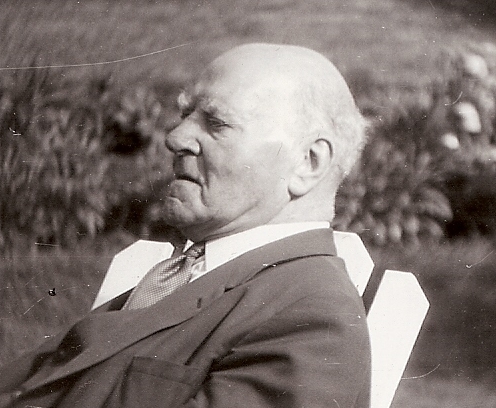
Max Enke aged 76 in 1960
Invasion (10/5/1940) To Internment (23/7/1940)
Just when dawn was breaking, I woke up to hear more anti-aircraft fire than the usual bursts that we heard on lots of nights. At 7 a.m. I got the B.B.C. and heard that both Holland and Belgium had been invaded and that they had asked France and England to help them. By noon French motorised troops were already moving through Eecloo. German bombers were already over Eecloo before 3 p.m. Four French soldiers were killed by bombing between Balgeroek and Eecloo that afternoon, And some civilians (5 or 6) on the main road from Eecloo to Waerschoot. Here at the works we sheltered in the fur warehouse in the concrete building. About 4 p.m. it was reported that a house on the Zuidmoerstraat in front of the factory was on fire. I called for some helpers and we laid two of the factory’s hoses across the road (hydrants are under the town water supply pressure). The fire was in an outhouse at the back of the house. We had it almost out in less than 5 minutes, when I had one hose withdrawn and left the other to finish off the job. Whilst on that job, we saw clouds of smoke issuing from the “India Jute Works”, which were quite burned out by evening. After one hose had been withdrawn, it was reported to me that there was smoke coming out of the factory roof. Leroy had it out before I could get to him after turning on the water valve and manning the 15 metres of the hose pipe. There was a circular hole of about 50 c/m (20 inches) burned through the floor. On our way to lower (the fire was on the top floor under the roof where the pulling machines are) we saw two more incendiary bombs lying on the floor. The first fire did not spread on the floor below, and the two dud bombs only scorched the floor. Those two were marked 1936, and their chemical contents had probably deteriorated (fortunately!). The Jerries evidently wanted to make the Audmoerstraat unfit for traffic by starting fires on it and literally making it “too hot” for traffic to pass. That would have driven the traffic to the wide Station Street. About 500 bombs were dropped back of the Convent School. They were too far to the South to get the factory properly. Besides the house stable mentioned, and the three bombs at the S.E. corner of the factory, one fell just beyond us at the coal dealer’s next door. He told me that he did not want any help as he could handle his little fire himself. That evening at Ghent I could from Bernard Spae hear the French armies rumbling along the rue de Bruges.
Next day (Saturday) I took clothes with me to stay at Oaklands to be more on the spot in case of emergencies. Nothing special the next two days (Whit Sunday and Monday) except for a reported parachutist, said to have landed in the fields behind Pinehurst and Oaklands. An anti-aircraft battery unit, covering about 200 square Kiloms, had its headquarters staff at Pinehurst, and its telephone exchange in the Oaklands coach-house. There was some alarm about the parachutist, as there were only two men with rifles to protect headquarters. On Monday evening just after 8 p.m. 8 G planes out of 5 [sic] were shot down, and another 8 by 7 a.m. next day. I saw some of our planes (3) shooting down a G. plane, but didn’t know enough to recognize what was what, and thought the three small planes that were flying rather strangely (really to get in bursts) were sort of “joy-riding”. With the number of interruptions, because of alarms, it was decided not to continue work at the factory for some days, which dragged on for weeks. On Tuesday afternoon, I returned to Ghent, made an arrangement with De Vos for reduced rent, which he later went back on, and burned up the anti-German things in the flat, and packed for leaving for Ondres in case that should appear to be necessary. Drove back to Eecloo on the Wednesday afternoon, and according to Alice at the Bierstal, only missed Godfrey by quarter of an hour, when he left for Ondres. On Wednesday and Thursday arranged for everybody to be paid off, i.e. wages settled to date. On Thursday afternoon felt that the situation looked more hopeful, and that we seemed safe for at least 48 hours, though by that time the Jerries were already on the North bank of the Scheldt opposite Terneuzen and Breskens.
Although the situation as regards the advance of the German army seemed better, at least according to the radio reports, which seemed to indicate that the advance had been checked, still it wasn’t cheerful to think that the lines were to the North of us on the Scheldt.
About midnight Ernest De Cae (of our office) turned up to tell me that there were notices posted up that no traffic, either wheeled or pedestrian would be allowed on the roads of the Province of Antwerp, East Flanders and West Flanders from 8 a.m. on Friday the 17th to 8 a.m. on Sunday the 19th. I decided to leave right away. That meant leaving the office at 5 a.m. I asked Paula and Ady whether they would come, but they said that the notice was too short. They therefore decided to stay on and see what chances there were of leaving later on. As P. & A. were not leaving with me, Ernest asked whether he and his wife might come with me.
A short time after De Cae left, Herman de Clercq (who later on died of typhus at Dachau camp in the spring of 1945) who was head of the Eecloo section of the Red Cross, came to see Ady, who had been working at the Red Cross hospital, which was in De Clercq’s factory. He had just come back from Brussels, where he had seen the head of the Belgian Red Cross, who told him that the Germans would enter Brussels that morning. He said that the Eecloo hospital unit would leave at 3 a.m. and the staff about 8 a.m. He offered P. & A. to supply them with a chauffeur, from the convalescents in the hospital, who could drive their car for them. Their car would be considered as part of the military convoy, and as such would be allowed on the roads. As this would give them more time to get ready, P. & A. accepted the arrangement offered. (The idea of keeping civilian traffic off the roads was to leave them clear for the retreat of the Belgian army from Antwerp, and for other military movements.)
I said goodbye to Paula and Ady a little after 4 a.m. and left for the office, where I picked up some papers. I left the factory a little after 5 a.m. with Ernest De Cae, his wife and their little dog. We went via Aeltre etc. to Courtrai, where we struck the main flow of refugees from Brussels, we were sent along small twisty secondary roads. That and the fact that we were in a jam of traffic prevented us getting out of Belgium before 8 a.m. When going through Comines a little after 8 a.m. the car ahead of us was stopped and ordered into a farm-yard as were also all the following cars. Whilst in Comines we saw a train on an embankment. This train, with refugees, was still there 8 or 10 days later, when the Belgian Army capitulated. After 24 hours we slipped out of the farm-yard, as did many others and got some kilometers further along but were caught by a gendarme, who ordered us into another farm-yard. We headed for the French frontier at Ploegsteert, but when we got there, were told that the British H.Q. would not allow any refugees to enter the British sector. That meant that we had to chase all North and get into France at Dunkirk. At Dunkirk we saw the docks smoking from the German bombing of the night before. (This was a week or so previous to the evacuation). At Calais we enquired whether a Belgian hospital from Eecloo was there, as I had understood from De Clercq that that was where they were going to. We were told that they were probably at Le Touquet or Berck-Plage. We left Calais by the Calais-Guines-Marquice road, and stayed that night in a small place called Landrethun. We left there on the morning of Monday the 20th of May. We were handicapped by the threat of being short of petrol. The pumps along the main roads had been emptied by the flow of motorists. We therefore took side roads as a better chance of getting some petrol. In that we had some success, but not much.
There were a lot of “Fifth Column” people about and suspicions were easily aroused. Once when Ernest had gone ahead to some shop in the distance to see whether he could get some gas I stayed at a bridge to await his signals to bring up the car. We did some distant sign making, as a result of which I was first asked the way by a cyclist, then a Belgian railwayman, whose train was stuck in the station (a little south of Calais) got into a conversation with me, and then a policeman came along. He was satisfied with my explanation. When eating our lunch in a small pub we got the French 12.30 p.m. news according to which “there was fighting to the South West of Landrecies”. That seemed some distance away, but by the afternoon the Jerries had captured Abbeville (may 20th, 1940).
At Marquise we got back to the main Calais – Boulogne road, and again struck the main flow of refugees in all sorts of cars, on foot, pushing small carts or prams, young and old. It made one sad and also furious. Although there was an awful jam, and queer driving, I saw no real accidents. I knocked down a cyclist myself, but it was his fault and he bore no ill will as later on he stopped me (Dunkirk) and warned me not to stay there because of the bombing. Just before Boulogne on a slight slope (not the main long one in the town) a car got out of control, dashed past us, knocked down a couple of cyclists, without serious injury, and then came to rest in the bank.
At Le Touquet, we drew a blank about the hospital from Eecloo. At Berck Plage we located a hospital from Ghent, but they knew nothing about an Eecloo one. We were told that a lot of Belgian hospitals had gone to Rouen. At Berck Plage we saw about 1500 unarmed French troops set off about 4 p.m. without weapons. What they were doing so far from the fighting we did not know. We left Berck Plage a little after 5 p.m. or so, headed South to Rue, and then turned East towards Abbeville, really trying for gas in villages off the main route taken by the refugees. (I then had petrol for about 35 kiloms.) In a small pub where I asked if there was some place where I could obtain gas, I met a Tommy, who ordered a couple of eggs for his supper. He told me that their unit would probably be moving that night. I expect that they will have been cut off south of the Canche at Etaples. He told me that an air force unit next to them had an average per R.A.F. machine of nine Jerries shot down. Further along in the same village, Ernest and his wife walked off to see whether they could find some gas, and I stayed with the car. A man approached me, and for 10 liters of petrol I arranged with him to take an Abbeville man to Abbeville. A short distance further along a woman rushed out of a house and yelled to me to ask if Abbeville was captured. I told her that I didn’t know and was going there. Further along there seemed to be some confusion along the road, and then we saw smoke rising from Abbeville, which did not surprise us as we had been told that it had been bombed that morning. A little further on we heard explosions coming from there. By this time I was off my map (Michelin No. 51). We continued by daylight and then by weak moonlight (rising moon) in dust behind a car ahead of us. In the end we struck a large road (Abbeville to St. Valerie) followed that westward till we were blocked in a queue that was held up because the railway crossing (at Noyelles s/Mer – about 3 kiloms from St. Valerie) was closed. N.B. St. Valerie is at the mouth of the Somme.
From later knowledge I suppose that the crossing was blocked with a train to hamper the Jerry advance from Abbeville. I head later at Tost that at about that time the bridge across the Somme at St. Valerie had been swung open and thus stopping road traffic. One man from Calais (later at Tost) went to sleep North of the Somme, when he could have crossed in the early evening. No one knew that the Jerries were so close. The radio news had fooled everyone. I remarked that evening that we had put another 100 kiloms between ourselves and Hitler. We had suspicions about the Frenchman with us. He said that he was a manufacturer with an Frs 8 million business in Abbeville, but he didn’t know roads or villages 10 Kms from there.
The Frenchman’s story was that he had taken his wife to Berck Plage, and was unable to get back by train to Abbeville, where he absolutely had to be by 7 a.m. next morning. My own impression is that he had been sent to Berck Plage to see what the situation there was, and was to report to the Germans at Abbeville the next morning, as to what sort of resistance their spear-head was likely to meet near the coast.
As the moon was high in the sky and near full, I did not care to stay in the open square, where part of the queue of cars was, as I was afraid of being bombed during the night. I therefore backed up a small farm road where there was considerable shade from he trees and apparently would be for some hours to come. Later events showed that it was well that we did. Whilst sitting up awake in the car as we did not like going to sleep with that Frenchman there (the previous night I had slept in a bed, and the two previous nights to that in the car) we saw three men in French uniforms march past us with a cyclist, who had a great bundle of something done up in a sheet. He appeared to have been captured by the 3 apparently French soldiers. The Frenchman, in the car, made the remark that French soldiers had long bayonets, and the British and Germans had short bayonets. Probably the cyclist had gone with some French uniforms to one of the places in the fields where we had seen Bengal lights burning (red & white) without our knowing what they were about, and had there met German soldiers who exchanged uniforms, and then pretended to take the cyclist prisoner, so that they could see what resistance they were likely to meet at Noyelles s/Mer.
At this time we still had no idea that the Jerries were within 100 Kilometers or more
| 200% |
| Figure A-1:Showing church at Noyelles and at the end of the small farm road that we were on, the widening of the road from Abbeville at Noyelles. It was at this spot that the Jerries machine-gunned the parked cars without warning and killed so many refugees, at 3 am on 21/5/1940. Photo taken at 7.30pm 22/5/47 |
from us. At about 3 a.m. there was a sudden burst of machine gun fire, which I thought came from a plane overhead, as we had just heard a lot of motor engine noise. Ernest said that the Germans were there, by which I thought he meant them in a plane. But he pointed out that all the tracer bullets were horizontal. The Jerries had come along the road from Abbeville and had without any warning opened machine gun fire on the square in general. Had we been there we should have caught it. I don’t think there were still many in the moonlit square, as most had gone up side roads etc. I warned two French officers, who had backed into the road after we had. They didn’t understand me at first, as they had no idea that the Jerries were so close, but when we saw cyclists riding away pursued by tracer bullets, they soon understood. These two were each in a separate car, and had probably bolted from their men. Just then Ernest called my attention to men moving in the orchard. All of us except an officer and I lay up against the 50 c/m bank where the orchard was higher than the farm road. I suddenly heard some “flick” or something and threw myself down as did the French officer. About ten minutes later I heard a gurgling sound in his throat and realised that he had been hit and was dying. Just then a Jerry came along the farm road. The French officer was nearest the square and the Jerry looked at him and muttered “verwundet” and came on. I was the next one, and I didn’t like the look of his pistol. Just then Ernest called out “civiles” and we were told to stand up, which we did with our hands up. We were marched to where the road joined the square, where I was frisked for weapons, and asked what I was doing with the military. My explanation was accepted.
We were told to go back to the car.
There was fighting for some time in Noyelles (rifle fire, hand grenades and Very lights.) When it was fully daylight, we were told to drive back to Belgium via Doullens.
The Frenchman, who was shot, was probably shot by the defenders of Noyelles sur Mer. We were standing behind the German fighting line, and were probably taken for German officers directing operations. This is the more likely as he was wearing a “tin hat”. It was about 3 a.m. by single summer time, when the firing started, and with our being under the trees, it would be difficult for the French to recognize us as not being Jerries. It seems strange that with all the killing that has been going on for four years, I have only seen three dead since the war started. The Frenchman shot next to me, a British soldier, the same day, on the Frevent to St. Pol Road, and a German soldier in a rifle pit between Westertimke and Kirchtimke.
The Germans, who got ahead of us at Noyelles, were only about 40 men. They were the spearhead that cut through to the coast at the mouth of the Somme, and the vanguard of the southern German army, which faced South and stopped reinforcements moving North to the Allied forces in Belgium and Northern France.
At Abbeville, we tried to cross the Somme and head South. There were few Jerries about, and as far as they were concerned we could have done it. However some cars with Belgian number plates came over the bridge and the drivers told me that they had tried to get away that way, but that with fires and fallen masonry, it was impossible to get through. While I spoke to these motorists, the suspicious Frenchman decamped. At Abbeville, I picked up a can of about 20 liters of petrol from the back of a Belgian truck, just as the Jerry went to the engine end to examine the car. By keeping between the can and the Jerry, I was able to get it to my car and put it inside.
After Abbeville, we first of all headed towards Doullens. Then as I hadn’t much petrol, and as from the Jerry boasting that the road to Eecloo should have been clear, we headed generally North. I cannot trace where we went, as it was South of the No. 51 Michelin map that I have. We passed one column of British prisoners with a Jerry in front and another one behind.
Also a column of unarmed British troops by themselves heading West. We got a little petrol from tanks of two ditched British motor-cycles. Later on we found some people helping themselves from a drum along the road. We claimed our share and got 20 liters there. These people also told me where they had seen a tank hidden in a field. We drove back there, and found the owner, who sold us some more. He was in a hurry as he was in uniform with blue overalls pulled on over it.
Further North we ran into the centre German army, which headed for the Coast at the mouth of the Canche, and then faced North, cutting off the Allied forces in the North. I turned a corner, found a car parked there (refugee) and swung into the middle of the road to see a big Jerry lorry with a pontoon section on it, bearing down on me. I reversed, stalled the engine, then a Jerry N.C.O. with a hoarse voice that goes with the rank, bellowed at me and came up to the car. I self-started the engine, went into reverse, and as the Jerry got some legging strap over an ornamental part of my front bumper, I gave his leg a big jolt, I thought my number was up then, but he seemed so satisfied that the four lorries with pontoons got past without having to slow down, that no more was said or bellowed.
Perhaps I should explain that the Jerries broke through at Sedan. They widened that gap to 100 kilometers, and poured three different armies through it. We saw the spear-head of the southern one at Noyelles, part of the centre army with the pontoons for the Canche, and later in the afternoon, we saw the advance guard of the northern German army at St. Pol, which was the army which attacked the Allies from the South East (Arras etc.).
When approaching St. Pol, we noticed that we were clear of the Jerries which is natural as we were between their centre and northern armies, but we did not understand the situation then. Neither did two French officers in a car, which I stopped, to give them what information I could.
The French officers that we stopped, immediately asked for our papers, and then listened to what we had to say. They finally said that they knew nothing except that the British were at Arras, and they (French) at Bethune. We later on heard from other refugees that the military had not known what the situation was, and were glad to get information from the refugees.
Not understanding the situation ourselves, I thought it would be good to reach the British forces at Arras, but it is as well that I did not success, as we should have run right into the Northern pocket. On the far side of St. Pol (E.N.E. side) we ran into a jam of French farm carts, and it was impossible to make progress. Whilst out of the car to see what the jam was like, I ran across two Tommies, who said that they had been separated from their unit the day before during the fighting around Arras. They said that there were six of them there. I advised them to head in the general direction of North West, so as to join up with the Allied forces. I also explained the situation to them.
When getting out of the jam to try to find some other road, there were shouts that the Germans were coming. Three of them came along the road coming from the St. Pol direction. Most people headed for the cellar of a small chateau there. I was on the road side so I put up my hands. One of the Jerries, with a pistol in one hand, put them over his head and shook his head at me, so I put my hands down, and later made for the cellar. There was a little rifle fire and some hand grenade explosions. Later on when I looked out, I saw that the farm carts had melted away, and that my car was left alone on the road. I brought it around to opposite the chateau (on the road), and was just going to fetch De Cae and his wife, when a Jerry came up and asked me whether that was my car. I said it was and was told that I must tow a car with three French civilians wounded into St. Pol, as one case was urgent, as the man had been shot through the stomach. The other two were wounded, one in a foot and one in a shoulder. I had to start off without time to fetch the De Caes. One man flourishing a pistol stood on my running board. I could not help pulling his leg (figuratively), so protested that I was scared of that pistol, which made me nervous. He explained that it was quite safe as the safety catch was on. I said that I knew nothing of safety catches and did not like it. He finished by putting it back into his holster. We were soon in a jam of farm carts, but with the Jerries shouting, a way was made for the cars.
When we got opposite the town hall at St. Pol, the Jerry said that he would take my car and give me another one. I protested that as I had done him a service with that towing, that he should leave my car. He said that I must discuss that at the Kommandatur. I took him for an officer (I didn’t know their markings for ranks then) and thought that he meant that he did not insist. Anyway, I drove away after asking some Jerry motor-cyclists to open a passage for me.
I headed back for the De Caes, but got jammed in the farm carts. The De Caes found me there. They told me that something had gone wrong with the Jerry advance, that they had blocked the road archway under the railway, near the chateau, with farm carts and had posted a sentry there, who allowed no one to pass. They were however allowed to pass, as they said that they belonged to the car that had towed the wounded. They were told that they might join their friend, whose car would be taken when they got to St. Pol. Unfortunately I had to drive through St. Pol and past the Kommandatur. Fortunately there was a constant stream of disentangled (unjammed) French farm carts passing that Kommandatur and I took care to keep them between me and that building.
We drove a little distance on the Frevent road and then consulted my map, and turned westward to the small village of Hautcloque.
Ernest did some scouting for a place for us to stay at. The two stayed at a farm house where I had my meals, whilst I slept at the next nearest house. We stayed there for 17 nights.
Date of the above is Tuesday May 21st 1940.
Hautecloque from May 21st 1940 to June 7th 1940
The 17 days that we stayed there were on the whole uneventful.
We were about 1 1/2 kilometers from the Frevent – St. Pol road (to the West of it).
We heard lots of heavy traffic moving along that road at night, at first going northward and then southward, but we saw very little German equipment or personnel. There were about 40 Jerries (Engineers) quartered in the village. At first we heard the fighting round Arras to the E.S.E. of us. Arras was taken and retaken about three times. Then the fighting drifted westward to Cassel, which is almost due North of where we were. There was some heavy fighting round Cassel, which we could hear. At first we were still in hopes of the Jerries being driven back eastward, but we gradually got the news of the Belgian collapse and the evacuation at Dunkerque. On June 5th we heard the opening of the battle of the Somme, to the South of us. Previous to that we had heard the rumbling of Jerry traffic on the St. Pol – Frevent road going South.
The local cure (a Dutch man) did useful work. He seized the flour in the chateau, belonging to the marquis, who had left, and had it baked into bread for villagers and refugees. We were issued with a “home-made” rationing card, on which we could each of us daily get a portion of bread.
The Germans wanted a list of everybody in the village with names and places of birth. Ernest explained my case to the cure’s secretary, who “forgot” to write down “Manchester”.
As the villagers complained that the Jerries had paid too little for a pig, people started to kill off their livestock and sell the meat retail to the refugees. Other villagers were warned off not to try and sell their meat in our village, as the market was reserved for our locals. The farm people where the De Caes stayed were rather simple. They had a little land and one cow and a heifer. The wife did all the work. The husband was the local “garde champetre” (village constable). We had to tell them to hide the bulk of their potatoes, and show them how, and to leave only a small amount “for their own use”. A few days later on, all surplus spuds were put into the ground – in spite of lateness of the season – as being the safest place. Somebody ploughed up some land and the neighbours round about planted their potatoes in the furrows (every second or third furrow). We also helped them to hide their fire wood, and did the interpreting for them, explaining to the Jerry soldiers that the hens hadn’t laid yet that day and that one of their “Kameraden” had already booked some for that evening, etc.
I had my car in the farm yard at first, but a neighbour doubted its safety there, and showed me a good hiding place amongst trees on his land. I put it there.
On the whole I kept close to the farm, as I had a close call of being spotted one day as an Englishman. Ernest and I walked to the Frevent – St. Pol road and just across it. A Jerry “Intelligence” officer seemed to think that there was something strange about us and asked for our papers. We explained that we were refugees from Belgium, and were staying at Hautecloque till the main Jerry army traffic was off the roads. (That was quite true, as we figured that the less Jerries were on the road, the less chance there was of my car being taken.) Ernest showed his “Carte d’Identite”, and I had mine out of my pocket and well covered by my hand (to not let the different colour be seen) when the officer said, that it was all right, that we could stay a few days longer in Hautcloque, but that we must move away from the village. At the time I thought that if he had seen mine, I should have been arrested on the spot, but perhaps that was not so.
We were well treated by the French. On the whole the Belgians were not popular, partly due to some of the Belgian refugees behaving badly. We heard of Belgians, who asked for water, being told to go to the Canal Albert to get it, and being refused it. The capitulation of the Belgian army also contributed to their unpopularity.
Many families of refugees had been separated. Some had turned to the right when rushing out of a house that was bombed, and some to the left, and they didn’t meet again. There was a notice board in the village on which such separated refugees mentioned when they had passed through Hautecloque and where they were heading for.
The petrol that I had in the tank of the car was not enough to get me back to Ghent, and I was afraid that if I ran short of gas I should have to abandon the car and lose it. Besides that, there was a risk of having the car taken from me by the German troops. After the German troops had moved South for the fighting round the Somme, there was less on the road and it seemed safer to travel.
I thus hung around Hautcloque in no special hurry to leave.
On the 6th, Ernest got into conversation with some Jerries and explained that I couldn’t leave as I was short of petrol, as I had used up so much when towing a car with 17 wounded. The Jerries were very much impressed (thinking of Jerry wounded) and offered Ernest some petrol after looking through his and his wife’s papers and seeing that they came from Flanders (where the “good” Belgians live). They thought that it would be better if their friend came with the car to fetch it, but the De Caes, who did not want my papers to be seen, got the 18 liters given in cans, and brought them to me, taking the cans back before the Jerry officer got back. The Jerries advised them to leave that same afternoon, as the R.A.F. had dropped a flare over the village the previous night, and would probably be coming back that night. The Jerries in the village all left that evening. It was too late for us to start, especially with early curfew regulations, so we prepared to leave early next day.
To look a little delapidated and refuge-like, we had a sack of potatoes on the mud-guard, some string tied about the car (all the best refugees had that or a mattress on top) and I smeared the car with some cow dung. As I rather overdid the dose, I had to wash most of it off again. As there was always the risk that the car might be seized, I did not care to take more luggage than what I could carry, in case it came to that. I therefore left two suitcases in France, one of which had my typewriter. I hope that they are still there. (I must write and enquire.)
The farm people were sorry to see us go as we had sort of acted as buffers between them and the Jerries. The farm woman cried at our leaving.
A woman and child wanting to go to Bruges, came with us and thus got a lift to Ghent. We travelled quite nicely, along secondary roads at first, to avoid troop movements. We joined the main Douai – Tournai road about half way between those two towns.
The only troops we met were some artillery, whom we avoided by waiting in the back street of some townlet until they had passed, and some foot-slogging infantry when we were approaching Tournai.
When going through Renaix, I noticed that Belgian army officers still carried their pistols. I thought that this was the modern equivalent of handing back his sword to a surrendered officer. However, later on I noticed that the cartridge clip was not in the butt of the pistol.
We reached Ghent about 4 p.m.
The De Caes stayed with friends in Ghent overnight. The De Voses were surprised to see me as they thought that I was then in England.
I continued on to Eecloo with the De Caes, who from what they had heard thought that the factory was all right. I first drove to the office yard and then to the other one and drove the car into the garage where it has been unto this day. Emile Cnudde gave me a good lunch, which pepped me up considerably, as I was pretty well played out, probably from nervous tension, when I got to Eecloo.
I was surprised at three people stopping me to thank me for having allowed people to use the factory dining room as a shelter. One went so far as to say that it was because of that that Providence had spared the factory from damage.
In the afternoon, I took the office bicycle and cycled back to Ghent on that. This was Saturday, June 8th.
So ended my attempt at getting away. Not getting out of Belgium by 8 a.m. on the 17th caused me a loss of 48 hours, and after that there was the shortage of petrol, and having to try and get it off the main track. The loss of the 48 hours could have been retrieved if I had had an extra tank with 50 liters of petrol.
GHENT & EECLOO
There was nothing outstanding between June 8th and July 23rd. My time was spent between Ghent and Eecloo.
I generally cycled on the office bicycle to one of those towns and stayed at each a day or two or three and then returned to the other.
There was little to do at Eecloo. In the office I wrote up the private Journal, and at Oaklands I went over the house with the servants to have pointed out to me what was missing there.
I made out a list in triplicate of what was missing. The gendarmes were given one. Dehulsters had one, and the other one must be somewhere.
On June 11th I ordered my first spectacles and obtained them the next day.
I tried to get news out about myself, but there was no proper way to do so. A former U.S.A. consul, who had known Papa, and who had spoken to me at the chess club, tried to get a message from me to Stephen via the department in Washington. After he had been to Brussels for a day, he told me that it could not be done as the U.S.A. diplomatic staffs had no privileges in the occupied countries and that all dispatch bags to the Berlin Embassy had to be sent open so that they could be examined by the Jerries. The U.S.A. Embassy at Berlin had diplomatic privileges. Later on I sent a message to the Belgian Red Cross at Brussels for transmission to Ady, who was a member of a Belgian Red Cross unit in France.
On July 3rd, I travelled to Brussels to attend a Cutters’ Union meeting there. It was by steam tram from Ghent via Alost. The journey took 3 1/4 hours each way (Standing half the time on the way back.)
Two Jerry officers and 2 orderlies were quartered in Oaklands on July 4th. They were part of an anti-aircraft ammunition column. In all they were about 57 or so, of whom most slept in their ammunition trucks, which were parked under trees in the Oaklands and Pinehurst gardens. I spoke to them at times.
It was not a pleasant time at Oaklands, even though I sat on the balcony and watched the Jerries below me having parades for rifle inspection etc.
My moving about might also have led to misunderstandings and trouble. For instance, I left on the afternoon of July 17th, without telling the Jerries that I was leaving. (Why should I?) About that time the R.A.F. dropped leaflets saying that they would bomb any houses where Germans were quartered.
At the Bierstal I called in to see Alice about Godfrey’s furniture. That night a bomb was dropped quite close to the Bierstal bridge. Also that night when there was a “Fliegeralarm” the Jerry officers wanted to wake me (in Paula’s room) to advise me to come to the cellar, and they found the bird had flown. Next morning they made enquiries from Kamiel about me and my whereabouts. Had Oaklands been bombed that night, this might have been twisted round to look black for me. Some of the office staff pointed this out and advised me to let the Jerries know about my intended movement.
On the morning of the 23rd, I was in the Oaklands bathroom at 7 a.m. when there was a knock. When I opened the door there was an Eecloo gendarme, who enquired where P. and A. were. I told him that they were in France, and asked what it was all about. After some hesitation he told me that all the English were being picked up. Also that officially they knew nothing of me, as I did not live in Eecloo, and that probably the Ghent police had called for me.
I had breakfast and made for the office and prepared to leave. Back at Oaklands for lunch and in the afternoon cycled to Ghent with Emile and my luggage. More packing up at 22, supper with De Vos, and then went with him to police station with my luggage. I had been advised to do so by the Eecloo police, who said that they would probably get such orders from Ghent. I did not want to be arrested on the street and thus be separated from my very necessary luggage.
The police took me to the Jerries who ordered me to be kept in the “lock-up” till next morning. The police were very decent. The policeman helped carry my luggage. I was allowed under escort to go and leave some surplus funds at De Voses. The gaol people were also friendly and gave me a mattress and one blanket more than the police had suggested.
Internment – From Ghent (23/7/1940) to arrival Westertimke (5/8/1944)
I reached the Ghent “lock-up” just before midnight on July 23rd 1940. This is just a police “lock-up” for holding people overnight (drunks and disorderlies etc). I had to leave my luggage in the office there and also the contents of my pockets, which had to be emptied out. The cell was quite comfortable. I had a mattress and three blankets in a cell for myself, and was quite comfortable. The only unpleasantness was that some drunk was brought along some time later and put into a cell, about two or three cells from me. He was in the noisy stage, banging on his door etc. which prevented me sleeping. Next morning the jailer called me as late as fitted in with arrangements. He like the others was friendly, because I had been sent there by the Jerries. He folded my blankets for me (his). I had breakfast sitting in the little courtyard of his house, from which he fetched more coffee when I asked for some.
The constable, who was to take me back to the Jerries came along a little before 8.30 a.m. and we sat there cursing the Jerries in general. I was at the Jerry office before 9 a.m. and was taken to some school room near the Ghent University. I was alone there from 9.15 a.m. till noon when some, who had been “picked up” in the Ypres district were brought along. About half of these were gardeners of the “War Graves’ Commission”. A little after 4 p.m. we were put onto lorries, and were driven through Brussels to Liege. On the way we passed lorries of women, who were being returned after having been “picked up” the day before (when I would have been if I had been at Ghent that morning). (The policeman, who went with me from police station to 22 Bld Bernard Spae, to leave funds with De Vos, told me that although he was 40 years old, he had that morning cried like a child at the work that he had to do of getting women and children on to trucks.) I stood half the way to Liege in that truck holding on to the roof of the same. Somewhere East of Brussels, someone gave up his seat to me.
We got to Liege about 9.30 p.m. or earlier, but with the delay, that we met with every time we got into a new military district, it was 11 p.m. before we got to the Liege Citadel. The Jerry officer there allowed us to have the lights on for 10 minutes for us to get settled down for the night. This against black-out regulations.
The Citadel at Liege is really a big barrack-square with four or five fairly modern buildings, which are Belgian army quarters. The quarters were good. There were some wounded French soldiers in one building. We were not supposed to talk to them, but we did. Some more internees (from Brussels and Antwerp) were brought in during the next few days.
The Jerry rations for us, were as usual insufficient. There was also a lack of dishes etc. to collect our soup in. For some days I only had a small rectangular “lebkuchen” tin, that I had brought along to hold some freshly boiled bacon, that I had boiled up just before leaving Oaklands on the 23rd. It was too small to hold even the small ration issued.
On the 28th about 500 more internees arrived. They came from Northern France (Nord and the Pas de Calais). They increased the “English” percentage in the camp, which previously had had rather a Flemish atmosphere. (A number of those from Belgium had British papers because they had been naturalised in Canada, but had Flemish speech for all that. Those from Northern France were mostly “War Graves’ Commission” and ex-Service men from the Four Years’ War.)
On Saturday, Aug. 3rd we were called early and had what passed as “lunch” at 9 a.m. We left the camp before noon in trucks for Liege station where we entrained without knowing for what destination. That train sort of “zig-zagged” (probably because lines were damaged) and we did not know whether our destination was to be the East (Germany) or West (Belgium). Finally we got to Huy (midway between Liege and Namur on the Meuse). We detrained, were lined up out-side of the station, and heard the guards given the order to shoot anyone that tried to escape. The population was friendly and handed out some smokes. We got up hill to the Citadel there, myself in a sweated and puffed condition.
Huy – Aug. 3rd to Sept. 8th 1940.
The Citadel at Huy is a massive stone fortress built about 1800 or before by the Dutch at the time that they were occupying Belgium. There were a few outside windows, but most of the openings in the walls were mere slits widening, in the inside to allow of firing a little either side of perpendicular to the walls. We were lined up in the central square, which is a pebbly dusty place. Those speaking German were told to step forward. I thought that I had better do so, and was with others that stepped forward told that each of us was to make up a group of 30, occupy a room and be “Stube Aelteste” of it, i.e. room warden or “chef de chambre”. Someone from a group asked me whether I would be their room warden. I sized up the group and agreed to it.
The room that we occupied (No. 10) was a good room as far as they went. All the rooms had stone floors with a little loose straw, which we spread out at night and kicked back into a heap in the morning. Some of the rooms were on the ground floor, where the stone floors were drawing up the damp from the ground below. About half the rooms had rooms below them, so their floors were better. Our No. 10 was next to the room that was over the kitchen. Our room was about 9.5 meters long and half that in width. With 15 men sleeping along each wall, we averaged about 25 inches of space each. At night I could not turn without disturbing at least one of my neighbours. We were so badly crowded that next day five left the room and found other accommodation in rooms that were so badly lighted that the electrical light had to be kept on all day. After about three weeks we obtained sacks for mattresses for putting the straw into. We also obtained a little more straw.
On Aug. 5th the room wardens held a meeting at which it was decided to ask the Jerries for permission to go shopping to start a canteen. Permission was granted, and a Jew (Antwerp diamond merchant) was to go out on Thursday (7th). We Gentiles did not care for the canteen getting into Jewish hands, and I, as speaking German, was asked to speak to the lieutenant about it. He told me that I was not a friend of Abraham, also that as I had brought the matter up, I was to go out for the shopping. I went out with two guards, who had orders that one was to stand outside of the shop, whilst the other one was inside with me. I went along again of the 8th. On the 9th, I was allowed an “assistant” (manager of an English bank at Le Touquet). We went again together on the 10th and 12th. As others were anxious to get out and as I wasn’t, since it meant carrying weight in a rucksack for some hours in August heat and then climbing up that Citadel hill, I stood back and let others go. Rosenthal, who was to have gone out originally was annoyed and fell foul of the Jerry sergeant and as a result ceased to be camp interpreter.
I was appointed as official camp interpreter. At parades for muster, there were generally some Jerry instructions to the camp. I had to shout out translations of the same in English, French and Flemish, and three times each – once at each end of the parade and once in the centre. I also had to act as sort of official go-between between the camp and the Jerries, transmit complaints, requests etc. In later camps, when we were organized, that sort of work was carried on by our Camp Captain and his staff. I had a certain amount of work in consequence of being both room warden and unofficial camp captain. Besides having to make up sundry lists, such as room lists, list of religious beliefs of the different 28 or so room wardens (the Jerries did not want any particular religious group to have predominant control in the camp) etc. men would come to me with requests such as: “I wish you’d ask whether I may go to the dentist”, “I can see my wife outside. You might please ask the lieutenant whether I may speak to her”. All of this meant a considerable amount of chasing round.
There were of course many requests and meetings to try and get more food. Some of our food was stolen and never reached the camp. We all went down badly in weight. Some of the older men were afraid that their would be food riots and that the machine guns that there were would be turned on us. I showed some visiting general my much slackened waistcoat, which annoyed him. I also told him we were not getting what “Liege” ordered. He was the general in command of the Liege district.
The general complaints about insufficient food may have impressed that general. Anyway the Jerries sent a captain of commissariat to look into the matter. It was rumoured that he had said that he had never seen a camp as badly managed (for food supplies) and that lots of the food never reached the camp. Later arrivals than ourselves at Tost, who had spent a short time at Huy after our departure reported that a Jerry sergeant had been sentenced for selling camp food. Any improvements as regards the food at Huy were after we left there.
When arriving at Huy, we still had our personal papers, passports and identity cards. After someone escaped, these were collected from us. Subsequently they were handed back and distributed to those concerned by our Canteen Committee, which had been formed to distribute the food bought in town, so that all rooms got their shares according to the number of men in each. For the first few weeks I advanced most of the funds for the canteen buying. Then as there had been a sudden rumour that we were leaving (unfounded), and there was the risk of not being able to sell the stock, it was agreed that each room should put up frs. 100 to finance the canteen.
The man who escaped was a member of a frontier lot of smugglers, so will have been all right once he joined his friends. As the clothes that he left behind were lousy, one was doubly pleased that he had got away.
One day a sergeant-major and some men came to our rooms and looked at the insides of our coats and overcoats. In a number of instances they cut out the tailor’s tags. We didn’t know what it was for, but thought that perhaps they sewed those tags into the coats of spies that they dropped from the air over England.
When we reached Huy there were about 696 of us. One escaped, about 16 were let out a fortnight or so after we got there, either because of “pull” in Belgium or because they were not British subjects. Southern Irish were released as German nationals were not interned in Southern Ireland. One man was released because of “cancer of the throat”, which he never had. The first day that I was back in Ghent I happened to run across him. He is still well. He fooled the Jerries over that.
On September 7th all those considering that they had medical reasons for being released, were told to line up and give their names. Those who merely had colds put down their names, which gave me considerable useless work, as I had to sit up that night putting down their names in alphabetical order, and sorting out their passports etc. in case they were needed next day when a doctor was to “vet” them. Another man was getting out the passports for about 40 younger ones who were under 18 yrs. old. He did the sorting in the guard room, with a sergeant put there to watch us handling the passports. He went to sleep, which didn’t matter, but when he started to snore I woke him to tell him that the Jerry guards in the room couldn’t get to sleep with his snoring. That sounds trivial, but when one could tick them off or pull their legs, one did so on principle. The doctor next day marked a lot of men for discharge, but as the orders from higher up only allowed for sixteen, the number of those released for medical reasons had to be kept down to that. After the medical inspection we were told to pack up and be ready to parade at 6 p.m. What with previous releases, the younger ones released and those released as being medically unfit, our numbers were reduced to 625. We left the camp about 7 p.m. and were marched to the station, which we left about 9 p.m. Before leaving a Dutch railwayman, who was sounding wheels, told us that the Jerries had lost 187 (or 178) planes over London the night before. That will have been their first mass air-raid over London. I was lucky to get a seat in one of only two second class compartments that there were on the train.
Railway journey Huy to Tost [now Toszek, Upper Silesia, Poland] (Sept. 8th to 11th).
As it was dark when we left, we didn’t see much. We seemed to stay most of that night in Aachen railway station. It was daylight when we left. I have an idea that we passed through Barmen, but do not remember properly. We did pass through Neanderthal, where the remains of one of the earliest species of “Homo Sapiens” was found. Also through Halle, Gottbus, Breslau, Gleiwitz to Tost.
A little beyond (East) of Aachen, we saw portions of the German “Siegfried Line” through which we passed. There were masses of barbed wire in large rectangular sections, also a lot of vertical concrete blocks, which were probably there to stop tanks. We saw no troops round that section, which is not surprising as at that time the Jerries thought the war was as good as won, and that line would never be used. (They had to use it four years later.) At two or three places along the route we saw painted on roofs “Wir Kapitulieren Nic”. That rather cheered us up. We considered that it meant that the Jerry morale needed “pepping-up”. At Halle there were a number of captive balloons around the town. At one spot we passed a lot of small speed boats or to be more accurate small flat bottomed boats of about 25 ft. long, into which we expected that overboard motors would be fitted. These were probably intended for the invasion of England. They were probably the sort that Jerry troops in Holland and Belgium refused to put to sea in. Before I left Eecloo and Ghent I had heard many reports of such refusals and reports of Jerry troops with their hands tied, passing through Caprycke and Eecloo in trucks. It was supposed that it was to make room for more Jerry prisoners that we were so suddenly moved out of the citadel at Liege. Some years later, I saw pictures of such boats in the Jerry papers as being used across rivers in Russia. We arrived at Gleiwitz at about 7 a.m. on the 11th. As usual, when entering a new military district (that of Breslau, which was VIII) there was a long delay before we received orders to proceed. It was 1 p.m. before we left Gleiwitz for the hour’s run to Tost. From the Tost station to the camp is about 20 to 25 minutes walk, which we did on foot, most of us carrying our luggage. Some luggage was taken by trucks.
Tost September 11th 1940 to November 12th 1943.
Considering the long time that we were there, it seems best to mention matters of interest under separate sections, and to cover the whole time period in each case.
Buildings etc. These formed part of a lunatic asylum that was built in 1900 and perhaps later for some sections. The camp had really been fitted up to receive officers, which is the reason that it first had the name “Oflag” (for OFizier LAGer). Subsequently it was called ILAG (Internierten LAGer). The VIII in the name referred to the military district, based on Breslau. As the buildings were less than 40 years old and had been constructed for what might be considered medical purposes, they were good. Except for a few smaller rooms, all rooms had double windows, which are needed in that climate. There was also central heating, which was turned on for an hour in the morning and an hour in the afternoon, which was sufficient. There were 21 hot and cold water baths, which were sufficient, even when later there was hot water on only three or two days per week. The only drawback was that the main building was a fire trap. Every window had bars across it, probably to prevent the former inmates throwing themselves out. Had there been a fire, especially at night, there would probably have been a fifty per cent deathroll. We were at one time rather overcrowded with up to 65 in one large room, which gave less than 10 cubic meters per man.
Population When we 625 arrived from Huy, we found 210 who had arrived a week before from the camp at Schoorl in Holland. We were thus 835. As the “Dutch” got there before us, they had already fixed up about a camp captain and other camp officers. We therefore had to fit in with their arrangements, which caused some friction as we were more numerous than they, who were very “cliquey”. That was smoothed out in time. Before the New Year 225 seamen from the Orient liner Orama, sunk off Norway about June 1940 were brought to Tost. They left again in July 1941. We met them again in our last camp at Westertimke in January 1945. Different oddments drifted in from France and Belgium and Norway, and during 1941, men from Greece, Crete, Jugoslavia etc. About September 1941 we had a large lot of 225 from the Wulsburg camp. These were mostly from Denmark and Germany. As overcrowding increased and the Swiss officials, who came as the “Protecting Power” to inspect us, about 300 were sent to Kreuzburg camp.
Food. This was inadequate, as was the case in all camps. It was however better than it had been at Liege and at Huy. I lost weight and felt myself getting weaker, with a greater effort required to get up in the morning. It was not until the Red Cross parcels started to come in, as from the beginning of February 1941 that the situation started to improve. By March, because of the Red Cross parcels, some internees were not taking all their Jerry rations. The surplus was given to those that asked for it. That helped me quite a lot, as did the exchanging of smokes for food. (Separately from the parcels we received 50 cigarettes per week, and frequently 2 oz of tobacco as well). The bread ration was at first 4 1/2 per 1200 grm. loaf, or a little under 300 grammes per man per day. This was subsequently reduced to 5 men and 6 men per loaf. At Westertimke it was at the end reduced to 9 men per loaf. We had a little margarine twice a week, a little jam once, and 66 grs. of cheese per week. The midday meal was a slop of vegetables with a slight flavour of meat, due to the little meat in it. We had a lot of swede turnips and carrots as the whole of a midday meal. Sometimes rather smelly re-wet fish with boiled potatoes, sometimes a porridge made of millet seed (not bad) or of barley.
Athletics. As there were lots of trees in the park, no active games such as football or hockey could be played there. Cricket was played in the summers of 1941, 42, and 43. Basketball in 1943. There was a craze for “Tom Thumb” golf in 1942 and part of 1943. There was a regular playing field about 12 minutes walk from the camp. When the ground was fit after the winter we were allowed out there twice a week (sometimes less) for about 200 internees at a time. For special matches, where more spectators wanted to go out, the Jerries could generally be prevailed on to supply more guards so that more of us could go to the field. (I think 500 was the most). Football and baseball were played on different sections of the field. There were also some walks at the end of the summer of 1943. These were really for the over 60’s, but I slipped out on some.
Library. There was a small library as from the beginning made up of books that were presented by internees or sent by international organizations. This was much augmented by the books brought along with them by those from Wulsburg (Autumn 1941). There were good reference books there.
Indoor games. As our writing materials and books etc. were taken from us on arrival, for censorship purposes, there was a lot of chess played at the beginning. This fell off later on when paper and books were returned, and a number of internees took up studies. Cards were played a great deal, but chiefly in the dormitory-living rooms, except for Bridge drives etc. The chief recreation rooms were the two large dining rooms, which could each seat (congestedly) 150 or so. Half of one dining room was reserved as a “Silence Room”, where one really had to be silent.
Studies. We had our “Education Department”. There were regular classes for Matriculation. More than 50% of those who sat for exams, passed. The regular exam papers were sent out from England, and the writing for them was done under properly supervised conditions. Some also studied and sat for other exams. These varied for different universities (Oxford, Cambridge, London, Northern Universities etc.) I took a junior geometry class for the matriculation classes. Afterwards I did not take people who wished to cram up for exams, as I found that they were not interested and were only out to fool some examiners. I gave a couple of courses in statistics (from a book Stephen had sent me) and also instruction in the use of the slide rule. The latter was not over successful, as many who wanted to learn knew too little arithmetic to know how to make proper use of a slide rule. Personally I studied Statistics, a book on Mechanical Engineering sent me by Peter, and some Mathematics (algebra, Calculus). The courses in Calculus given us by Dr. Hunter (Arnold’s friend) were altogether beyond us, even for those who took the lessons as a refresher course. Dr. Hunter (head of the geodetic survey in India) was too clever for us, to be a good teacher to us.
Control of Food Parcels (private parcels and Red Cross ones). The Jerries never liked the latter. Their newspapers all stated that England was being starved by the efficient German blockade, and that therefore England could not be in a position to send us such parcels normally. The parcels were therefore considered as “propaganda” to mislead “unthinking” people in Germany to think that England was not short of food. At first the Jerries argued that as the parcels (weekly issue) were sent to the camp as a whole and not addressed to individuals, that they must be considered as being for the camp as a whole, and that they should therefore be used to supplement the rations in the kitchen. We resisted that attempt and won out on it. There is a standing order that everything has to be opened. At first the Jerries were easy about that and were satisfied if the corner of a packet of chocolate was broken open as “clearing” a whole parcel. Later on we had to have all tins that were taken out of the supply office opened, with a Jerry standing by to see that it was done. This was to stop internees having unopened tins for taking with them on an escape. We did not have to take out all tins etc. as soon as we got the parcel, but could leave a number behind, and fetch them a few days later. Each man had a slip showing what tins he had in storage. These were crossed out as taken out. At Westertimke we had to take out the whole of our parcel as soon as we had it and had to have all tins opened, and the contents of three tins emptied out. Fortunately it was winter time; also as we did not all get our parcels at the same time, one could “lend” someone else a tin for him to return it a few days after when he got his parcel.
Theatricals and Concerts. We had our little theatre, and some quite good small cast plays were acted and also concerts given. A Jerry interpreter always had to be present (probably to see that there were no funny jokes about Hitler and Co.) Some Jerry officers came at times to see the plays. Once when a Jerry doctor had smacked a man (American) for not taking his pipe out of his mouth when the doctor passed, the whole audience left when that same doctor came that same day to see the play that was on. It was then explained to him that the actors could not go through the play for an audience of only two (doctor and interpreter).
Parades (Musters). At Liege and Huy they were outside (July, Aug. and Sept.). At Tost they were at first outside in the park. Later they were always inside, as they were also at Giromagny. (One man told me that when in another camp, they had had to parade every two hours of the 24 and outside at that).
Escapes. At Tost there were about 4 lots of get-aways, of two men each time. All were recaptured almost immediately or within a few days except two (Caminado a “Times” correspondent, and a Canadian, Johnson). I never heard exactly what happened to those two, or that they got to England. There were reports that they had got to Switzerland. Perhaps they stayed on the Continent to work behind the lines. Giromagny, within 30 kilometers of the Swiss border was more useful. Two or three stayed out when helping to truck supplies from the station to the camp on our arrival. One night a whole sixteen left, including our chief civilian doctor, who considered it his duty to leave to report conditions in the camp. Two of those sixteen took the wrong road and were recaptured. They escaped again and got to Switzerland that time. In all about 25 definitely escaped from Giromagny besides 3 that openly climbed over the barbed wire in day-time.
Censoring. This was erratic. Once the Jerries had a man black-listed all his letters seemed to get into trouble. At first they stopped a man’s correspondence for a month or so, till it was pointed out to them that it was against international regulations to stop a prisoner’s mail. Books were confiscated in lots of cases. But lots of books that were on the disallowed list, passed the censor. At first all “Penguin” books were forbidden because some copies had had jokes or advertisement drawings making fun of the Nazis. Lancelot Hogben’s books were not allowed. “Gentlemen Prefer Blonds” was not allowed. We never saw the list.
Leaving Tost (12/11/1943)
According to international agreements, people may only be interned in the country in which they are resident. Various internees had frequently complained that they were so far removed from their families, that it was practically impossible for them to have visits from them, although visits were allowed in theory. Finally the Jerries decided that they would do something about it. (Actually I think, and many others thought so too, that the real reason was that the Jerries wanted those good buildings for other purposes.) The biggest group from any single country was from France. It was decided that we were to be moved to a camp in France, which was suitable for about 800. There was a general readjustment of internees as between Tost and Kreuzberg, which in general amounted to internees from France being brought back from Kreuzberg, and internees from Germany and Denmark, and some other countries being sent to Kreuzberg. After this readjustment of internees, the camp was moved as a whole and very efficiently at that. All our personal effects were moved, as also our camp supplies, which at that time amounted to about 14,000 Red Cross parcels, our hospital stores, library, education equipment, with blackboards etc, theatrical scenery and costumes, and even personally made, knocked together benches and such like, some of which really were not worth moving. (The reason that we had so many parcels, was that shipping and transport difficulties were foreseen, and we were given a substantial reserve, which might only be broken into after permission had been obtained from Geneva.) (14,000 parcels meant about 16 weeks’ supplies). We finally left Tost station on November 12th 1943.
Journey Tost to Giromagny – November 12th to November 15th 1943.
I forget just via what towns we travelled. I remember that we passed through Nuremberg, which had been considerably knocked about, especially around the big Stadium – Party Rally place, which is next to the railway line. We were in 3rd class coaches. The one that I was in was an Italian one, with a leaky steam pipe so that steam could not be turned on. Only the first four coaches on the train were heated. With snow on the ground it was cold. We were properly arranged eight to a compartment, but since some people, as usual, wouldn’t play the game, and wouldn’t get out of any wrong compartment that they had got into, there was overcrowding in some compartments, which had more people than sitting room for a 72 hour journey. I was one of the few who volunteered to leave a compartment to go to one that was said to be less crowded, and gained thereby, as the compartment to which I moved had 16 eats for only 10 people. One man made a rough hammock out of Red Cross parcel string and slept under the roof, and another in a luggage rack, so we remaining 8 had the luxury of two seats each. I kept warm with a vest, shirt, waistcoat, pullover, coat, overcoat and two blankets. We got to Belfort early (daylight) on Monday the 15th, but with the usual delay when getting into a new military district, we only got to Giromagny by late afternoon dark.
Giromagny (15/11/1943) to (2/9/1944)
We got to the camp after dark. It was a French barracks. It was a great come down from the good buildings at Tost. The Swiss (Protecting Power) officials had said at Tost that they had not seen the place, but “that it could only be a move for the better” which most of us did not agree after we had seen it. The buildings were of stone with stone floors, which were very cold, especially as we were short of fuel. We were almost continuously cold that winter. The barbed wire was almost “on top of us” and gave us very much hemmed-in feeling. The camp will have been better for the French, as they could go outside it (and did not have the barbed wire cramping) and had more buildings to use. The laundry building and a number of the latrines were outside the barbed wire. Water was short when we got there. I was asked to go out and see what could be done about it. I promptly got my feet wet, as there was so much surface water about. Next day I reported to the Jerry colonel that there would be all the water that could be wanted in a week’s time. That did not satisfy him as he said that one could not always have to have a Guttesdienst every time there was a water shortage. The camp was considered so unsatisfactory – even by the Jerries – that we were advised not to unpack as we might be leaving almost immediately. However we stayed there another 9 1/2 months.
In our part, which was probably the part used by the French N.C.O.s and privates, there were 9 barracks, all of about the same size, with slight differences of internal arrangements. Each barrack, besides some smaller rooms, had 7 fairly large sized ones, into each of which 24 of us were put. One room of the 7 was to have been used as a recreation room for that particular barrack. However as tables and benches could not be raised for these “recreation” rooms, they were gradually used as dormitories, thus relieving the congestion in the other rooms. Barrack 1 was used for supplies of stores and chapel; about 80 “Americans”, who were of mixed nationalities, whatever they may have been in theory, were in No. 2 (the Jerries considered that sufficient to overcome the regulation that different nationalities might not be kept in the same camp). Nos. 3, 4, 6, 7, 8, 9 were dormitory living room barracks, No. 5 was a sort of camp recreation centre, with canteen, silence room (luckily with a wooden floor) three small class rooms, a sort of physical jerks room, and a theatre. There was a shortage of fuel, and one was hardly ever warm that winter. Wood was seized where possible. The fine doors of the horse stables went early on. Interiors of roofs were stripped to the danger point of the roofs collapsing. The cardboard from the Red Cross parcels was of course very good. Considerable bread was burned as fuel, which we could afford to as having too much bread to eat. December and January were not badly cold. It got badly cold, with snow on February 1st and lasted for 6 or 7 weeks. I tried to keep warm by eating a lot, the extra supplies coming from bread, cigarettes etc. It was probably that or the continuos state of cold that upset my blood an caused boils in March and April. The sanitary arrangements were primitive and almost non-existent. The lighting was bad – somewhat improved later on.
The change of scenery appeared pretty to us at first after the flat tableland of Upper Silesia. It was pretty especially when the slopes and hillsides had dustings of snow in varying degrees and varying shades depending upon the direction of the light and the time of day. On very fine days we could see the Jura to the South of us. (We were in the Vesges, just North of the Belfort Gap (Trouée de Belfort). Giromagny is situated in a sort of horseshoe with the open end towards the South. That kept the northern winds off us in the winter, but made for a stuffy airless sort of place in the Summer, when a number of us did not feel too well in consequence.
I warned the Jerries that there would be a water shortage in Summer, and had some outings, looking for water, in consequence. I took an “assistant” with me, which gave me more prestige and the other man an outing. When out on April 20th I spoke to an old peasant woman, who was the first woman that I had spoken to since August 13th 1940, which was the last day that I went out shopping at Huy. After I had everything fixed up, the French owner, who was quite friendly personally and who had brought us out drinks and eggs etc. refused to let us dig there. The reasons that he gave the Jerries were not the same as the ones that he gave me privately. Eventually we dug on the “Cummune’s” land under some difficult conditions and only got a little water. As many as 15 men would go out to dig. They got the outing for as little digging as they cared to do.
With the Allied advances in the Summer there were all sorts of rumours – generally too optimistic. We thought that the F.F.I. were almost outside (Forces Françaises Interieures). The Swiss insisted that we be moved as the Belfort Gap was a strategic position and a too dangerous one for prisoners to be kept in. We were moved at rather short notice. Though our personal effects were moved, we lost heavily on our camp equipment (2000 Red Cross parcels, 800 invalid parcels, clothing stores etc.) We left camp on Sept. 2nd, the station on the 3rd and arrived at the station for the Westertimke camp (Tarmsted) late on the 4th and at camp early on the 5th.
From Westertimke (5/8/1944) To Ghent (20/5/1945)
Detrained at Tarmsted (ex train from Giromagny) on evening of 4th. Marched to the camp at Westertimke, getting there about 2 a.m. on 5th. Westertimke is only a small cluster of farms etc and not likely to be shown on a map. Situation is almost on a straight line from Bremen 31 kilom. to the W.S.W. to Hamburg 90 Km. to the E.N.E. I could see the results of bombings on those two towns. There were a lot in September. The camp consisted of four separate enclosures. The biggest one, to which we were transferred at the end of January, was the Milag (Marine Internierten Lager). In September Milag had about 5000 of the Merchant Navy. Another large enclosure, which was subdivided into three sections had ours (Ilag) of about 425, Marlag (Marine Lager) having about 2000 Royal Navy ratings including Royal Marines, Oflag (Offiziers Lager) with about 600 Royal Navy officers. We were next to the Marlag, with whom food versus cigarettes exchanges could be effected over the double rowed barbed wire (this was not allowed but the German guards helped to retrieve packages that fell between the barbed wires for a commission of a cigarette or so.) Shouted conversations could be carried on with Marlag. I exchanged a few shouts with someone from Victoria, who knew Galiano and the News there. The Ilag had 5 barracks, of which four were used for living in and the other for food supplies, library, chapel etc. The buildings were the usual type of low wooden hut. They were warmer than at Giromagny, where the walls and floors were of stone. Also Westertimke being nearer the sea and at a low altitude was not so cold. The air at Westertimke was better and fresher. There was also an enclosure with about 600 Indian Merchant Seamen. Another, smaller enclosure was known as the Dulag (Durchgangs Lager) which is the isolation camp. All new arrivals are isolated there and questioned. The same for those leaving camp. Their luggage was also searched there.
Our chief trouble last winter was that the Red Cross parcels did not arrive regularly as the German lines of communication were shot to pieces. We were generally down to a parcel a fortnightly instead of weekly. Then we had four men share a parcel. Thanks to some special arrangement, which I am not clear about we got supplies for weekly parcels about March or February, and had weekly parcels to the end. I think the cars were American ones with American petrol and Swiss drivers. Our supplies came from Aubeck. A lot of other camps were less fortunate, and some had no parcels for three months. The German rations by themselves are definitely insufficient. It is therefore not surprising that releasing armies found camps with prisoners too weak to stand. They said that of the camps they had released we looked in the best condition. It was partly for that that the other camps were moved before us. When the Russians poured into East Prussia etc in the early part of the year, a lot of prisoners from over there were marched Westwards. Some fell out on the way and were probably frozen. The civilian refugees must have had a very bad time. Being a refugee in Belgium and France in May, is something very different to being a refugee in East Prussia or Upper Silesia in January. Some moved Prisoners of War said that they had seen notices in railway stations saying “if your child dies don’t leave it here”. The mortality amongst children will have been very heavy. In March we could from the camp see refugee caravans on the road. We heard that they had been on the road for six weeks. In one case when a local farmer felt sorry for them and gave them a good meal, he was denounced by a good Nazi refugee for having too much food.
To make room for the P.O.W.s from the East we were on January 31st, transferred to the Milag a quarter of a mile away, as were also 750 Royal Marines from the Marlag. The Barracks were of the same type, but we were more tightly packed in a room. The Milag inmates had been packed more tightly together to make room for us new arrivals (1180 or so.) At Milag we rejoined the Orama seamen, of whom we had met 225 at Tost. The Orama was sunk off Norway in April 1940.
There was one long cold spell last winter from about December 20th to February 1st 1945. As the winter progressed and the Germans lost their different coal fields or had them under heavy bombing (Saar, Upper Silesia and Ruhr), we ceased to have coal in the camp. One or two from a room depending on the size of the room were allowed to go to the woods to bring in wood from there, but as the distances were from 1 to 2 miles and the wood had to be carried back, a man could not bring in much. We chopped up a fair amount of German camp property at times, such as beds, tables, benches, cupboards etc. but of course that wasn’t allowed and we had to be careful, though some guards did not mind. Once when a guard came to fetch a saw that had been lent, we made him wait until we had finished sawing up the bed that we were busy on.
On the whole we were less cold at Westertimke than at Giromagny. I lay down about 3 or 4 hours to save strength, each day, as I figured out that I saved the equivalent of a full day’s food per three weeks. After the cold December winds, I applied to be excused parade because of the “risk of lumbago”. Our own doctors let me off whilst I was “under treatment” which consisted of not going to see them. However in the Milag camp, I had to go back to parades, which were outside except when it rained, as the doctors there (Major Harvey of the R.A.M.C.) argued that there was nothing wrong with me – about which he was right.
The food consisted of the usual meagre German rations. We only got the same as the non-working German civil population, whereas we should have got the same as “depot” troops, or soldiers guarding us. We often insisted on our rights but did not get them. There were two further cuts in rations before the end. In 1940 we were 4 1/2 to a loaf, and in 1945 we were 9 to a loaf. A lunch of stewed swedes and hot water makes one ???? do?? to cl??? it off, but there is little food value in it. We also had potatoes boiled in their jackets for lunch.
At times we saw large formations of U.S.A. planes pass overhead. There was a big ?????? flight(?) on December 31st or January 1st right overhead, but I only saw parts of it as the weather was very cold that day. “And the skies were filled with shooting, and their rained a ghastly dew, Of the nations’ airy navies, grappling in the central blue.” as Tennyson puts it. [Editor’s Note: The correct quote is: “Heard the heavens filled with shouting, and there rained a ghastly dew From the nations’ airy navies grappling in the central blue;”] At one time I saw 5 parachutes in the air of men that had “baled out”, and I saw one Jerry fighter come down in flames. We were told next day that 3 U.S.A. bombers had been shot down and 7 German fighters. The R.A.F. passed at night on their way to Hamburg, Cuxhaven, Bremen, Hanover etc. We heard them but did not see them.
Our experience and reaction was different to that of most people in this war. We were in a quite safe spot, as the whereabouts of our camps were known, so we had no fear of the planes and we were glad to see them and hear their bombs burst, and see flames shooting up at Bremen and reflections at Hamburg and elsewhere. Very few camps were bombed accidentally. One was near Salzburg, one at ?gimal (near Giromagny) and our former Ilag camp at Westertimke was bombed when we had moved to the Milag. Four Rumanian sailors were killed and 4 mortally injured and some wounded through their own fault. They were celebrating the coming end of the war and had a party with an acetylene lamp lit up and no black-out at 2 a.m. The R.A.F. had their orders to bomb any light seen at night, and we had been warned of that by a wing-commander in our camp. Our fighter planes were often over around the end of March and in April, and we could from the camp see and hear them letting off bursts at what traffic they caught on the roads. From the above mentioned fight at the beginning of year to the end we did not see more than a dozen German planes all told. They seemed to have been driven out of the sky. We had all sorts of justified complaints in this last winter, housing, general camp arrangements, over-crowding, insufficient food, but we all rather felt that it was only temporary (also shortage of fuel) as the war was going nicely. Our morale was good.
On Monday, April 9th, British tanks were reported to be at Zeven, which is about 12 km. easterly from Westertimke. The German morale broke then. The guards all showed their pleasure at the prospect of being captured, and the civilians were also happy. All the fighting forces in our collection of camps were ordered to leave at 4 p.m. (Merchant Navy and civilians were considered to be “interned” and not P.O.W.s and were not included in the order to move, which came from some higher command somewhere. The move was put back to 6 p.m. then to midnight, then to the morning, and it finally took place about 10 or 11 a.m. In our camp, with the German morale gone, gates were left open that night, and next morning the strange sight was seen of a German guard holding back some cut barbed wire and charging each man who went out two cigarettes. Of the 750 Royal Marines in our camp, who should have left, about 500 were missing next morning. Some were hiding in the nearby woods, some were in the camps, with their tunics hidden away, and themselves wearing clothes and pull-overs borrowed from seamen and civilians. The Germans got an unmuzzled Alsatian, who sniffed about 5 hiding under some building. As showing how the German morale was gone, I mention that when they brought that dog to our section I violently protested that it was not muzzled and finally told the man who had it in leash, that if a single one of us was bitten, he would be shot after the war. Though he did not muzzle the dog he did not go any further along the road with it. I understand that a lot of men of the fighting forces from the adjacent camp were also missing on the morning of the 10th. They were to march to Lubeck. Unfortunately they had a burst from an R.A.F. plane when on the road and two R.N. officers were killed and two wounded. To prevent the R.A.F. thinking that our camps were empty, our own camp had painted on roofs “Merchant Navy still here” and we could read on the roofs of our former camp “R.A.F. moved East”. After April 10th the Germans still counted us; but it was at the request of our leaders, who thought it better for us to have a certain amount of discipline. Men from the other camps who were not able to march to Lubeck (age, infirmity etc.) were moved to our camp. After about the 20th of April, we had Royal Marines, under their own officers guarding the camps, without rifles on the inside of the wire, and German guards with rifles on the outside. The British reconnaissance at Zeven had been too weak to hold the place. From about April 15th to 20th there was heavy shelling to the W. and S.W. somewhere in the vicinity of Bremen. When it suddenly ceased we guessed that the infantry attack was being made. The Germans in Zeven were surrounded about the 22nd and captured about the 24th or so. On the 26th, we were suddenly given an hour to pack what we could carry a distance of 5 miles or so. The idea was that we were to be evacuated through the fighting lines to Badensted (on our side of Zeven) which was in British hands. We of course got ready but hoped it would be put off. The initiative came from the Germans. Our leader, Captain Wilson, told us that he did not think that British G.H.Q. would agree to the necessary armistice; but advised us to get ready. The Germans did not want to start that armistice for at least 12 hours, so Major General Adair turned down their suggestion and said that he would take the camp with as little loss to us as possible. It appears that the Americans had once agreed to something similar and the Germans had used the time to move their guns and to plant mines all about the place. We were very glad that the move did not take place, as apart from a lot of us being too weak to have done it, we should have lost nearly all our effects. I have not yet mentioned that our medical officers (Major Harvey R.A.M.C. and Surgeon Lieut. Commander Simmons R.N.) had had reports of heavy outbreaks of typhus in other camps. They therefore had all of us inoculated against typhus. The influx of refugees from the East brought typhus with them. Typhus is spread by lice.
The positions:
The old paved road from Hamburg to Bremen, which passes through Zeven, Badensted, Ost-Timke, Kirchtimke, Westertimke, Tarmsted, runs about 300 yards to the North of the North end of the Milag camp. The new Autostrade from Hamburg to Bremen is about 18 kilom. to the south of the camp. We could hear artillery fire from the autostrade direction for about a fortnight before we were relieved. In the last week before our release we saw a few small groups of prisoners being marched past our camp to the Dulag. The guards generally let them stop for a rest i.e. for a conversation when they were alongside our wire. We didn’t get much news from them, as such remarks as “We were caught in some b*** village somewhere” while quite true were not very helpful. One tank captain who was captured on Sunday the 22nd, was back on his tank on Saturday 28th. Some of our own officers had talks with the prisoners when going to see them on some excuse, such as taking them Red Cross parcels, etc.
Conditions got lively by Friday the 27th (of April). Since noon on the 26th, when there was talk of our marching to Badensted, both Ost-Timke and Kirchtimke (latter about 3 Km. away) must have been captured as the Jerries dropped shells on Kirchtimke. These shells either just went over the south east corner of the camp (foot-ball field) or just didn’t. They were called “Moaning Minnies” or perhaps it was “Whining Minnies”. The British artillery replied, but not heavily because of the nearness of the camp. We heard German machine gun fire before noon, by which time the attack must have been closing in. At lunch time some Jerries marched along our southern barbed wire, and reported that the water wheel mill, which is only ten minutes walk from the corner of the football field, had been captured.
About 5 p.m. we were suddenly warned that the attack was coming (along the main road just north of the camp). The barracks at the north end were all evacuated for the time being, as was also the hospital, which was near the north end. What exactly happened I don’t know. A few stray bullets flew around the camp, but no one was hit. An electric wire over our barrack was cut by a bullet, and some barracks had some bullets through them. One man sitting on a table must have been close to a bullet as it struck the table leg next to him. Some people got into trenches that had been dug during the last few weeks, and some didn’t. I didn’t, as our barracks was on lower ground, and for it to be hit by a bullet it must first have passed through 4 or 3 other barracks. By about 8 or 7 p.m. the German tanks (or mobile guns) which they had against regulations placed close to the camp for protection, were seen to be heading to the West (Bremen). By that time there were British forces in Bremen, (to W.) between us and the autostrade to the S., and on the Kirchtimke side to the East. There [were] probably also some forces in the North.
When we turned in that night we knew that we were as good as released. Next morning our tanks were outside the wire, and we could carry on conversations with the men there. I won’t mention the regiment, as the censor might not like it (view postcards may not yet be sent from Belgium, so all sorts of regulations may still be in force.). All Saturday the fight was going on to the West of us. In the afternoon a shell burst just over our heads, but luckily no one was hit. I was shown a nasty long jagged piece of it, whilst it was still warm. There was further fighting to the West all Sunday morning. One shell burst over our square but no one was hit, but in our former Ilag camp, a shell that burst short killed two Poles and wounded 7. On Sunday afternoon some of the houses of Tarmsted (about 3 km. to the West) were burning as the result of being shelled. I was there one or two days later, by which time the fighting had drifted further North. We could hear the British artillery working up from the South. There was heavy artillery fire one morning before dawn (Wednesday or Thursday) and then quiet. The Jerries were then reported to be in a small pocket of a square kilom. and had been wiped out. Their tanks were reported to be manned by White Russians.
For some time after our liberation we heard German placed mines being blown up around us I only heard of two accidents, one was a British tank and one a German farm cart taking refugees back to their homes.
Outside of our small lot of civilians and a few R.A.F. officers, all our camp was connected with the sea, being either Royal Navy or Merchant Navy. They were repatriated according to length of internment, which came to the dates on which their respective ships were sunk. They were taken by truck to Lueneberg air-field and from there flown to England. 1200 left on the 29th, the day after our release, and a lot the following day. Then there was a slow down as there was some congestion at Lueneberg as the flying weather was not good. They quite rightly had the preference over us partly for their past service, and also as they were wanted for the war in the East. They had all left in about 11 days, except for a few. As the cleaning services in our camp was so disorganised by so many leaving, German civilians, mostly picked out Nazis, were brought in to clean up the latrines, wash-houses, ash and garbage pits etc. Later on some Jerry prisoners worked there under guard, filling up trenches and generally tidying up. About 300 Jerries were shut up in the Dulag. They were mostly cases awaiting trial for war crimes. The last night we were in the camp a few hundred Jerry prisoners were in the barracks at the north end. A line of barbed wire was run across the camp there and our army guards placed there.
All the civilians were evacuated on May 12th, a fortnight after having been released. Twelve of us preferred to travel by road instead of flying. I was one. I was somewhat afraid of flying and was influenced by someone who had been in an air-smash. We were supposed to go with hospital units, and were warned that it might take weeks. We had to appear before a R.A.M.C. captain. I was given a medical chit, which stated that I suffered from “Airphobia”. Five others and I left on an ambulance on Saturday morning (12th), and were taken to Verden base hospital, where we had lunch. We were then motored to some camp, but persuaded the driver to take us on further. He took us on to Niemburg, where there was a large Russian camp in good buildings. The camp was guarded by British troops. The Russians were of course quite free and could go in and out of the camp on showing passes. With some more persuasion we induced the ambulance driver to take us on to Diepholz. There we stuck for 6 nights, but were very comfortable as the town major had found us comfortable billets with a German family. Whilst there I was instrumental in the arrest of Adolf Priem, who boasted that he was No. 13 of the Nazi party. If true, he must have been one of the early party members, and have joined only six numbers after Hitler, who was No. 7. He evidently had some pull and claimed that he was a bosom friend of Goebbels. Anyway the Diepholz “Ortsgruppenfuehrer” Schlund was in awe of him. I saw the Military Government (our people) about him. He was the last name down on their list, but they did not seem to realize his importance. That evening, when we were at supper a police car came to arrest him (he lived in a separate wing of the same building that we were in).
We finally got away on the 18th on the first train that left Diepholz. It was really a train of French repatriates, but as Britishers, our people, who were handling the transport, helped us on, and gave the then 10 of us a nice clean newly repaired goods wagon to ourselves, whilst the French were 20 to a wagon. One man had headed off for Holland and another for Denmark. We passed through Oanabrueck and Emmerich, and other towns. The two mentioned were quite flattened out. I had a good look all round me when in the station at Emmerich, and the only construction still standing was a factory chimney. Long chimneys can sway a certain amount in a blast, and therefore, except for a direct hits, do not suffer as much as more solid and shorter buildings. We crossed the Rhine on the morning of the 19th over a bridge that the Royal Engineers had built in 16 days. A little later we detrained and had lunch and a wash at some temporary camp.
The town at which we detrained on the morning of the 19th, was Bedburg. We left there about 7 in the evening, on a passenger train on which our party had 2nd class compartments. The engine and engine crew were from Great Britain. We made quick time from then, travelling via Tilburg and Rosendaal, and then non-stop through Lierre to Scharbeck, where we arrived some time before 5 a.m. on the 20th (Whit-Sunday). There was a drink and a big sandwich for each one on the train which continued on to Lille about 5.30 a.m. A man from Antwerp and I got off. The other eight of our party were mostly for the French coast region in the North. One headed for Monte Carlo, where his mother was. The man from Antwerp and I had some loss of time as people weren’t at offices before 6 a.m. on Whit Sunday. Finally I headed for the Midi station and left on the 6.50 a.m. train for Ghent, which did not get there till 8.05, or twice as long for the trip as before the invasion. I had a little loss of time there, as every returning person is checked up there to see that no “blacks” or traitors slip in. Everyone was very helpful. I was handed a tram ticket, and a boy scout helped me with my luggage to the tram in front of the station. I let myself in at No. 22, and said good-day to the de Voses before going up. When outside I had had a look up at the windows to see whether the flat appeared to be occupied. I rather fancied that P. and A. might have been there already.
The foregoing covers the period mentioned in the heading.
As to general camp matters:
We were not subjected to physical brutality as happened in a number of other camps. I only know of three cases in which someone had his faced smacked. In the two latter cases an official protest was lodged with the Jerries. In the first case, on the train to Tost, we were still unorganised and somewhat cowed. Three Jews who had no nationality were taken out of the camp, against our camp captain’s protest, which was unavailing, as they were not British. They were probably literally worked to death. A short time afterwards at least one was dead. Some of the Jerry actions seemed to be based on causing us annoyance.
The censorship, as the world over, was stupid. Messages, which they did not see were got past them, and innocent statements were held up. A sailor wrote “Tell our friends in the Army and in the Navy that we are being well looked after here, also – tell it to the Marines.” A man wrote “Hoping this finds you in the pink.” He was had up before the censor, who wanted to know what this reference to Russia meant. To the Jerry mind, pink meant red, and red meant Russia. Ady asked me to pass a message on to Peter. That was stopped as I was not allowed to pass on messages. I also sent the same message to Marion with a request to pass on to Peter. Later Peter made a remark, which showed that he had the message.
Re the 400 or so civilians, who were flown part of the way. They left camp on May 12th, the same day as we, and were taken by truck to Lueneberg. They were there on the Saturday and Sunday nights. On Monday they were flown to Brussels. Time of flight from 10.30 a.m. to 12.30 p.m. They were held at camp there till Tuesday, when they were given the all clear, and allowed to continue on to their destinations. They thus got in (to Ghent) 5 days before me as I was told by one of the other two from Ghent. I understand that those for England (about 120 of the 400) were flown to Paris on the Tuesday. I don’t know when they continued on to England, but it will probably have been Wednesday or Thursday. On Saturday, I read at Bedburg in a Friday’s English paper that some repats who were being flown to England crashed in Northern France. The 24 repats in the plane and the crew of 7 were all killed. I do not yet know whether they were some of our former camp mates or not. Whoever they were it will have been very sad for those waiting for them in England.
 The Marion Project - A Family History