
Dr. Alexander McLaren

Our subject for this Family Web Event is our illustrious ancestor – the famous preacher and prolific author, Dr. Alexander McLaren.
Alexander McLaren was born on 11 February 1826 in Glasgow, nearly 200 years ago.
You might ask, “What possible connection could I have with someone born 200 years ago?”. But listen as we explore Alexander’s life – you may recognize in yourself or other family members similar characteristics – after all many of us share some of his genes.
Alexander’s father was David McLaren, his mother Mary Wingate McLaren. He was their ninth child. His oldest sibling was 16 at the time of Alexander’s birth, while his youngest was 5. His father David had five brothers and a sister, and his mother Mary had three brothers, so Alexander Joined a large McLaren family, many of whom were in Edinburgh and who would play an important part in Alexander’s early years.
Alexander’s father David had been hoped by his parents to be destined to become a minister in the Church of Scotland but, in his senior year of training David came under the influence of the evangelical movement and decided against that path. Instead he accepted a position in a business firm and fashioned a very successful career, one consequence of which was that, in 1836, he was offered and accepted, the position of manager of the South Australian Company. This saw him leave Glasgow and his family for four years and travel, a six month voyage, to Australia, Kangaroo Island and what was to become Adelaide. Australia family will know more of his impact on their country.
Before David’s departure family Sundays had two services, conducted by him and others, both of which Alexander would attend even though in his earliest years he was too young to understand their contents. There was no evening service – instead the time was devoted to education.
When still young, Alexander was taken by his father to Edinburgh, to meet and mingle with his Uncle James’ family and boisterous cousins. From then on he was always welcome and for the remainder of their time in Glasgow he and his family would spend Christmases in Edinburgh.
From an early age Alexander strived to learn his lessons perfectly, showing both intelligence and a capacity for great effort. He went through the curriculum of the High School of Glasgow and entered the University of Glasgow at age 14. When the family moved to London in 1840 he had to curtail taking his degree, but he remained behind in Glasgow long enough to be present at the annual prize-giving at which he was recipient of many awards.
In Glasgow he had also attended a Bible Class at which influential teachers developed and quickened his early impression of evangelical and Baptist beliefs. At age 14 he found himself wrestling with conscience, guilt, sins and salvation and ultimately he found, and I quote from what he wrote, “peace and pardon in believing that Christ is the Saviour. Since then I have found in reading the Bible and in prayer great joy and pleasure such as I never felt before.” He was baptized in May 1840.
For clarity, since Baptists look to the Bible as their sole authority for faith and practice, they believe that baptism is only for those who have put their faith in Jesus Christ as Lord and Saviour, and it is a voluntary lifelong commitment.
Non-conformists were barred from Oxford and Cambridge so, in 1842 he entered Baptist College at Stepney for pastoral training. His brilliance was quickly recognized and he was marked as special.
There are many aspects to being a pastor, not just preaching to, one hopes, a growing congregation, but also fund raising for building a chapel or its subsequent maintenance, pastoral care, perhaps teaching Sunday School or evening Bible classes, giving mid-week lectures as part of the education of youth, and so forth.
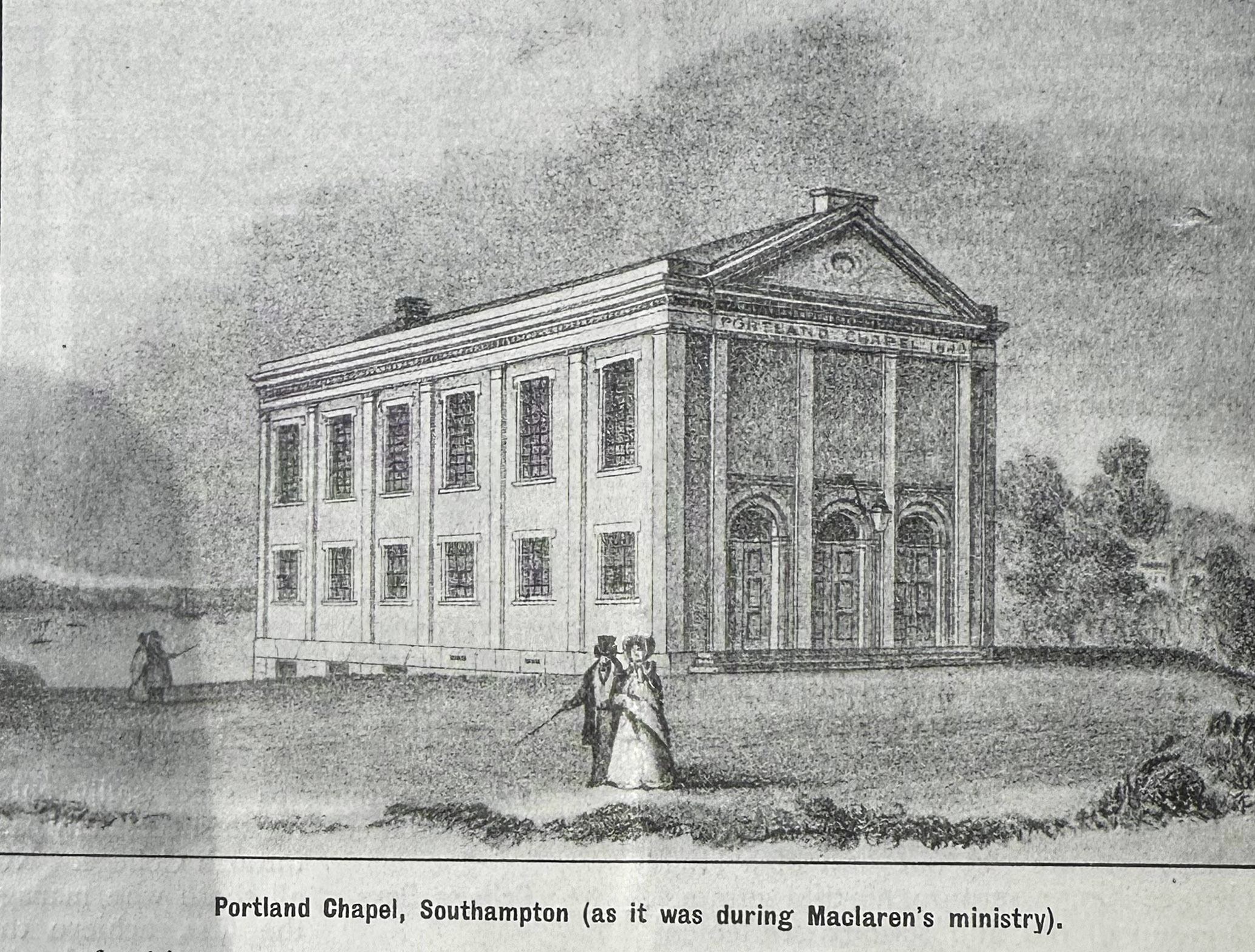
Although Portland Chapel in Southampton had opened with great promise, the first pastor resigned before completing his third year. His successor was a failure, lasting just two years. This forced a complete reorganization of the church and a resolve by those in charge to not repeat the prior mistakes. An invitation was made to Stepney College to provide a preacher for two services; the College had no hesitation in sending Alexander, on November 16, 1845, even before his degree was complete, and before his twentieth year. After the two services the invitation was extended to three months. He made such a good impression and his preaching was so popular, soon filling the Chapel, that he was unanimously invited to take up a permanent pastoral position there. After consultation with his father, Alexander accepted, and in 1846 began his ministry at Portland Chapel in Southampton. He would remain there twelve years, until 1858.
Alexander’s preaching was magnetic.
“During his long career he held firmly to the belief that one of a preacher’s first duties is to efface himself, his part being that of a herald, one who has a message to give”
And so here is this brilliant young man, with a message to give his listeners but determined that he not be the central figure but rather it be his message.
“Many attempts have been made to describe the effect it had upon his listeners, but it remains true that it was necessary to hear him before it could be truly understood…
“We may speak of the spare figure, quivering with life and feeling; of the firm set mouth, the unmistakable sign of a tremendous will; of eyes that pierce and shine and seem to compass everybody and everything in their quick lightning glance; or of the strangely magnetic voice – but in vain.
“We may describe his preaching as ‘logic on fire’ or that his words thrill like electricity; that he speaks like one wholly possessed by his theme…
Alexander worked tirelessly and continually at his pastorate. And his reputation spread – he constantly had to decline invitations to preach throughout Hampshire on Sundays or to deliver lectures on weekdays. But, as the years went by he often received advice from his mentors to move to a larger parish, to spread has influence into a wider world.
In November 1855, Alexander McLaren became engaged to his first cousin Marion, James’ fourth daughter in the large family of Edinburgh cousins, someone he had known since early childhood. In March, 1856, during the Easter holidays, they were married at Marion’s home, a happy union which would last until her death in 1884.
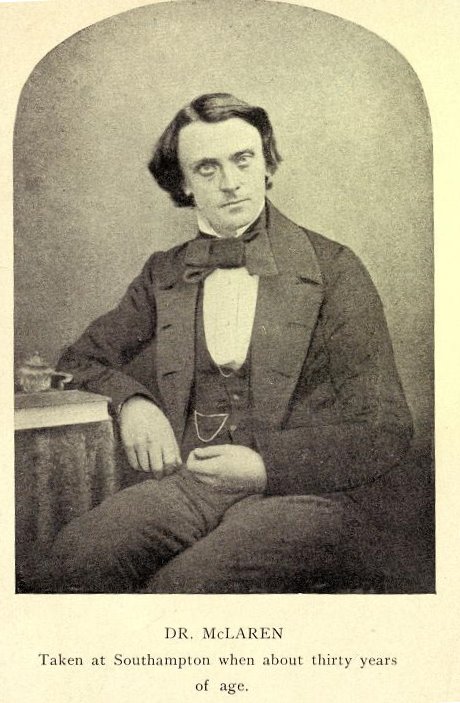
Their first child, daughter Jane Louisa McLaren was born in February , 1857 and a second daughter, Mary (Minnie) McLaren was born in 1858, also in February.
Later that year Alexander finally acceded to the advice he had continued to receive to seek a wider world for his teachings and messages, and the family relocated to Manchester where Alexander became pastor of the Union Baptist Chapel on Oxford Street. There he served as Minister for 45 years, from 1858 until 1903.
That’s enough from me. Let me turn things over to Francesca for more exploration of Alexander’s beliefs and character.
 The Marion Project - A Family History