
Short History of Max and Galiano Island
An Essay by Ruth Enke published in “A Gulf Islands Patchwork”
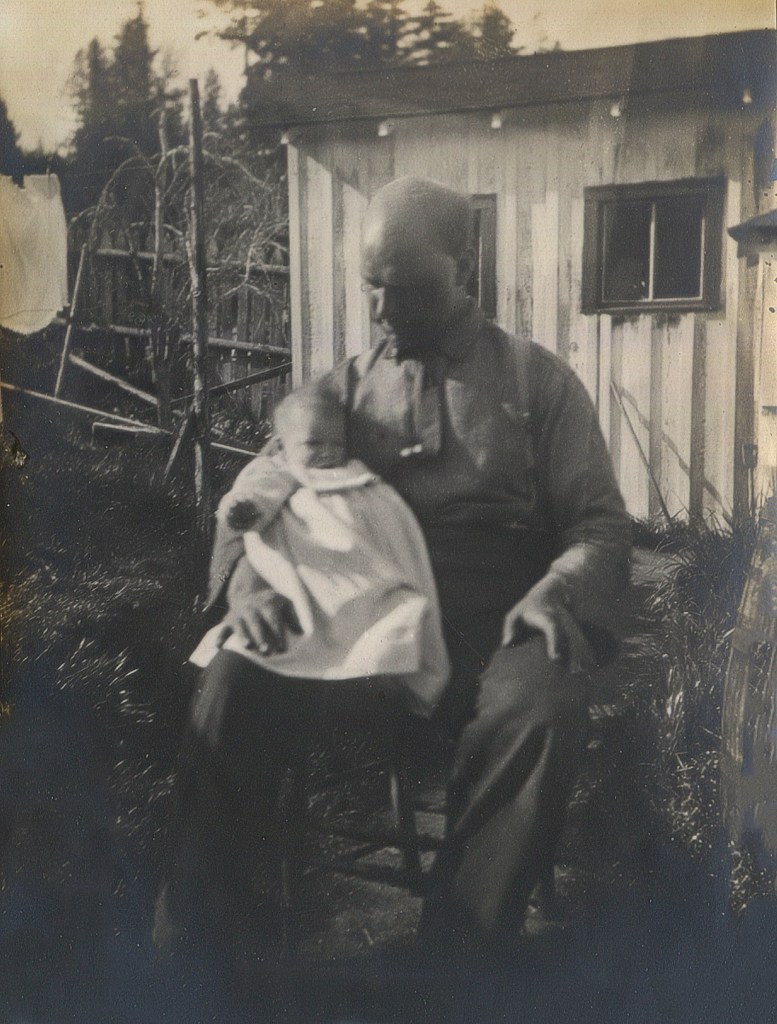
Max Enke of Valley Farm Galiano
My father Max Enke was quite poo poohish when I told him that the Gulf Islands Branch of the B.C. Historical Association wanted an article about him because he had been “a colourful character and had done so much for Galiano in the early days of the century.”
‘Me? I didn’t do anything for the Island,” he protested.
“Well, a colourful character, then,” I shouted since, in his later years, my father had grown deaf.
“Colourful? I was never colourful.”
“What about the sundial you made on a stump outside the postmaster’s house?” I asked.
“That wasn’t colourful. That was common sense. Irwin, the post-master, lived in the valley not far from us. One boat day, when I had some letters to mail, I found he’d left too early for the wharf. So I made him a sundial to help him know the correct time. After all, in those days there was no radio with a time signal to set you clock by.”
“The sundial was a pointed reproof?” I suggested.
“Not at all. It was simply to help him to be more efficient in the future.” My father was silent for a moment. “Don’t let these people get away with the idea that I was a Belgian. You might emphasize that I was always a British subject. That’s why I emigrated to Canada and not the U.S.A. Wanted to stay with the flag.”
“Why should they think you were Belgian?” I asked. My father shrugged. “Everyone did. You see I came out from Belgium because my father, who was also a British Subject, was living there for business reasons. I brought 13 Belgians out with me – 11 men and two women.”
“What about the baby you delivered?” I asked. My father looked surprised. “That was nothing. After all I was 23, and there wasn’t a doctor on the island. So when this Belgian woman started having the baby, and her husband didn’t know what to do, I went along and lent a hand. But I had a book to help me – a first-aid book, written in Spanish.”
“What about the First World War, and the rumour that you were a German spy?”
“Oh, that.” My father wasn’t interested. “Well, Enke was originally a German name and in war time people get a bit hysterical.” “It’s funny,” he added, “Out there, in the First World War, they called me a German spy. But in World War II, when I was back in Belgium, the Germans nabbed me as a British subject and I had five years as a British civilian prisoner of war. When Hitler invaded in 1940, I was too slow in getting away. Couldn’t make it on those crowded roads. So I stayed on a French farm for 17 days and then returned to Belgium.”
I steered the conversation back to Galiano. “Do you remember the carriage with the coachman’s box and the rubber tired wheels? It was a Victoria and you told us kids that it had come round the Horn, and had been driven in London’s Rotten Row.” “Bought it second-hand in Victoria, “ said my father, “Fifteen dollars. I could have got a landau for twenty, but it wouldn’t have been so good for packing feed.”
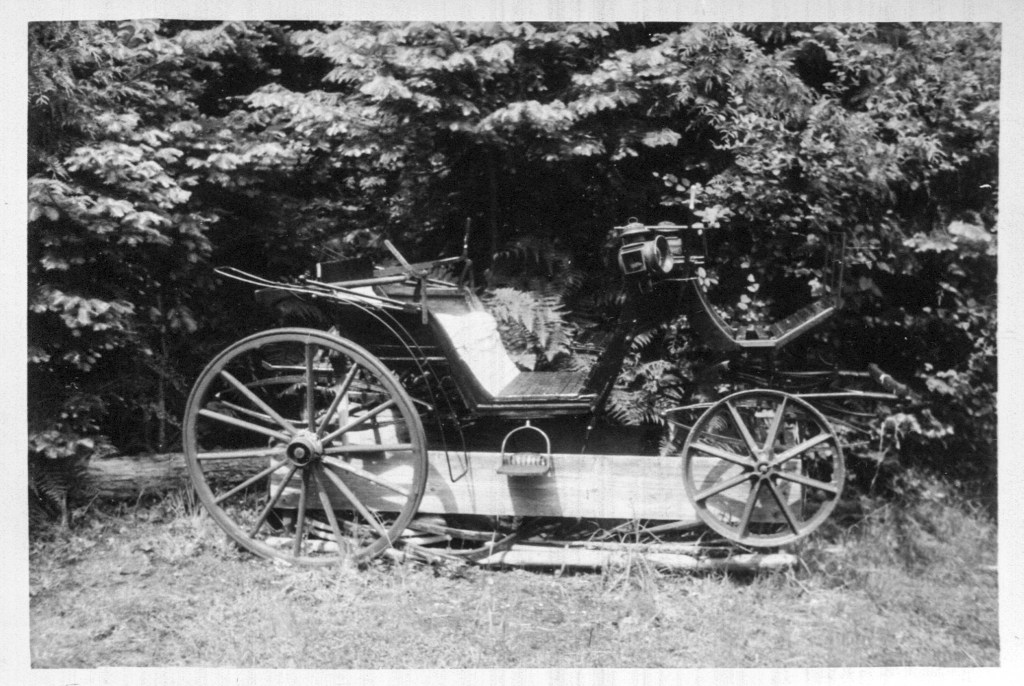
It was my turn to digress. “I loved that Victoria. The big treat was to be allowed to sit beside you on the coachman’s box. It was miles off the ground, and you used to say, ‘Hang on!’, when we went down hills. Often going to the wharf we’d have the carcass of a pig or sheep reclining in the back seat. Rather different from the frills and furbelows of Rotten Row”.
“Yes, yes,” my father was growing impatient, “But they don’t want that kind of stuff, Ruth. You’re doing this article all wrong. Here, I’ll write out the plain facts for you. This is what you put.”
“My father like my mother was a British subject, and was born in Manchester. He came to Galiano on May 1st, 1907, and landed from the old “Iroquois” at the old Georgeson wharf because the wharf at Sturdies Bay was undergoing repairs. That month he bought the Valley Farm from Herbert Macklin. A few weeks later he bought the adjoining properties belonging to Baker, Craig and Sinclair. The islanders didn’t approve of these purchases because they resulted in the departure of residents and their replacement by Belgian labourers. Some years later he bought other properties including the Cain peninsula, which helped the settlement of that part of the waterfront. At one time he held slightly over 1300 acres. In 1928 he moved back to Europe for business reasons.”
I made one last attempt. “What about your herd of registered Jerseys? Didn’t the help the stock on the island? Were you not always agitating for better service to the island? And I seem to remember some very hot discussions about roads and schools.”
“Can’t think why this historical outfit has got after me,” said my father.
Max and Marion Enke and the Bluffs Park
The following excerpt is taken from https://galianoclub.org/club-programs/parks/bluffs-park/ :
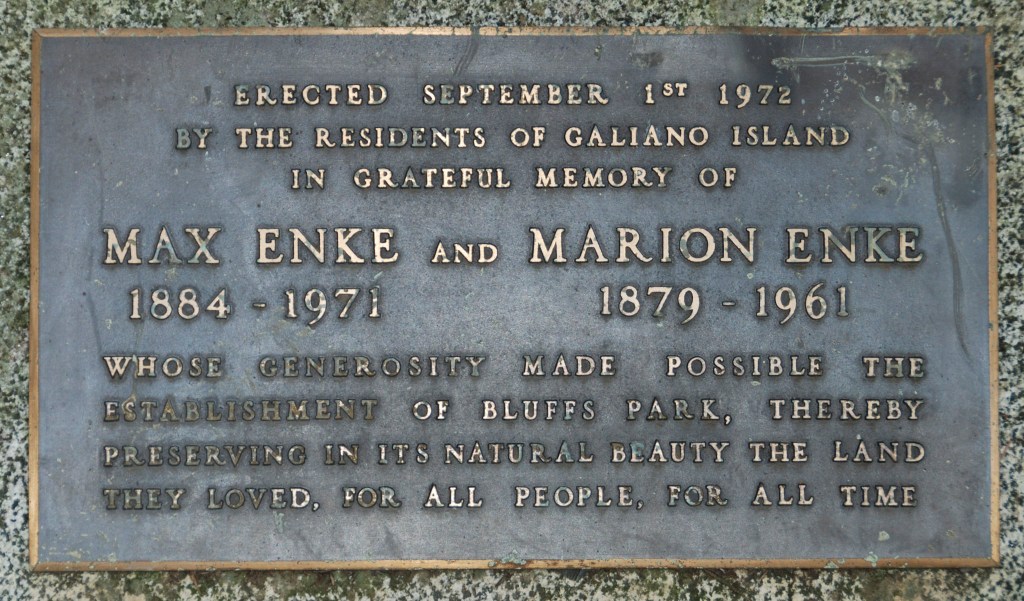
The Bluffs Nature Protection area —— named for the magnificent 300ft shoreline ‘bluffs’ located there —- was created in 1948 through a land donation by Max and Marion Enke and the financial contributions of many islanders. The area above the bluffs had already been a most popular hiking/picnicing destination for decades. Comprising approximately 139 hectares (342 acres) of green space —- forest, cliff and meadow ecosystems —- The Bluffs has been under the guardianship of the Galiano Club since a Declaration of Trust was agreed-to in 1951.
Originally The Bluffs was created with two sections. One, the area surrounding the actual bluffs, was set aside for recreational use. A second section, further inland, allowed for selective logging as a source of lumber for community building projects. The island’s 1st Fire Hall was constructed using lumber from The Bluffs. However, in 1988, increasing public awareness of the need to preserve forest lands, encouraged the Galiano Club to disallow future logging within any area of The Bluffs, to have the land rezoned as a Nature Protection Area.
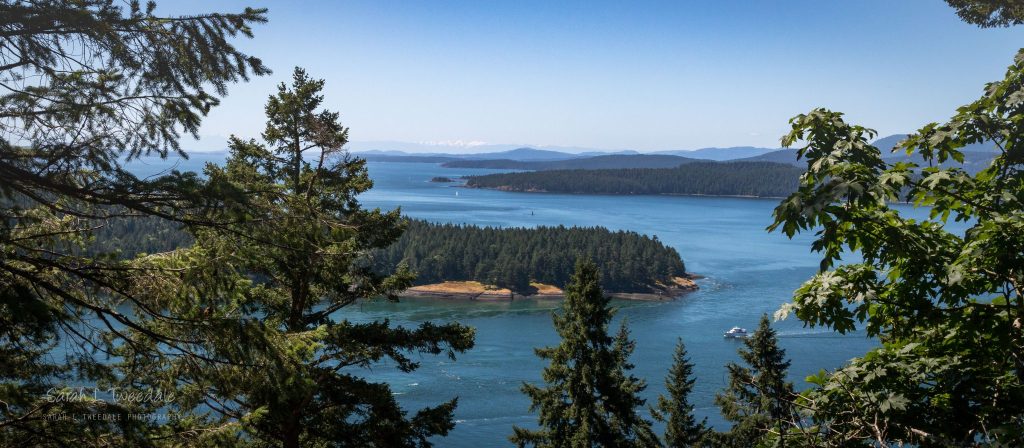
The viewpoint, a wide open area just above the actual bluffs, looks on to Active Pass, over the nearby southern Gulf Islands and, beyond to the high ridges of Vancouver Is. On a clear day one can see the snow-capped Olympic Mountains of the northern USA.
Hikers/walkers can access The Bluffs via the Sturdies Bay Trail managed by the Galiano Island Parks & Recreation Commission(GIPRC). There are many short trails, all under a mixed forest canopy, throughout the area for the use of hikers/walkers only; several connect with the popular viewpoint area, a splendid site for a picnic, for photo-taking, for contemplation. Each of these hiking trails has been named and all are displayed on map signs conveniently located at most trail junctions.
Bluff Road bisects the area and is connected to the main thoroughfare of Georgeson Bay Road, the access route for cyclists, motorized vehicles arriving via the Sturdies Bay BC Ferry Terminal. A small vehicle parking area exists adjacent to the viewpoint. For visitors with limited mobility the incredible viewpoint scenery is accessible to all vehicle passengers from this parking area. An Info Panel is located there, map included, which explains much about the human history of The Bluffs & also, its several ecosystems. Nearby is a stone monument erected in 1972 by the Galiano Club to commemorate the contribution of Max & Marion Enke.
Excerpt from “A Gulf Islands Patchwork” – History of Galiano Bluffs Park – written by Donald New:
“The beautiful open bluffs overlooking the southern approach to Active Pass, and rising approximately 600 feet, have been enjoyed for many years by the people of Galiano Island and by many visitors. The snow-capped peaks of the Olympic Range are visible to the south, overlooking the southern part of Vancouver Island. In the foreground lies a number of islets of our own group.
“Following World War II, the Galiano Island Development Association decided to look into the possibility of acquiring the Bluffs as a park. The land belonged to Mr. Max Enke, formerly a resident of the Island; and in 1947 an agreement was reached with him to sell approximately 94 acres, comprising a half-mile strip on Georgeson Bay waterfront, for the sum of 1,000 dollars”
“When the necessary 1,000 dollars were collected, the sum was sent to Mr. Enke, who replied by saying that he felt it would be a pity to incur the expense of a survey, and that we had better take the whole half-section (320 acres) for original stipulated price. …”
 The Marion Project - A Family History