
A Bride on Galiano Island
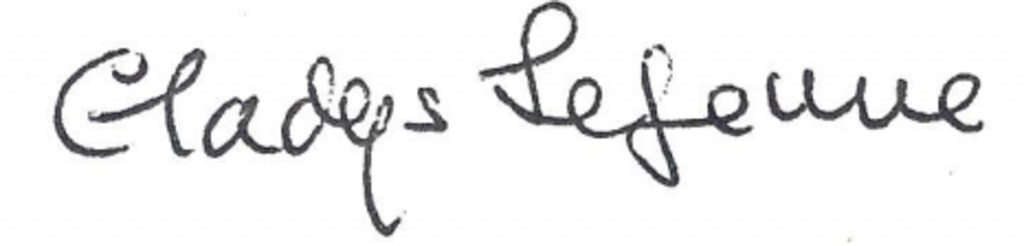
by Gladys Lejeune
I shall never forget my arrival on Galiano Island in 1914; we had come by boat from Victoria and arrived at the wharf in Sturdie’s Bay. Arnold and I had been married in Edinburgh just before and he had come to help his brother-in-law, Max Enke, on the farm in the valley. We were taken up to the Sinclair house through the bush in a farm wagon, and I must say it seemed like a pretty lonely place after Edinburgh.
When we got to the house, which was about 2 miles from the wharf, I was amazed at the smallness of it. We walked up a little path with roses on both sides; the door was unlocked and we walked in. There was a small sitting room on one side of the passage and a bedroom on the other; at the end of the passage was the kitchen and a still smaller dining room. Of course the first thing I looked for was a bath, but when I asked Max where it was he looked surprised and informed me there was no such thing. I asked where one kept the food; he said, “Well, you keep the milk in a bucket of water covered with a piece of cheesecloth, so that the water would drip over the milk can and keep the milk cool.” “Where do you get the water,” I asked. He pointed out the well in the back garden. It was a bit of a surprise too. I then inspected the very black iron stove. I had never seen one just like it, with the woodbox at the side where you pushed wood in, and the little cupboard shelf above — four holes covered with tops, which you lifted off with a small hook-like tool. I then asked Max where I could buy my bread. “Well,” said he, “you will first have to walk to Burrill’s store and buy a bread machine.” The store was run by Fred and his brother Joe. Joe, Max informed me, played the fiddle at the dances. “Where are the dances,” I asked. “You row across the Pass to Mayne Island,” said he. “It’s not far as the crow flies. I pictured myself all dolled up, rowing in small boat to go the Mayne Island, where he said I might be asked to dance by an Indian. Of course, my idea of an Indian was a red man with feathers in his hair.
The next day Arnold and I sallied down the tree-lined path to the store, about two miles, to buy a bread machine. This was quite easy, but I was told I would have to make the bread myself. I had never made a loaf of bread in my life and simply did not know how to begin. The flour was in a large sack and had to be stood on a chair in the kitchen. Max said he would come over from the farm next day and help me to make a batch. This was an amazing performance. I had forgotten to get any yeast, so we had to make a special trip to the store to buy some. Max first showed me how to set the bread and said that I would have to put the machine with the dough in it on a chair beside the stove to let it rise. He suggested leaving it there until next morning, when it would have risen but he said I would have to cover it with something good and thick to keep it warm he suggested a blanket I simply could not bear the thought of my good wedding present blanket being so used but the only other thing I could think of was Arnold heavy tweed overcoat. This I used and to my horror, when I went into the kitchen next morning, the bread had risen all right and forced the top off the machine; the dough was all over the overcoat. At about 10:00 o’clock Max arrived to show me how to proceed. He punched the dough on the kitchen table, cut it in four lumps, and filled four square bread tins. Then he made a pattern with a knife down the length of the loaf. What this magic pattern was supposed to do I never did know, but I always did it from then on. He then said I must put the four tins in the little cupboard at the top of the stove for 20 minutes before putting them into the oven. Having no time-clock in those far off days and no wristwatch, I had to keep running into the bedroom to look at the new traveling clock, given us as a wedding present, to know when the 20 minutes had passed. Then I pushed the loaves into the oven. I didn’t realize how often I should have to put more wood into the firebox to keep the oven hot. After an hour I was quite exhausted, but, lo and behold, I was rewarded by four lovely crispy loaves of homemade bread and was the proudest person on the island.
My next project was to invest in a proper bathtub. We found an old one with claw feet in the barn, full of pig food. When we got it to the house, we had no idea where to put it. Max suggested the corner of the kitchen, handy for emptying the water boiler into the bath for a hot bath. This was done, and the very enterprising man who fixed the bath made a wooden lid to fit over the top; when you lifted this up, you attached it to a hook on the wall and prayed that it would not fall on top of you. At other times it made an extra table. I believe we had the only bath on Galiano Island, and we felt quite affluent.
To keep the meat fresh, it was hung on the wall at the back of the house in a box attached to the wall; it had a fly screen front. This kept the meat cool and fresh and was our only “ice box”. All our friends came to see our splendiferous kitchen cabinet, which we had bought at great expense. It was stainless steel and we kept everything in it except our clothes.
One day Arnold brought me a rowboat and we christened it “the doughnut”. It was bright blue with red seats. He taught me to row, and I think I was the only woman around rowing in a white tennis shirt and tartan tie and a hobble skirt down to my ankles —- no minis in those days. We did row over to Mayne Island to the dance and I did dance with a half-breed Indian (a very nice man) and on the way home across the Pass we felt much bumping and found, at about midnight, that we were in the midst of a school of whales — an exciting experience.
I used to walk to the wharf twice a week to fetch the mail. Mr. Irwin was the postmaster and to pass the time he used to read the Bible in Greek. One day I found a big package and to my amazement and great delight I found that my sister had sent me from London two large Liberty straw hats, one beige and one pale pink, trimmed with beautiful Liberty scarves. I felt like a real swell when I wore them to fetch the mail.
One thing I always enjoyed was the visit of the old Indian woman, Mrs Indian Tom, with her daughter Lala. They lived on the Indian Reservation at the mouth of the Pass, and they came every Friday selling beautiful fresh fish, which she showed me how to cook. I had never eaten so much salmon before or since. Lala, a teenager (but there was no such word in those days) walked behind her mother. Once she arrived carrying a sewing machine strapped to her back. Mrs. Indian Tom’s basket of fish was attached to her back by a wide headband. When we were leaving Galiano to go back to England for Arnold to join up for the First World War, I came home from the wharf one Friday and found the old lady walking back and forth on the front verandah, covered in my husband’s tartan traveling rug . I asked where she had got it from, and she pointed to the open bedroom window. She wanted me to give it to her as a parting present, a “potlatch”, but I said I couldn’t possibly do that, as Arnold loved it and it had been given to him by his mother when he first went off to boarding school. “Is there anything else”, I asked, “which you would like to have as a parting gift?” To my amazement she said she would like my corsets. Up to that time, weighing under 100 pounds, I had never worn such things and when I thought of my figure, and then looked at hers, I wondered how she would have used them. I gave her a pretty scarf instead. This delighted the old lady; as she left, she wished me good luck in “King George’s Land.”
One of my great joys on the island was to call at Whaler’s Bay on a charming Scottish woman, Mrs. York, on my way home from fetching the mail. She would give me tea from her English cups and give me sandwiches, homemade, of coarse brown bread, spread with thick butter and sliced fresh tomatoes covered with dark brown sugar. I have never forgotten them.
I really enjoyed my life on Galiano, and when I pass the island now sometimes, to stay with friends in Victoria, I am amazed at the change which can be spotted from the boat. I wonder whether the people enjoy any of the simple delights which we had. I cannot imagine women in Liberty hats picking blackberries and helping to feed the new lambs. One day, long ago, I was walking along to visit a friend and I found a poor sheep wedged between two rocks, with its four feet up in the air. I rushed over to the farm and fetched Arnold. We managed to get the sheep out from between the rocks and set her on her feet; she scrambled away. He congratulated me on saving its life, said that she was “in lamb”, and called me a good sheep woman.
Sunny California where we now live seems a long way from such simple experiences. Once we stopped off at Galiano and walked up to see our old house. It was a sad sight. The house was dilapidated, the garden all overgrown and a sheep was lying in the living room, surrounded by bracken growing through the floor. Romance had fled!
 The Marion Project - A Family History